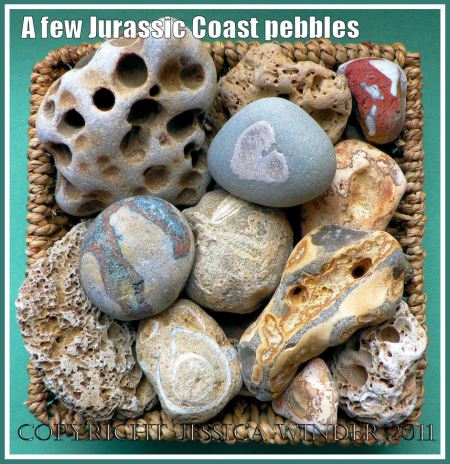
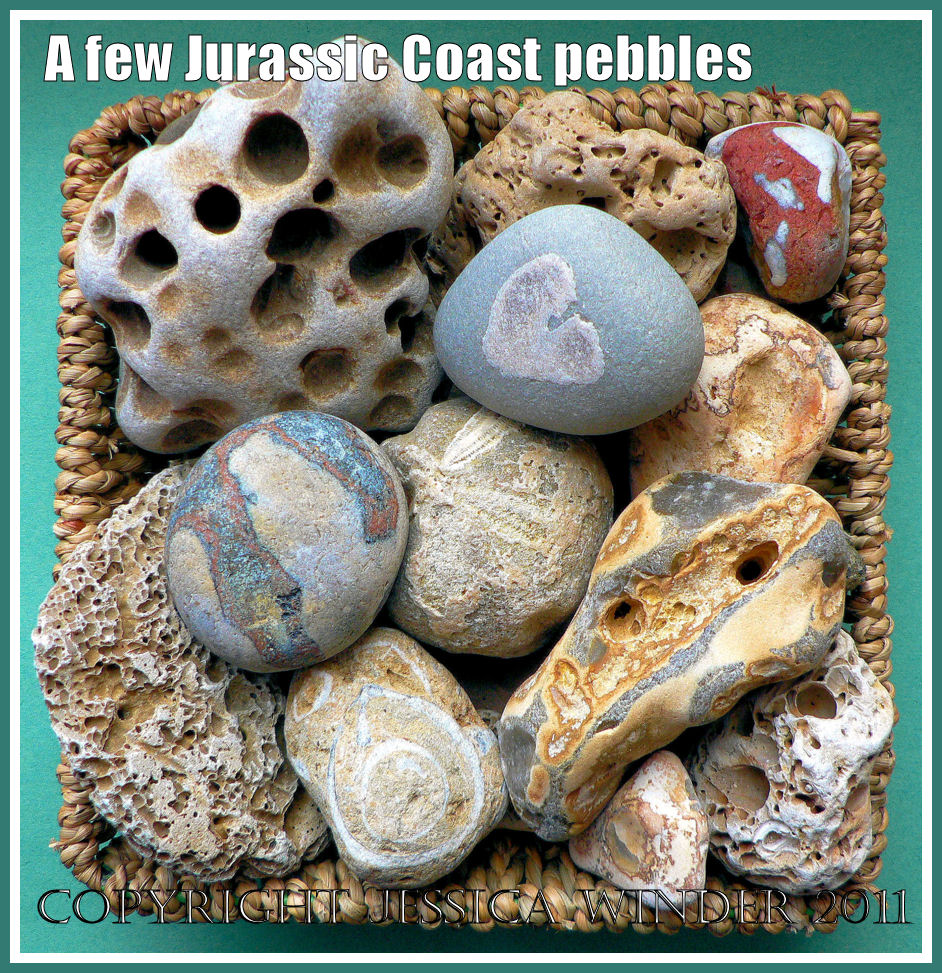
A small basket of Jurassic Coast pebbles. It includes a small heart urchin fossil from Lyme Regis in the middle, and a blue-grey limestone pebble with a white heart-shaped mark from Charmouth. The holes in some of the stones are caused by burrowing marine animals: the large holes, like the ones in the pebble top left, are probably made by a bivalved mollusc called the Flask Shell, Gastrochaena dubia Pennant. The smaller borings in other pebbles are most likely the result of attached mud-tube-living marine worms like Polydora ciliata (Johnston) in which the acidic waste products dissolve the stone.
The other pebbles include three mottled yellow, white, grey irregular-shaped flint nodules; a pebble with a fossil gastropod; and two strangely patterned stones with reddish designs reminiscent of some of the Chesil Cove pebbles that I featured in an earlier post. I think they are Triassic quartzite pebbles from Budleigh Salterton in Devon and the coloured markings are caused by oxidising iron within the stone.
Revision of a post first published 17 June 2009
COPYRIGHT JESSICA WINDER 2011
All Rights Reserved
 Jessica's Nature Blog
Lovely!
LikeLike
Jessica, these are absolutely gorgeous. I love the colors and textures but mostly how you’ve arranged them all together. The whole is greater than the sum of the parts.
LikeLike
Hello, AmyLynn. Thank you. I am so glad it has given you pleasure to look at my composition of pebbles and fossils. Making arrangements like this lets me re-live the pleasure of my visits to the beach. These small objects not only look attractive but have fascinating natural histories to tell – if you can only unravel them.
LikeLike
Hello! I’m just touching this and was wondering if you could recommend some book that would help to identify them! I live on the Jurassic coastline and would love to identify rocks on my beaches
LikeLiked by 1 person
Hello, Millie. Although there are many excellent books about the geology and fossils of the Jurassic Coast, I don’t know of any written about the identification of pebbles on the beaches there. However, there area few books about pebbles available at the moment which may be more or less helpful. These include the new edition of an old book “Pebbles on the Beach” by Clarence Ellis re-edited by Robert MacFarlane in August 2018; “A Field Guide to the Identification of Pebbles” a pamphlet by Eileen Vander Flier-Keller March 2007; “Beach Stones” by Margaret W. Carruthers and Josie Iselin April 2006; and “The Book of Pebbles” by Christopher Stocks and Angela Lewin April 2020. The first two would probably be the most useful to you but the last two would be interesting and have beautiful illustrations. They can all be bought on Amazon.
LikeLike