
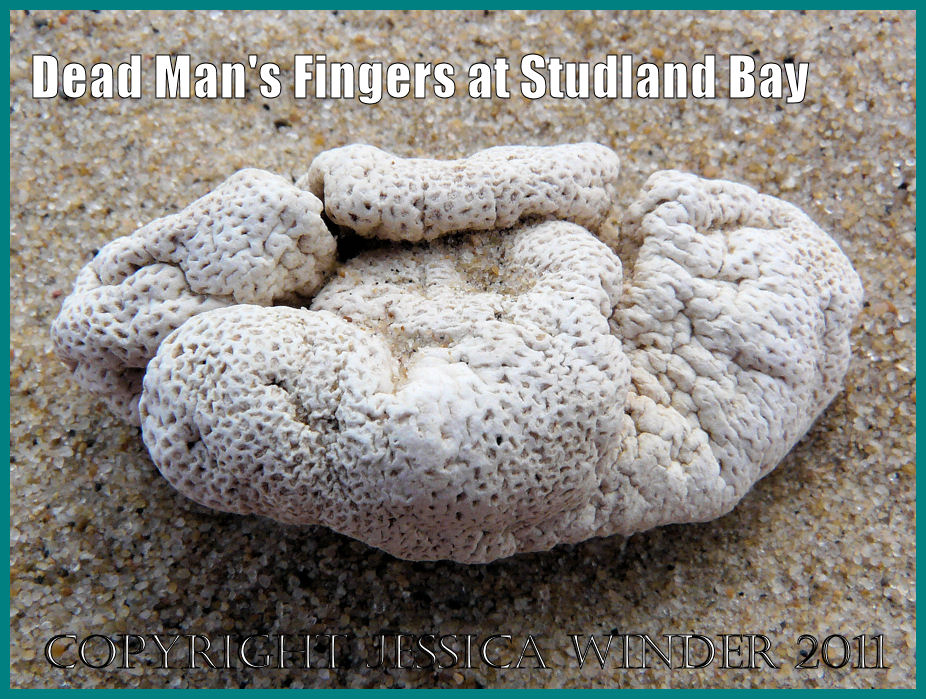
Dead Man’s Fingers, Alcyonium digitatum (Linnaeus), is a soft coral. This one was washed up by the sea onto the sandy shore at Studland Bay, Dorset. Each of the holes or pores would have originally housed a small living animal in this colonial organism. Each tentacled polyp (a bit like a sea anemone in construction but very small) is embedded in a common spongey mass that is made stiff by the inclusion of minute chalky or calcareous spicules. An important feature for identification in live specimens is the fact that the polyps are usually the same colour as main surface.
This soft coral can grow upto 20 cms high. It lives attached en masse to rocks and stones on the lower shore and down to about 50 metres under water. Colour can vary from white, to dull yellow or orange. It is given the gruesome common named because the pale fleshy lobes are thought to make this animal look like the leached and bloated hand of a drowned sailor. It is a very common seashore creature found on British beaches.
Revision of a post first published 2 June 2010
COPYRIGHT JESSICA WINDER 2011
All Rights Reserved
 Jessica's Nature Blog
Hi, I found at Galapagos seashore a round transparent substance, in size 10 cm. more or less from edge to edge, weight half a pound or less I didn’t find in internet it, unfortunatelly I didn’t take a picture .
Could you tell me pls, what it is?
Thanks
LikeLike
Hi, I’m very sorry but I don’t think I can help you. I know nothing about the marine fauna around the Galapagos as I am based in the UK with just local knowledge. The only thing I can suggest is that you observed some kind of coelenterate like a jellyfish, or part of one. Hope you are able to find the answer somewhere else.
LikeLike