
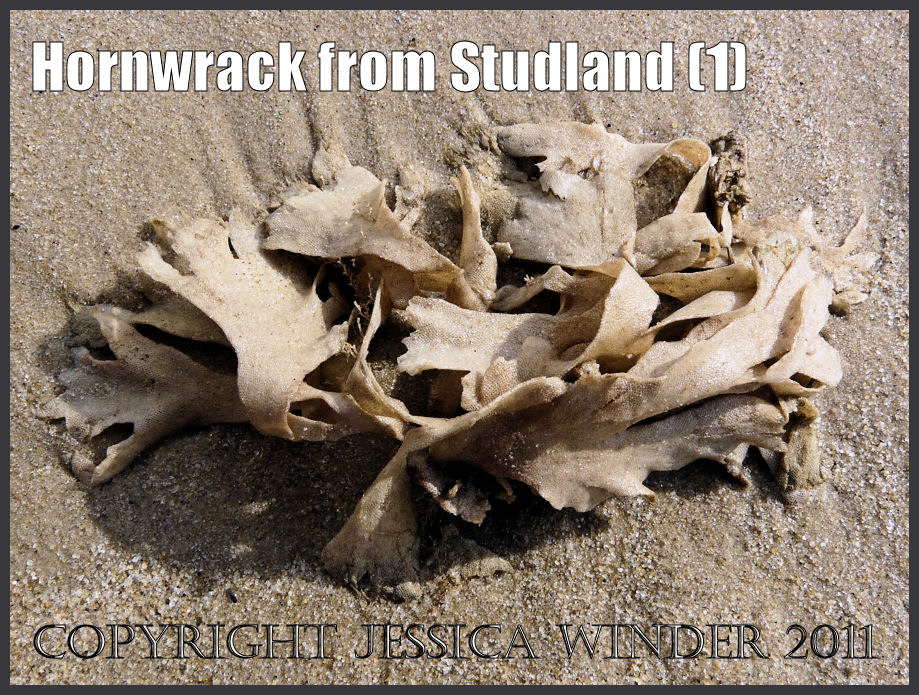
Hornwrack looks like light-coloured seaweed but it is in fact animal in origin. This photo shows a dried specimen of Hornwrack which is a colonial Bryozoan with the Latin name of Flustra foliacea (Linnaeus).
On close inspection you can possibly see the multitudes of individual ‘cells’ or boxes in which the individual animals lived. Joined together, these boxes have a lace-like appearance. The animals lie in the boxes from which they poke out their hairy appendages in order to strain minute food particles from the sea water to eat.
Unlike the Bryozoans Membranipora membranacea and Electra pilosa(mentioned in the posts Sea squirts and sea mats at Ringstead in February and Sea mats – what are they? ), where the colonies encrusted the seaweeds, Hornwrack forms an upright leaf-like, branching, and slightly calcified structure. The photograph below shows some of this organism as it is being washed ashore at Studland Bay in Dorset. Sometimes it occurs in great abundance on that particular beach.

 Jessica's Nature Blog
One Reply to “Hornwrack from Studland”