
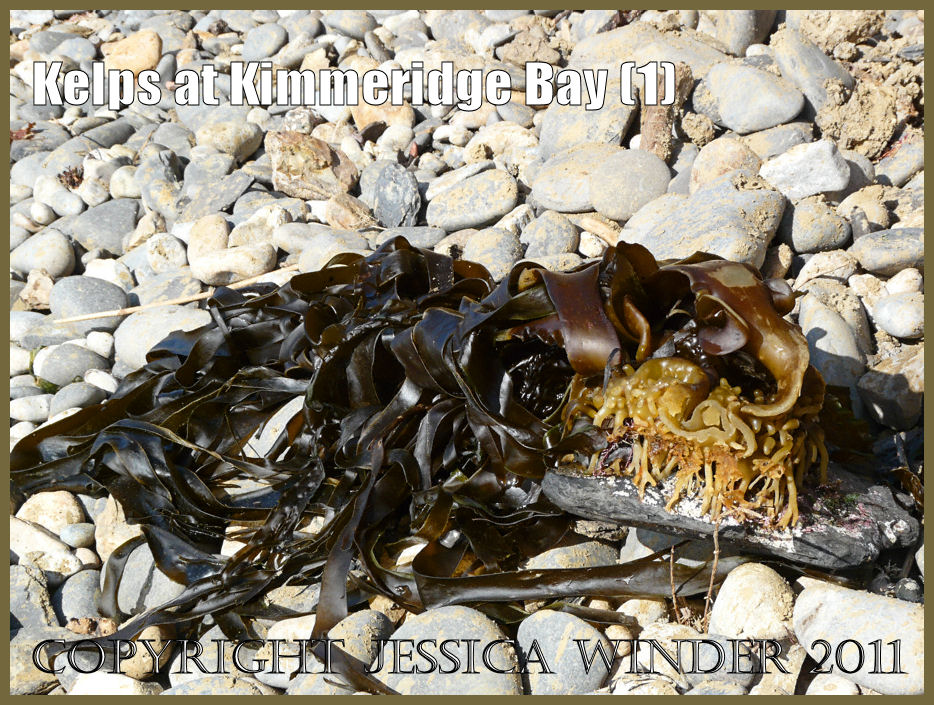
I found three types of kelp washed up on the seashore at Kimmeridge Bay on 15th March 2009. Kelps are the largest of the British brown seaweeds or Phaeophyceae. They are perennials in plant terminology compared with many of the more ephemeral red and green algae that appear seasonally or annually. Kelps all have a flat blade joined to a stalk, sometimes substantial, in turn attached to rocks by a much branched structure called a hold-fast. They live at low water or deeper.
The kelp on the pebbles in the photograph at the top is known as Furbelows, Latin name Saccorhiza polyschides (Lightfoot). It has been washed up onto the shingle complete with the large stone to which it is attached. The holdfast is like a hollow knobbly ball. The stem is smooth and flat, often with a twist just above the holdfast, sometimes with really noticeable wavy or frilly edges. The blade starts off as a single blade but becomes divided up into long straps. The whole thing can reach 4.5m long and 3.5m wide.
The photograph below shows in detail the characters of stem and holdfast by which this species is identified.

Cuvie, or Laminaria hyperborea (Gunnerus) , is another type of kelp found on the strandline (shown below). This one also has a long stem but with a round rather than a flat cross-section; and the outer surface is roughened and not smooth. The blade is divided up into long straps just like the Furbelows described above. The holdfast is not bulbous in this type but simply a complex of ‘rootlets’.

Additionally, it is typical that some smaller red seaweeds are actually growing on the stem. You can see these details more clearly in the picture below.

The third type of kelp I saw was Sea Belt, or Poor Man’s Weatherglass – Latin name Saccorhiza saccharina Linnaeus. This is easily recognisable from the crinkly puckered blade. You can spot it straight away amongst the piles of seaweed on the Kimmeridge strandline shown in the two pictures below. This weed has a thin short stem and a holdfast of branched rootlets.
When this seaweed is dry, a fine sugar-like powder coating appears on the blade hence the saccharina in the Latin name. Because this dried weed becomes limp again in damp air, it is traditionally used to forecast rain.

For more information about seaweeds a useful website is Algaebase which is a data base for all agae including marine seaweeds. For more information on the three kelps illustrated click on Furbelows, Cuvie, and Sea Belt.
For more information about Kimmeridge Bay see the Purbeck Marine Wildlife Reserve Web Site.

COPYRIGHT JESSICA WINDER 2011
All rights reserved


These photographs really show seaweed in a different light.Very impressive.I recently found a Laminaria saccharina on my locasl beach and placed it in a pool of water and it just came to life, amazing. I have been looking at a Natural History Website that is doing a seaweed survey and will be taking part very soon.Your photos and information will go a long way in helping me identify various types so thank you very much.
LikeLike
Thank you for your comment, Michael. I am pleased that you found the various articles about seaweed on Jessica’s Nature Blog useful. All the best with your participation in the seaweed survey. I am sure you will enjoy it and learn a lot.
LikeLike
Hello. I am in Tasmania and have collected a frill stemmed seaweed which looks similar to furbelows. Do you know if it is edible? I thought it was Undaria but am now confused!
Lovely blog
Rose
LikeLike
Hello, Rose
If you think you have Undaria, then you could well be right. Although I have written several posts about seaweeds from Queensland where I spent a wonderful holiday a few years ago, the Furbelows seaweed in the article you mention is a native species to the UK; and Kimmeridge Bay is in England near to where I live. Both species (Undaria and Furbelows) are actually edible but I don’t think Furbelows grows in Tasmania.. The Undaria which definitely occurs in your part of the world is an invasive species from Japan where it is cultivated as food. It is smaller than Furbelows kelp and the blade or frond has a central midrib (this is lacking in the British Furbelows). See the website http://www.biosecurity.govt.nz/pests/undaria for more information about Undaria. Hope this helps with the identification you need.
Best wishes
Jessica
LikeLike
Thanks for your reply Jessica. It’s undaria positively. I also collected sea lettuce for consumption. The water is so clean down the south coast. I will blog about it one day on rosalindentree.com.
I spend winters in North Queensland you might like to have alook on my blog.
Happy spring soon!
Roselinde
LikeLike
Glad you are now confident about the seaweed identification. I am sure readers would like to hear about the way you eat seaweed. Not many people eat seaweed here in the UK. The water is generally speaking not as clean as off the Tasmanian coast. Your blog is lovely and shows a lovely family. If I had access to palm leaves, I would want to be making baskets like yours. Meanwhile, I wish you well and happy days in the sunshine.
Jessica
LikeLike