
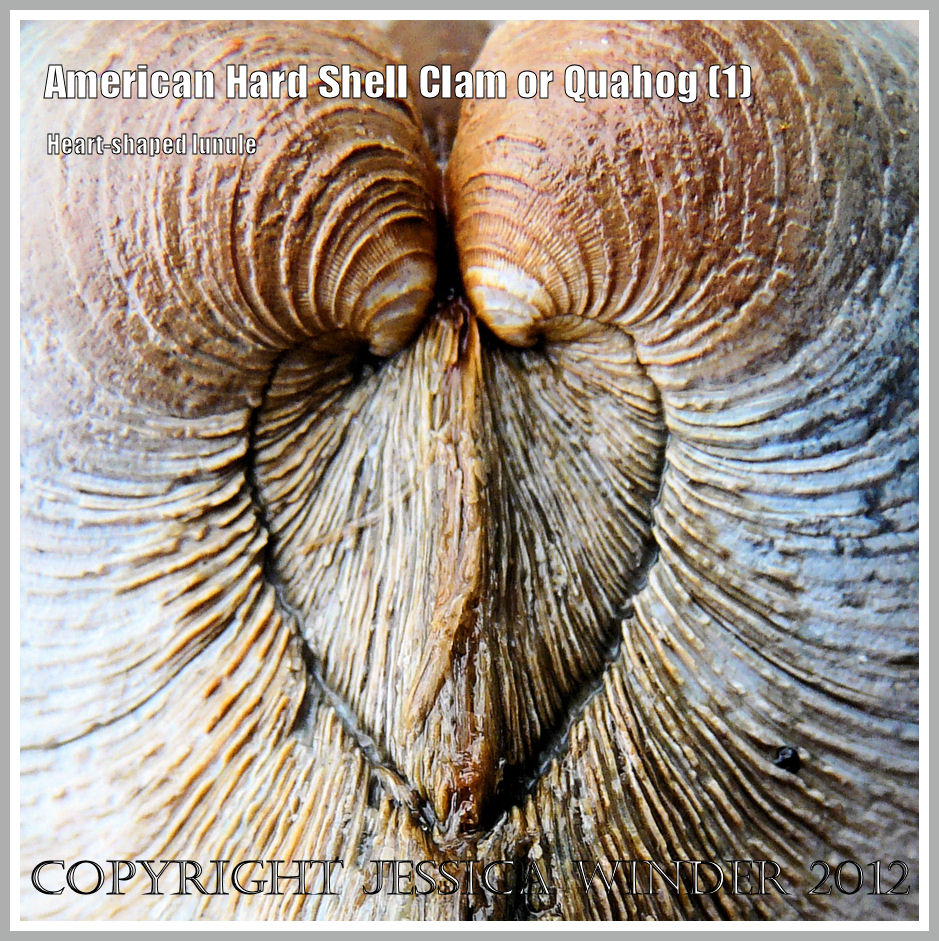
Here’s a natural heart for Valentine’s Day. The lovely heart-shaped feature shown in the photograph is an area of the shell called the lunule. The shell in question is a Hard Shell Clam or Quahog – Mercenaria mercenaria (Linnaeus) – that was found at Studland Bay in Dorset, UK – although it is actually an introduced species in the UK.
Each part of a seashell can be described in a precise way that indicates position and function, which enables identification to species level, and allows comparisons to be made between specimens and types.
The lunule is a depressed area in some bivalved mollusc shells, located in front of the beaks or umbones (the bumps that stick out near the hinge), in one or both valves (as in the quahog shown in this post), differentiated from the rest of the shell by a change in growth line pattern or colour.


COPYRIGHT JESSICA WINDER 2012
All Rights Reserved
 Jessica's Nature Blog
Nice!
LikeLike
Thanks, Steve.
LikeLike
Beautiful close-up images Jessica.
I sometimes find fragments of quahog shells here. I love the deep blue colour.
LikeLike
The details are so intricate, aren’t they? I took the photographs outside on a rainy day so there were a few challenges keeping the camera lens dry. I was pleased with the shot but I was also at the limit of what my camera could do without a tripod. I keep thinking that maybe I should upgrade either the camera or my skills to get clearer images.
LikeLike
Oh how lovely. I feel so behind the times as the other comments are from 2010. 🙂
LikeLike
This is another post revision. Little did I know that my re-organisation of the blog, proposed back in January 2011, would take so long to do – but life can take many twists and turns to confound the best of plans. At least I have time now to create new posts as well, like the “Gorse at Rhossili”, yesterday; and the photographs posted without text on my Photographic Salmagundi blog.
LikeLike