
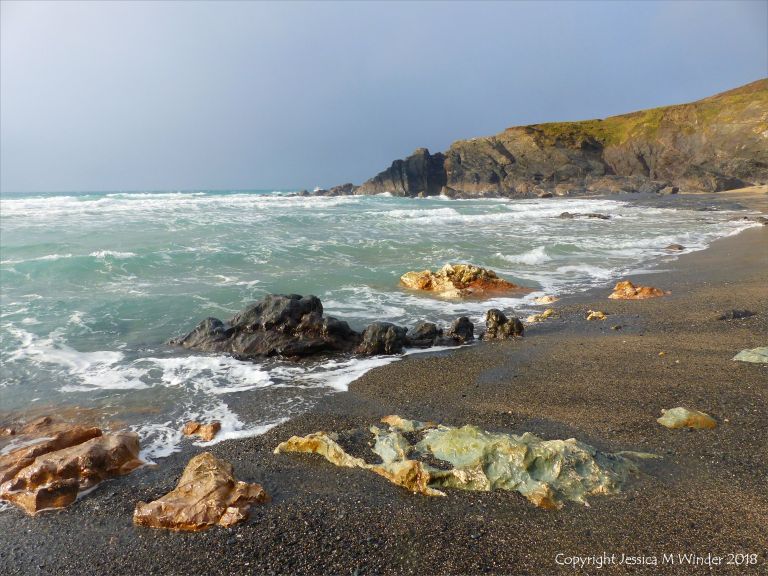
Polurrian Rocks 52 – View looking north from the water’s edge in the Lizard Boundary Fault zone towards the cliffs of Devonian metasedimentary rocks at Polurrian Cove in Cornwall.
https://natureinfocus.blog
Polurrian Rocks 52 – View looking north from the water’s edge in the Lizard Boundary Fault zone towards the cliffs of Devonian metasedimentary rocks at Polurrian Cove in Cornwall.
 Jessica's Nature Blog
I love how the rock formations come up out of the beach. I like the idea of the rock stretching far beneath the surface.
LikeLike
Beautiful view.😊 The stones in the beach, is it from a mountain under the soil? Or it´s big stones?
LikeLike
The soft loose sediments drape over the rocks, concealing and revealing the underlying rocks at the whim of wind and tide.
LikeLike
The stones are probably solid rock, the same as that in the nearby cliffs, and part of a fault zone, and all part of the same formation. At this point, the strata are partially cloaked by the sand. The degree to which these rocks are exposed depends on the movement of the softer sediments above. As everywhere on planet, the soil and other loose sediments are a thin covering over the rock of the earth’s crust, or in the case of rocks further along this particular stretch of coastline, the earth’s mantle (which is normally underneath the crust).
LikeLiked by 1 person
It’s a lovely view – though a bit unnerving, the way the cliffs are leaning to the side.
LikeLike
Yes, I guess the beaches themselves are ground up pieces of these very same rocks. It is fascinating to think how it changes every day.
LikeLiked by 1 person
Don’t worry, Lucy, they are made of a kind of rock that does’ not crumble easily, it is well baked and solid, not like the rocks along the Jurassic Coast where they are always collapsing and slipping. Quite safe.
LikeLike
Yes, that’s right, in this location at least. You might have noticed that the sand is very dark, with many almost black pieces. In other places the beach sand does not come from the local rocks but has been brought to the area on the bottom of glaciers in the Ice Age (the Gower Peninsula in South Wales has beach sand like that).
LikeLiked by 1 person
Yes, I did see that, it is fascinating to think about. I remember going to Florida as a young child and the very white sands there, which I think came from coral. And in Hawaii black sand, from lava rocks.
LikeLiked by 1 person