
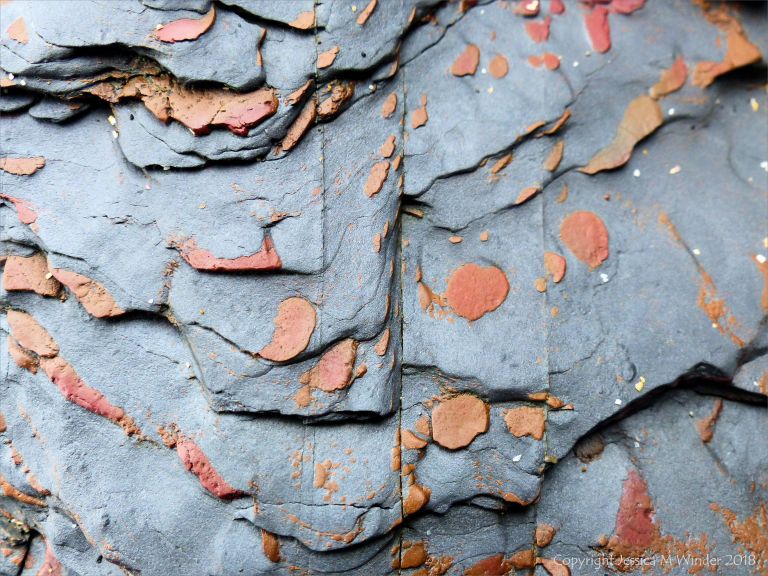
Polurrian Rocks 12 – Close-up of meta-sedimentary rock from the Devonian Period 372 – 388 million years old Carne Formation on the north side of the Lizard Boundary Fault at Polurrian Cove in Cornwall.
https://natureinfocus.blog
Polurrian Rocks 12 – Close-up of meta-sedimentary rock from the Devonian Period 372 – 388 million years old Carne Formation on the north side of the Lizard Boundary Fault at Polurrian Cove in Cornwall.


What an interesting pattern. Do you have any idea why the rock looks like this, with the embedded red bits?
LikeLike
I especially like this one. The peeling layers with the rusty spots appearing as surprises.
LikeLike
I am not too certain, Linda. I haven’t managed to find an definitive explanation in the literature yet. They could be weathered remnants of a fine red layers like those illustrated in previous images. The colour makes me think they might contain iron. They look a bit like the siderite nodules (iron carbonate) that are found elsewhere in Carboniferous sandstones and limestones. The iron might itself be derived from organic decomposition sludge on the former seabed?
LikeLike
Thank you. Claudia. The spots are an interesting presentation of the red material that forms fine sheets between the strata elsewhere.
LikeLiked by 1 person
I’ve not seen rocks like this before.
https://looseandleafyinhalifax.blogspot.co.uk/
LikeLike
Yes, the same for me, Lucy, though I have seen rocks of a similar date but different appearance on the north Cornish coast at St Ives. Cornwall seems to have a lot to offer in terms of rock types.
LikeLike
Thank you very much for your photographs. I´m a spanish geologist currently working in Galicia, north Spain. I was just looking in the web for outcrop pics of the Gramscatho Gp. flysch rocks, because I have some not-well identified rocks probably a correlatable Devonian… grey to green greywackes and slates with candy-coloured quartzite thin beds, pseudo-pebbles and lenses… very close to your photographs! Thks again!
LikeLiked by 1 person
Thank you again, Paco. I am pleased that my photographs were useful for your research.
LikeLike