
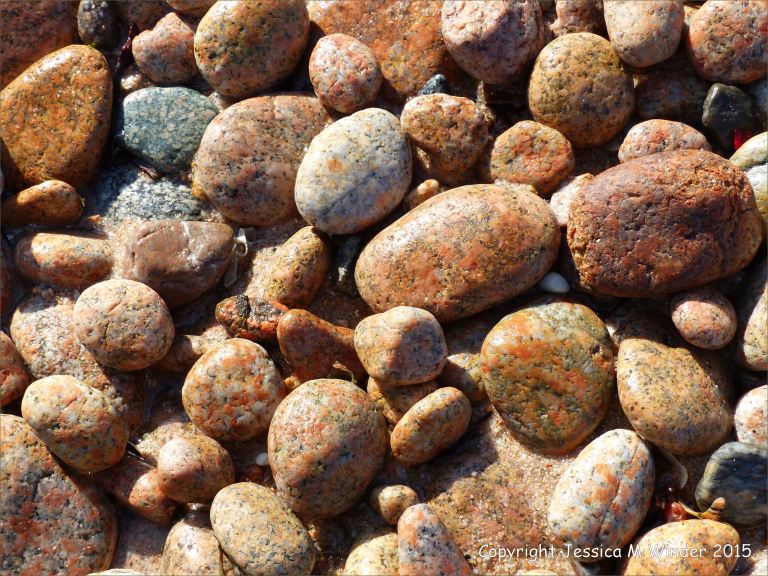
The colours and patterns of the pebbles on the beach at Albecq on the north coast of Guernsey in the Channel Islands reflect the varied geology of the north of the island. The northern part of Guernsey is made up of igneous rocks such as granite, diorite and gabbro and formed about 400 – 500 million years ago (de Pomerai & Robinson 1994 pp 5 & 7). Most of the pebbles in these photographs would have originated in nearby bedrock that would include Cobo Granite, Icart Gneiss, Perelle Gneiss Group, and Bordeaux Diorite Complex. These rocks are constituents of what is known as the Northern Igneous Complex. The patterns in the rocks are due to the coarse mineral crystal composition. Potassium-rich orthoclase feldspar is responsible for the recurring pink-orange colour, with light grey plagioclase feldspar; quartz grains are transparent; and biotite mica is seen as small black shiny crystals (de Pomerai & Robinson 1994 p 49).
REFERENCE
de Pomerai, M. and Robinson, A (1994) The Rocks and Scenery of Guernsey. La Societe Guernesiaise, St Peter Port, Guernsey. ISBN 0 9518075 2 8.


 Jessica's Nature Blog
This level of detail is wonderful to see and read. Thank you.
LikeLike
Incredibly beautiful!
LikeLike
Thank you. I thought so too. I couldn’t stop taking pictures of them.
LikeLiked by 1 person
Thank you. Linda. I wish I could confidently say what rock type each pebble is but that would take a lot more visits to the site and in depth investigations.
LikeLike
Zooming in on your very clear pics reveals an astonishing variety of colours. So, not just little brown and grey stones… RH
LikeLike
Yes, the delight is in the details.
LikeLike