
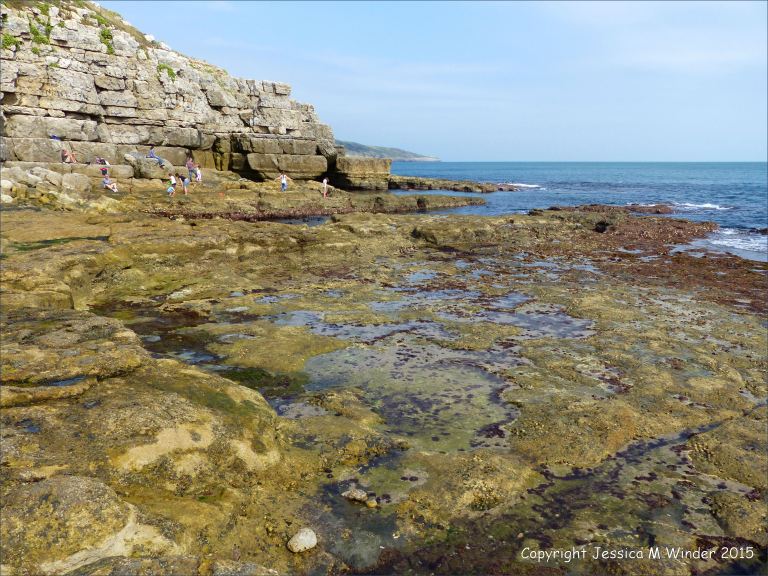
The flat quarried limestone ledge on the water’s edge at Winspit in Dorset provides a slightly unusual substrate for seashore life. There are natural gullies and deep angular man-made inlets in the stone but the area is mostly characterised by an extensive network of very shallow rock pools. Although only capable of retaining a centimetre or two of salt water as the tide recedes, these shallow pans and the surrounding surfaces are intensely colonised by numerous marine organisms, The natural patchwork of seaweeds and seashore creatures resembles a vast multi-coloured carpet with predominating pink and green hues.
The depressions in the rock are caused by the differential erosion of the softer limestone and the more resistant black chert nodules liberally embedded in it. The chert is composed of hard quartz derived from the opaline silica of decomposing sea sponges millions of years ago. The exposed rock stratum belongs to the Portland Chert Member dating from the Jurassic Period. Physical wear and acid erosion affect the softer matrix by chipping away and dissolving the stone respectively. The result of these ongoing processes can be seen from the small pitting marks.
In addition to this, the colonising organisms contribute significantly to erosion processes. For example, encrusting lichens can penetrate the rock surface, and as limpets feed by scraping this and other types of biofilm from the surface, they incidentally remove minute particles of stone with the food. Over great periods of time this feeding behaviour, together with other natural phenomena, imperceptibly degrades and removes rock thereby increasing the depth of the depressions. Additionally, the limpets always return to a home base when the tide goes out, and the circular impressions left by the friction of the shell margin as the limpet suckers tight down to prevent moisture loss are evident everywhere. When a large limpet dies or is removed, the home base is frequently re-occupied by new generation small limpets.
The natural depressions retain water at low tide, sometimes just a few millimetres but enough to support continued activity and prevent dessication. The wet hollows and much of the surrounding rock are covered by a patchwork of black, green, pink and white encrusting lichens and algae with groups of sessile or acorn barnacles. Some of the encrusting algae are calcareous, and there are abundant short tufts of pink calcareous coral weed, branched and articulated. Soft, finely-branched and filamentous red algae also occur – sometimes amusingly attaching themselves like decorative plumes to the shells of living limpets which often provide a home for dark brown encrusting algae, while dark red, almost black, beadlet anemones also glisten in the water.


 Jessica's Nature Blog
I just love the textural qualities of your photographs. They are beautiful.
LikeLike
Thank you, Kate. Good luck with the Open Studio event on Saturday.
LikeLike
Beautiful, almost abstract photographs Jessica. I love wandering around this type of location too.
LikeLike
Visitors are advised not to descend to the ledge at Winspit on safety grounds. I can understand that. However, it remains extremely popular for all ages, who find it worth the effort to get down to this artificial shore. It is amazing and I always seem to find something new of interest. What you find depends on the time of year and the state of the tide. There seem to be some natural shores elsewhere with similarities to Winspit, like on the Worms Head Causeway in South Wales, and Doolin Quay in Western Ireland (Burren country) where the limestone has lots of shallow pools but the seashore life is very different.
LikeLike