
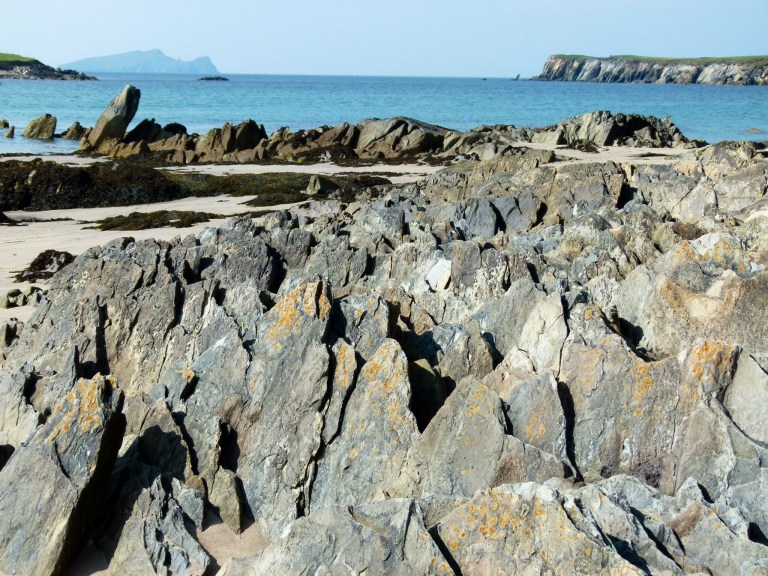
The mountains look down on the golden crescent of sand at Ferriters Cove. It is isolated and peaceful – where the sound of gently lapping waves is only occasionally broken by raucous calls when flocks of oyster catchers or herring gulls suddenly take flight.
Rock layers here stand up like stacked tombstones with wide knife edges, or stumps of strata with sharp points protrude from the surface like nails on a fakir’s bed. The rocks are fossiliferous marine Silurian sediments, from the Ferriters Cove Formation in the Dunquin Group, dating from between 423 and 395 millions of years ago. They are composed of pale brown, yellow, grey and red siltstones, mudstones, and sandstones. They were deposited in a shallow sea with active volcanoes on its shore and hinterland, which produced volcanic deposits such as lava and tuffs. The character of the rocks changes as you walk along the beach. Fossils such as brachiopods, corals, and trilobites are found in the mudstones.
Some pictures illustrating these features are shown below.
Don’t forget, you can click on any photograph to enlarge the image!


 Jessica's Nature Blog
Another brilliant collection Jessica, and very informative too.
LikeLike
Thank you, Adrian.
LikeLike