
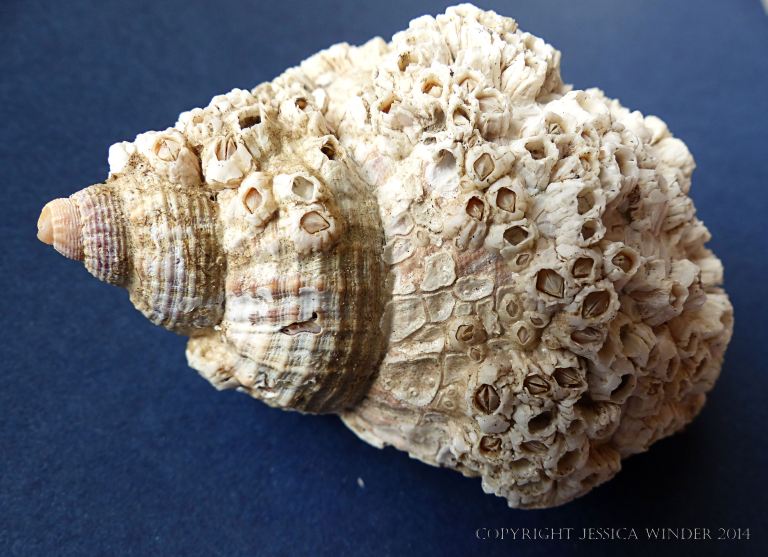
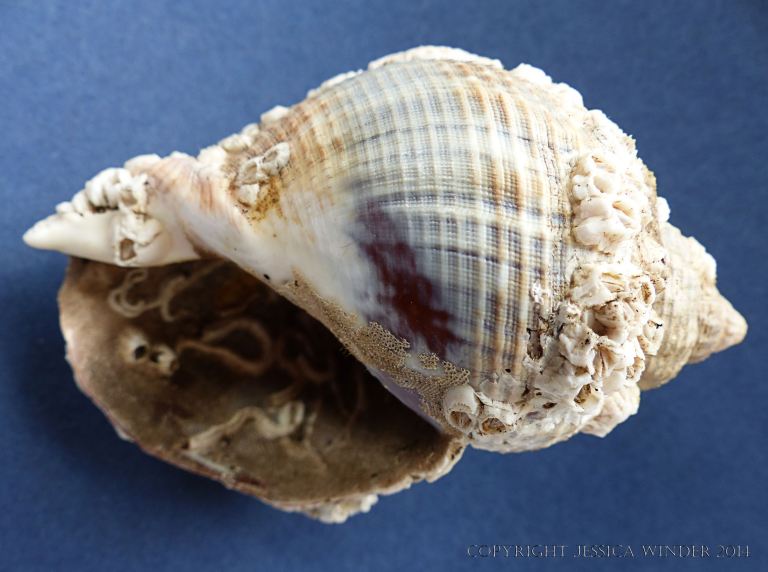
Acorn Barnacles (Cirripedia) settle on almost anything in the sea or on the seashore. These images show the empty shell of a Common Whelk (Buccinum undatum) that I picked up on the beach at Rhossili on the Gower Peninsula in South Wales – it has proved to be an ideal substrate for them.
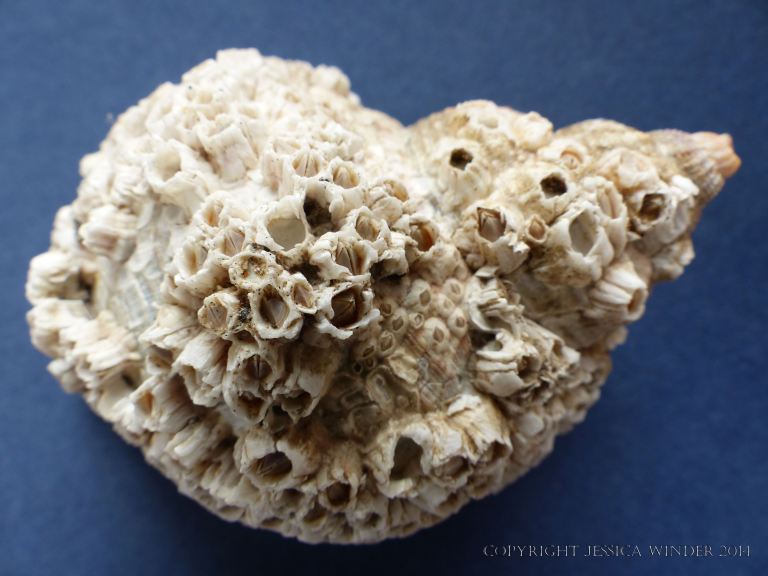
The outer surface of the shell is almost entirely covered with barnacles. The majority are intact with the lateral and also the terminal plates. Many specimens are mature but there are juveniles too. In one area, the barnacles have been knocked off but you can still see the basal plates by which they were attached. Some barnacles may have been living on this common British seashell while it was still alive. However, it is equally possible that the shell became colonised by barnacles once it was empty. The few calcareous tubes of marine worms which are stuck on the inner surface of the aperture or mouth of the shell would have settled there once the whelk flesh had disappeared.
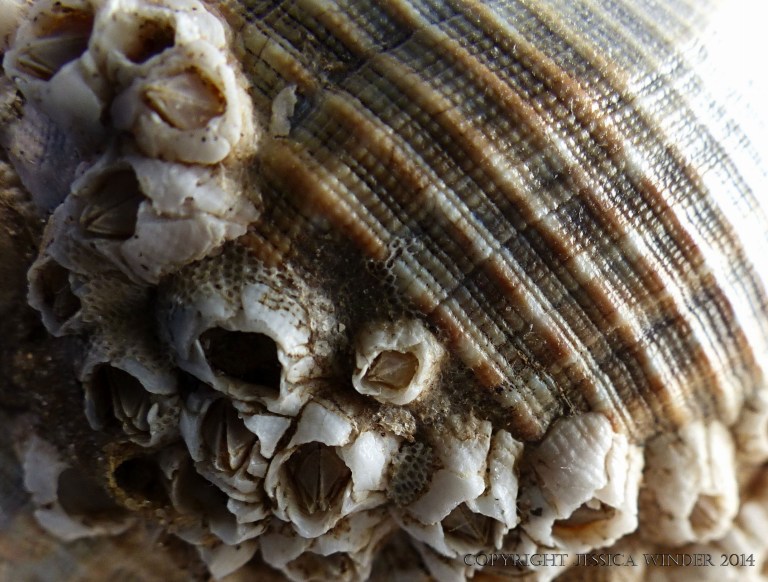
The close-up shots reveal the details of the structure of the barnacles, made up generally from six fixed lateral plates overlapping each other to form the shell for the animal, with four articulating terminal plates forming the lid to the chamber. The whole barnacle shell is in this instance securely attached to the whelk shell by a basal plate that often remains in place even when the barnacle becomes detached. Not all species of barnacle have a basal plate.
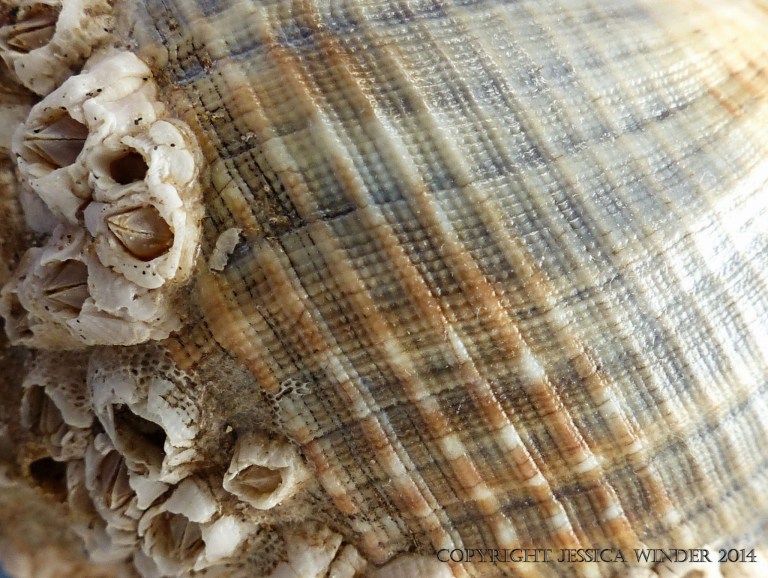
The macro-photographs also show the intricate pattern and texture of the whelk shell surface with a regular criss-crossing of ridges. This gives an almost lattice-like effect where the growth lines intersect with the natural ornamentation or sculpturing of the shell. In close-up, it is also possible to see small areas of the colonial microscopic animals called Bryozoa or Sea Mats (resembling fragments of lace) which are clinging to the bases of some of the barnacle shells.
COPYRIGHT JESSICA WINDER 2014
All Rights Reserved


Reblogged this on PalaeoMud and commented:
Fantastic photos with great detail. Thanks for posting!
LikeLike
Excellent Jessica. Reminds me of the poem by Jonathan Swift,
“So nat’ralists observe, a flea
Hath smaller fleas that on him prey;
And these have smaller fleas to bite ’em.
And so proceeds Ad infinitum.”
LikeLike
Fantastic….I found a very similar whelk recently so its wonderful to find out more about it. Thanks yet again.
LikeLike
Photo #4 is wonderful!
LikeLike
That’s the way it is. You think you know something, then you discover another deeper layer of understanding, and another, and so on down to the molecular level. Then you begin to be aware of how the object sits in the wider picture and you start the journey of understanding its place in the history of time, its environmental context, how it fits into the web of inter-relationships with all the other organisms and the inorganic world around it. There seems to be no end to the learning from the simplest of objects – like this whelk shell.
LikeLike
Thank you, Clare. You’re kind to comment.
LikeLike
Thank you, RH. I think the shell pattern is great this close up but I must try and get an even closer look.
LikeLike