

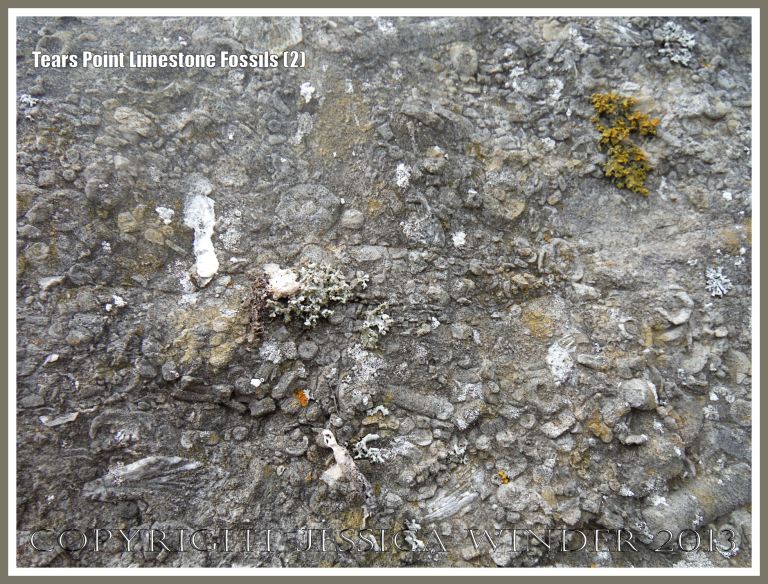
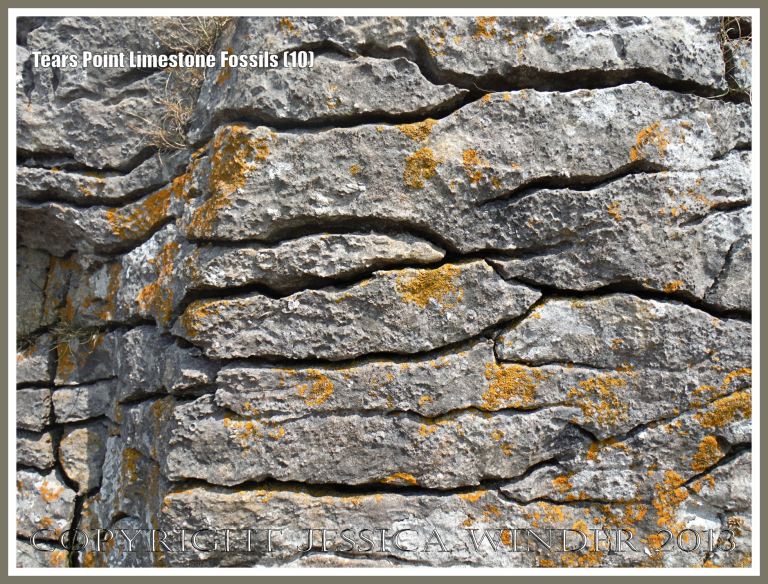
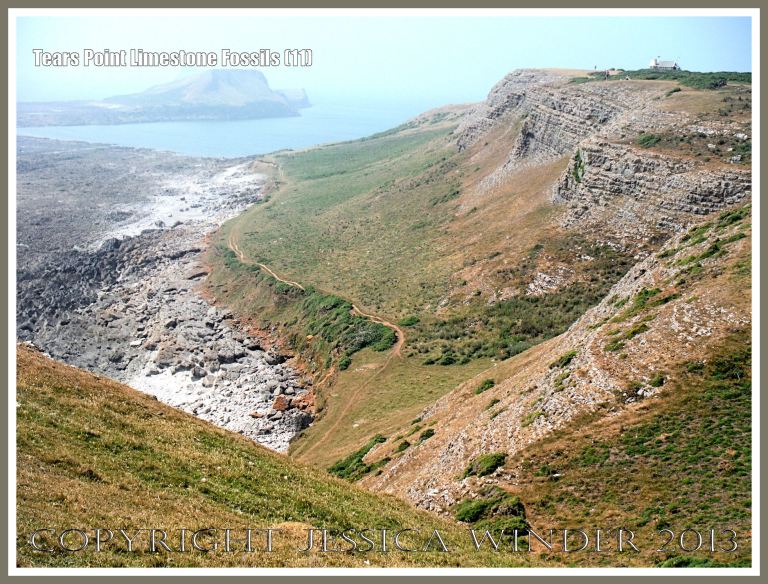
Tears Point Limestone is a sub-division of the Carboniferous Limestone in Gower, South Wales. It is named after the location in which it is found – between the western edge of Fall Bay and the eastern edge of the Rhossili headland where it abuts the Worms Head Causeway. I haven’t yet had an opportunity to examine this rock where it outcrops on the beach but I have seen it where it is exposed high on Tears Point. However, the easiest place to discover the fossils that this rock contains is by looking carefully at the dry stone wall along the Gower Coastal Path between Fall Bay and Rhossili.
Tears Point Limestone is part of the Black Rock Limestone Group of the Carboniferous Limestone which is described on the Worms Head Solid and Drift Map (England and Wales Sheet 246) as being limestone, dark grey, thin to thick bedded, bioclastic, and dolomitic in the upper part. It is one of the earliest deposits of the Carboniferous, following the Lower Limestone Shale group and preceding the Gully Oolite. It is also described as being highly bioturbated containing abundant crinoid and shell debris, ribbed brachiopods and occasional solitary rugose corals such as Zaphrentis and Siphonophyllia.
Bioclastic means that the rock is made up of sediments containing small, often broken, pieces of the fossilised hard parts of invertebrate creatures.
Bioturbated means that the original sediments, before they hardened into rock, were churned up by the activity of burrowing sea creatures, or may still clearly contain trace fossils of their tunnels and burrows.
Dolomitic means that due to various processes including exposure to seawater during burial the limestone contains a higher proportion of magnesium along with the normal calcium carbonate. This makes the rock more porous.
Crinoids, also known as sea lilies because of their superficial similarity in appearance to flowers, are marine invertebrate animals related to the Echinodermata (sea urchins, star fish, brittle stars). In life, and they still exist in deep ocean beds today, they look a bit like a jointed starfish on top of an articulated stalk fixed to the sea bed. Only the individual pieces of the stems and arms are found in the Tears Point Limestone; small rounded discs sometimes with a hole in the centre, sometimes several pieces together in a short length.
Brachiopods are similar to bivalved molluscs but they are actually unrelated and have internal hard parts as well as the two outer shells. They are a type of organisms that can still be found today but are relatively rare.
Rugose Corals live as single individuals rather than colonial corals and their fossilised hard parts are large in comparison with the remnants of crinoids in the limestone. Sometimes they are seen in the rock in cross-sections which are roughly circular or ovoid with a radiating matrix of dividing walls within. They are also seen in longitudinal section form.
Allaby, M. (2008) Oxford Dictionary of Earth Sciences, Oxford University Press, ISBN 978-0-19-921194-4, is one of several good books for definitions of geological terms.


COPYRIGHT JESSICA WINDER 2013
All rights reserved
 Jessica's Nature Blog