
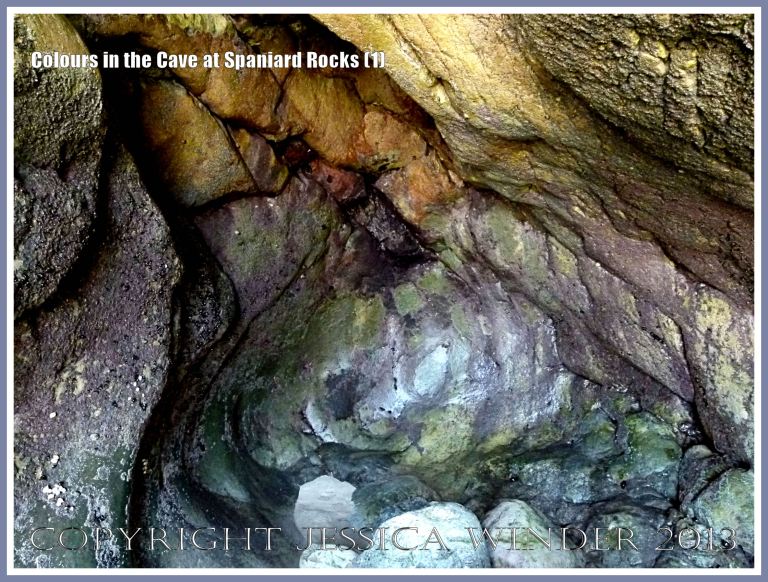
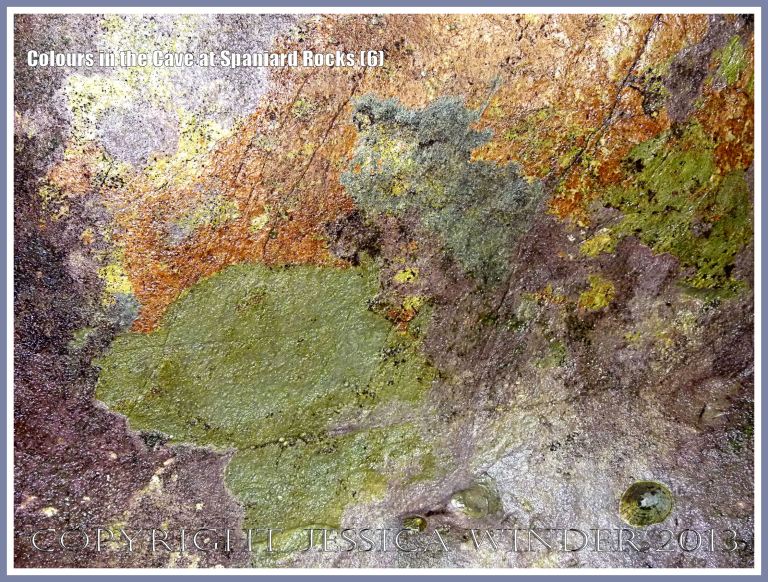
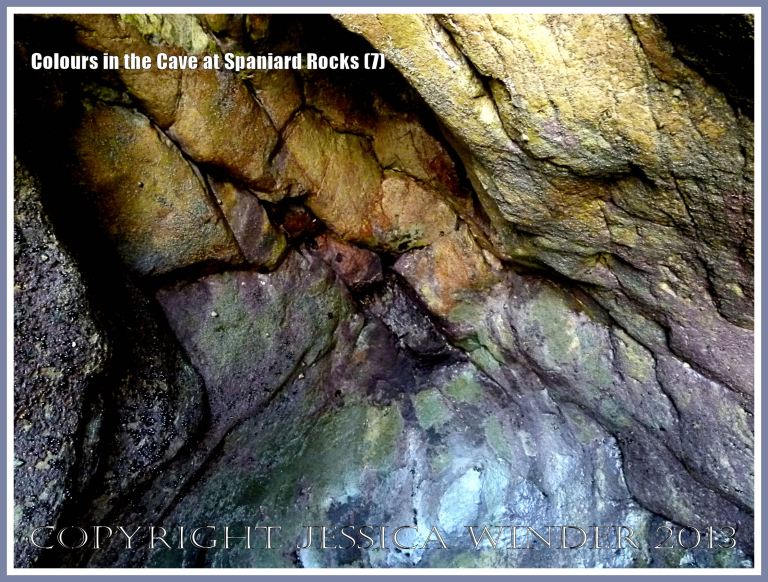
Natural patterns of what are probably bacterial and algal encrusting growths cover the damp rock surface in the recess of a small limestone cave near Spaniard Rocks on the Gower Peninsula. These give green, red, orange, blue and purple patches. The High Tor Limestone rock itself adds to the effect with the inclusion of minerals like iron that tint the rock shades of yellow and orange.



COPYRIGHT JESSICA WINDER 2013
All rights reserved
 Jessica's Nature Blog
Your photographs are very revealing as is the accompanying text, thank you. Do you happen to know about Birnbeck Limestone Formation which gets lumped together with High Tor Limestone but seems to be quite place-specific?
Thanks again,
Harriet
LikeLike
Hello, Harriet
Thanks for the question. It seems that the Birnbeck Limestone Formation (BBL) is the old, now redundant, name for the type of rock that is now called High Tor Limestone (HTL). The name Birnbeck Limestone Formation was originally used in the Bristol area where it was given to the type of Carboniferous Limestone found on Birnbeck Island at Weston Super Mare (see Whittaker and Green 1983). The name High Tor Limestone Formation was first given on the Swansea (247) sheet geology map and used by George et al in 1976. The HTL is named after the type location for which it was first described, in the sea cliffs and foreshore reefs below High Tor, Southgate, Gower, South Wales.
George, T. N. et al (1976) A correlation of Dinantian rocks in the British Isles, Geological Society Special report, No. 7
Waters C. N. et al (2009) The Lithostratigraphical framework for the carboniferous successions of Southern Great Britain (onshore), British Geological Survey Research Report RR/09/01 , Keyworth, Nottingham, 2009.
Whittaker, A. & Green, G. W. (1983) Geology of the country around Weston-Super-Mare. Memoir of the Geological Survey of Great Britain, Sheet 279 with parts of sheets 263 and 295 (England and Wales)
I hope this helps to answer your question.
Jessica
LikeLike