
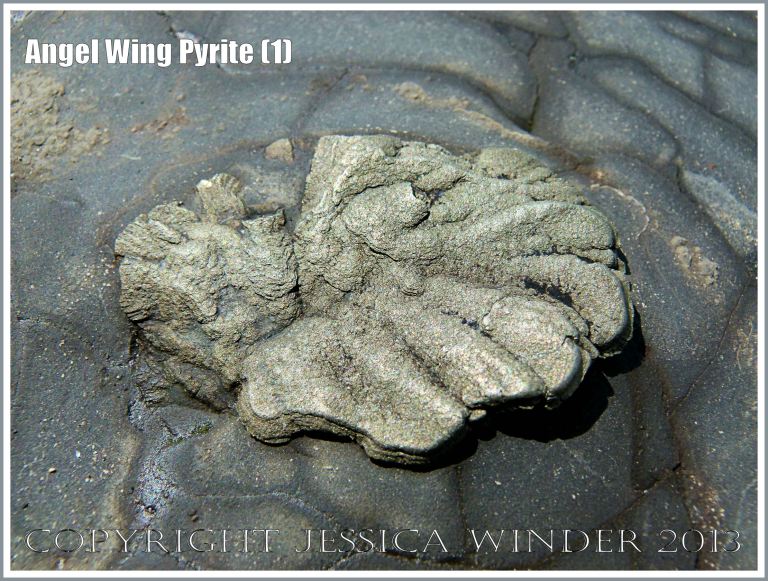
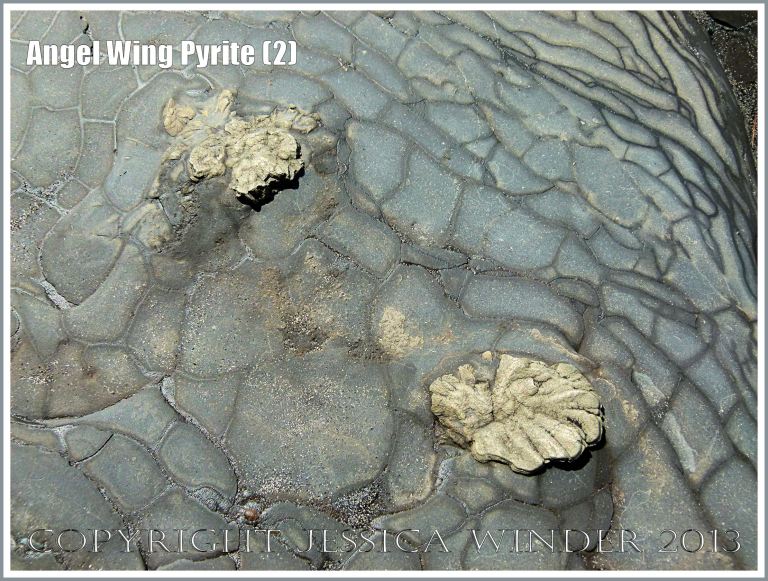
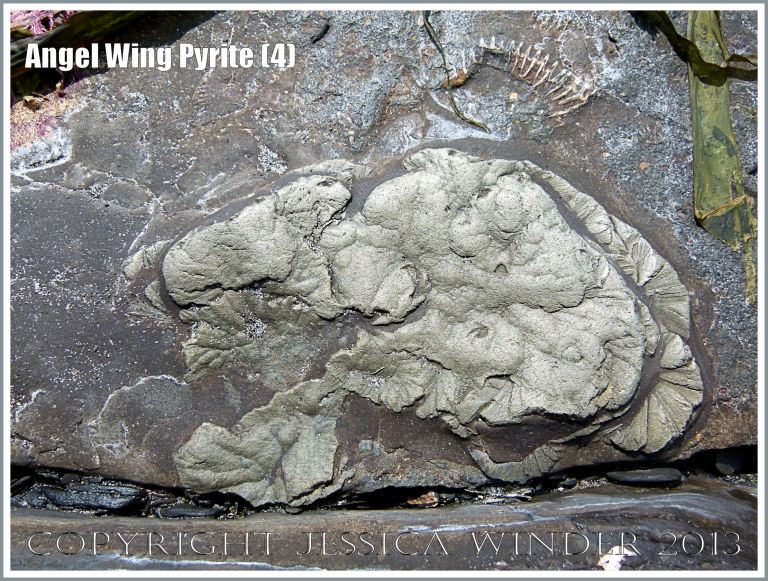
I have often seen similar objects embedded in the rock platform on the beach at Kimmeridge Bay in Dorset. I had thought they were all ammonite fossils that had been transformed into iron pyrites or Fool’s Gold. Now I am not so sure because the shapes of some of them are very distorted to be fossils, and I have just learned about the existence of Angel Wing Pyrite.
Iron pyrites is iron sulphide, FeS², and under normal conditions it would form cube shapes, or pyritohedrons. However, when the crystals develop in the restricted confines between the compressed layers of bituminous shales, they grow out laterally in a radiating fibrous form. Sometimes these can be perfectly circular growths commonly known in the United States as a Pyrite Sun or Pyrite Dollar. Sometimes overlapping discs along adjacent bedding planes can look like Pyrite Flowers.
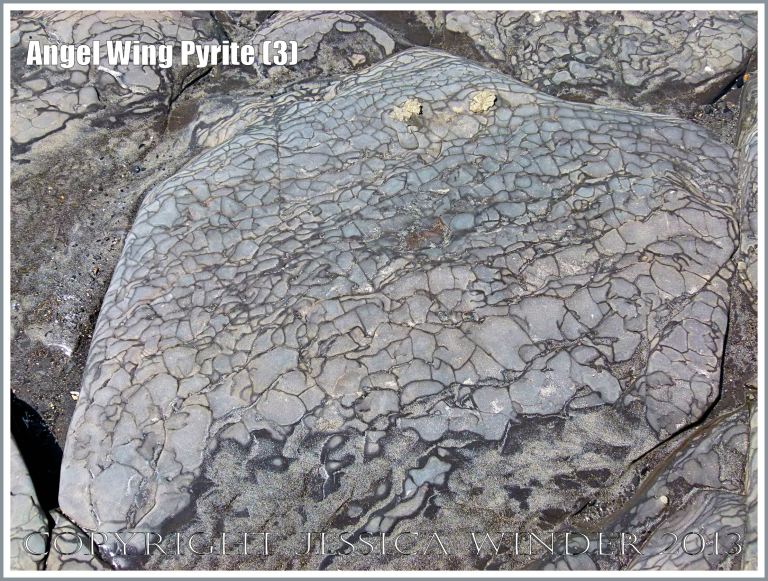
The examples shown here lack that regularity of shape and can assume various shapes which are locally called Angel Wings. They occur in the Maple Ledge Shales of the autissiodorensis Zone of the Kimmeridge Clay deposits.
COPYRIGHT JESSICA WINDER 2013
All Rights Reserved
 Jessica's Nature Blog
Oooooh, how very interesting and beautiful!
LikeLike
Thanks, Jody. Sometimes the pyrite really does look like wings, and you can buy specimens in the fossil shops in nearby Lyme Regis.
LikeLike
Hi Ms. Winder,
How often do you see very irregular pyrite suns like Angel Wings? Are most of them very round or irregular? I find the shape angel wings to be very fascinating and I’m wondering how often something like that occurs. Also, what do the pyrite flowers look like? Do they have a pyrite nodule in the middle with angel wings sprouting out of the nodule or are they angel wings layered on top of each other?
Sorry for all the questions.
LikeLiked by 1 person
Thank you for your enquiry, Brie, and apologies for the late reply. Unfortunately, I am unable to answer your questions as I am just an amateur geologist and have only seen the angel wing pyrite on a single occasion myself. Maybe you could ask your questions on one of the many Facebook pages or websites devoted to geology or crystals for a satisfactory answer. Sorry, I am unable to help.
LikeLike