

On the beach at Whiteford, near Llanmadoc in Gower, there is one place where many boulders and occasional water-logged timbers outcrop on the sands. The rocks could well have been deposited by an ice-sheet, while the wood may well be the remains of a forest that was submerged ten thousand years ago.
At low tide, hundreds of thousands of common winkles, Littorina littorea (Linnaeus), emerge from hiding places under stones and sand. You can see trails in the sand showing how they travel to exposed hard surfaces on rocks and wood to feed. These surfaces may be covered with acorn barnacles but the winkles are vegetarians and are not interested in eating these. The winkles are after the thin encrusting film of microscopic green algae which coats every surface. Winkles have a sort of rough tongue called a toothed radula which they use to scrape this deposit off the surfaces.
Huge numbers of empty winkle shells can occur on the strandline at Whiteford. Many of the empty winkle shells found there, on the sandy spit beyond the point, have started life on the stones and boulders around the old Whiteford lighthouse.
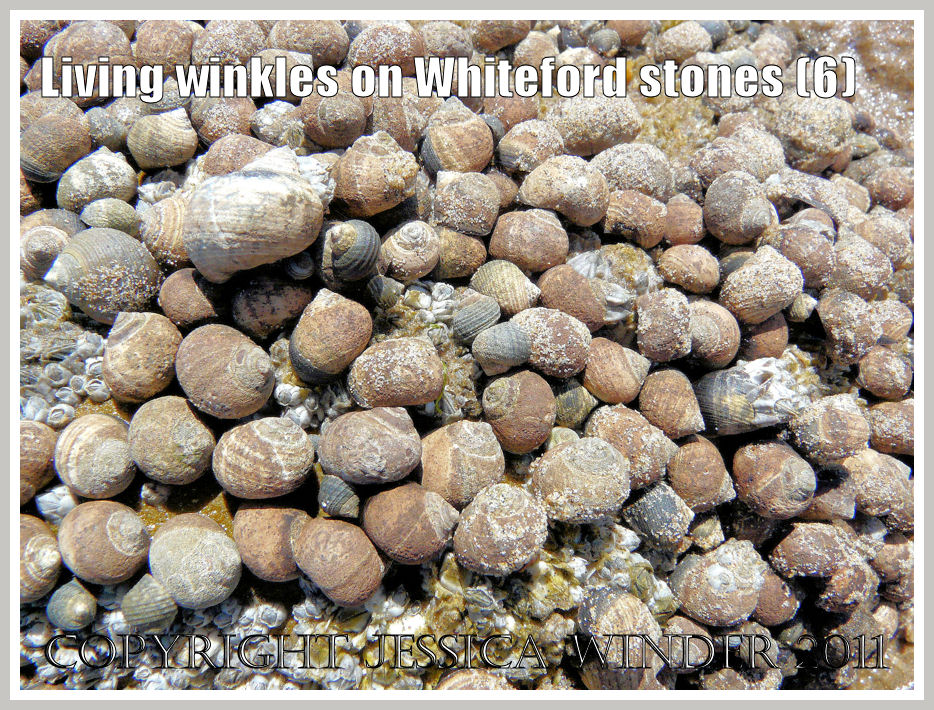
In common with these drifts of empty winkle shells on the strandline, the shells of these living specimens of gastropod mollusc are also thick and rough with a dull and worn surface. In close-up the shells also appear pitted; pitting can be caused by a lichen living in the matrix of the shell.
In other locations in Britain – like the seashore along the Jurassic Coast in Dorset – the shells of the living common winkles are not dull and rough like the Whiteford shells: they look very different. You can see some photographs of these, for example, in the post called Holdfast habitat at Ringstead Bay.

Here is an ancient piece of wood projecting from the sand. At its base you can see the trails in the sand left by winkles as they move towards this hard surface. The winkles congregate at the base of the timber and climb upwards along the worn grooves to graze the algae.

Here is a close-up view of the winkles grazing on the eroded surface of a piece of old water-logged wood.
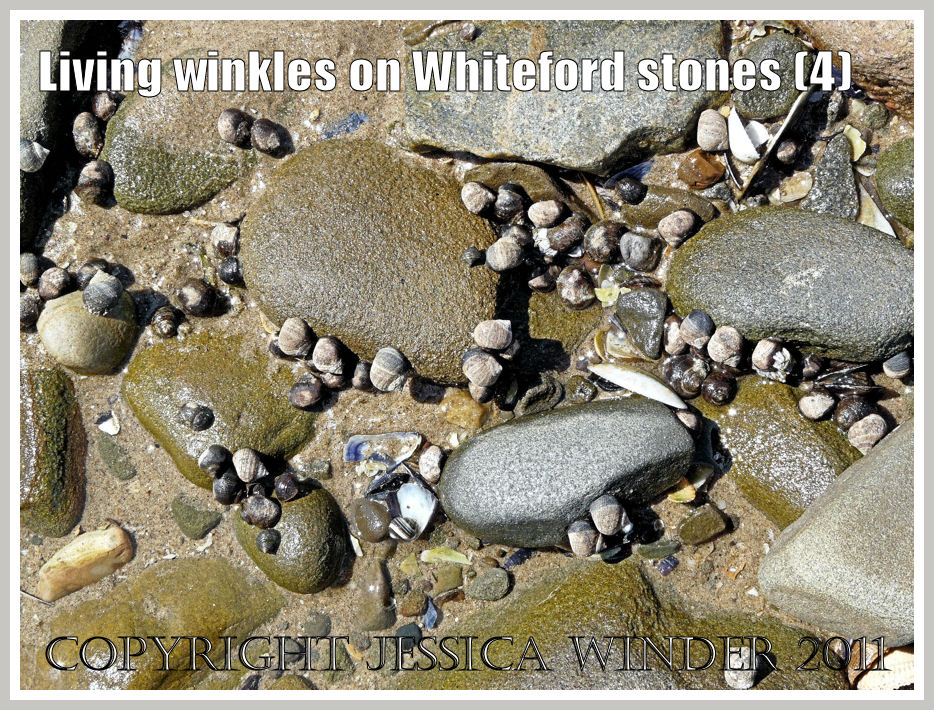
A scattering of living winkles are also found feeding amongst the smaller, smoother, algae-coated stones.
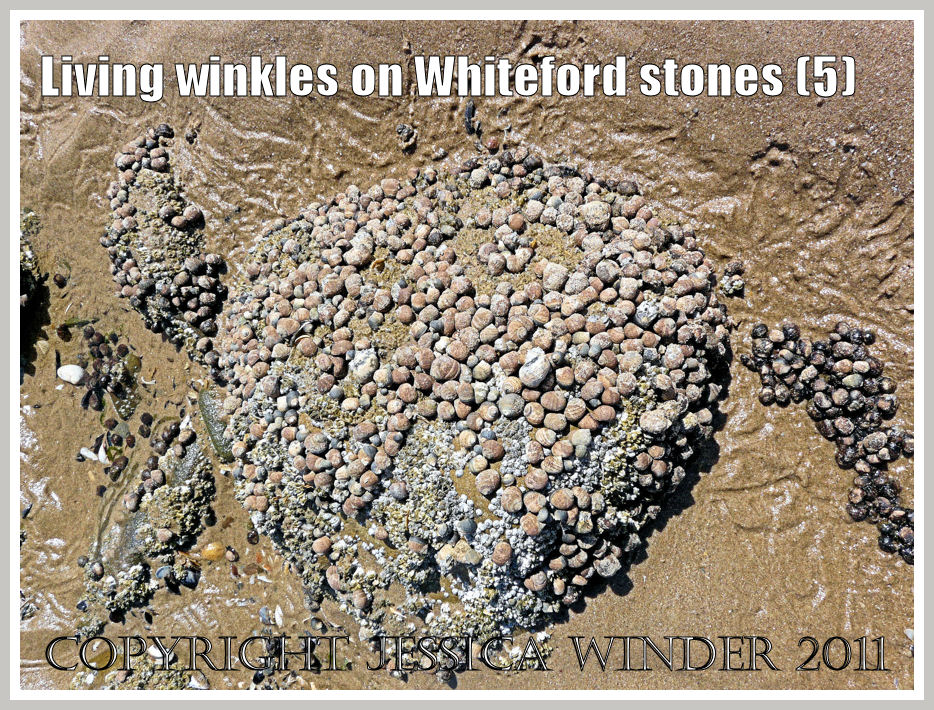
On larger boulders the winkles are tightly clustered together and may entirely cover the surfaces. In the picture below you can see how dull and worn the shells are. Some of them have grains of sand sticking to them and a few even have barnacles attached.
Revision of a post first published 24 September 2009
COPYRIGHT JESSICA WINDER 2011
All Rights Reserved
 Jessica's Nature Blog
Accidently…….. I have just found your blog ….. and have enjoyed your observations…
You reminded me of . ……when i was a boy and my friends and I would sometimes collect winkles clustered on the remains of wooden posts and oyster boats on the foreshore, below Village Lane and the Antelope Pub, in the Mumbles………. and elsewhere…
A soak in clean water overnight and a quick boil before picking out the insidea with a pin……. very tasty………. as I remember……..
Cockles dug from the sand further out as well…
LikeLike
Hello, Robert. Thanks for stopping by. Pleasant to think about the way it used to be. Nowadays I would hesitate to eat things from the seashore even after an overnight soak. Despite a life-long interest in marine molluscs and all things seashore, I have never tasted winkles – I’ll take your word for it that they are tasty.
LikeLike