

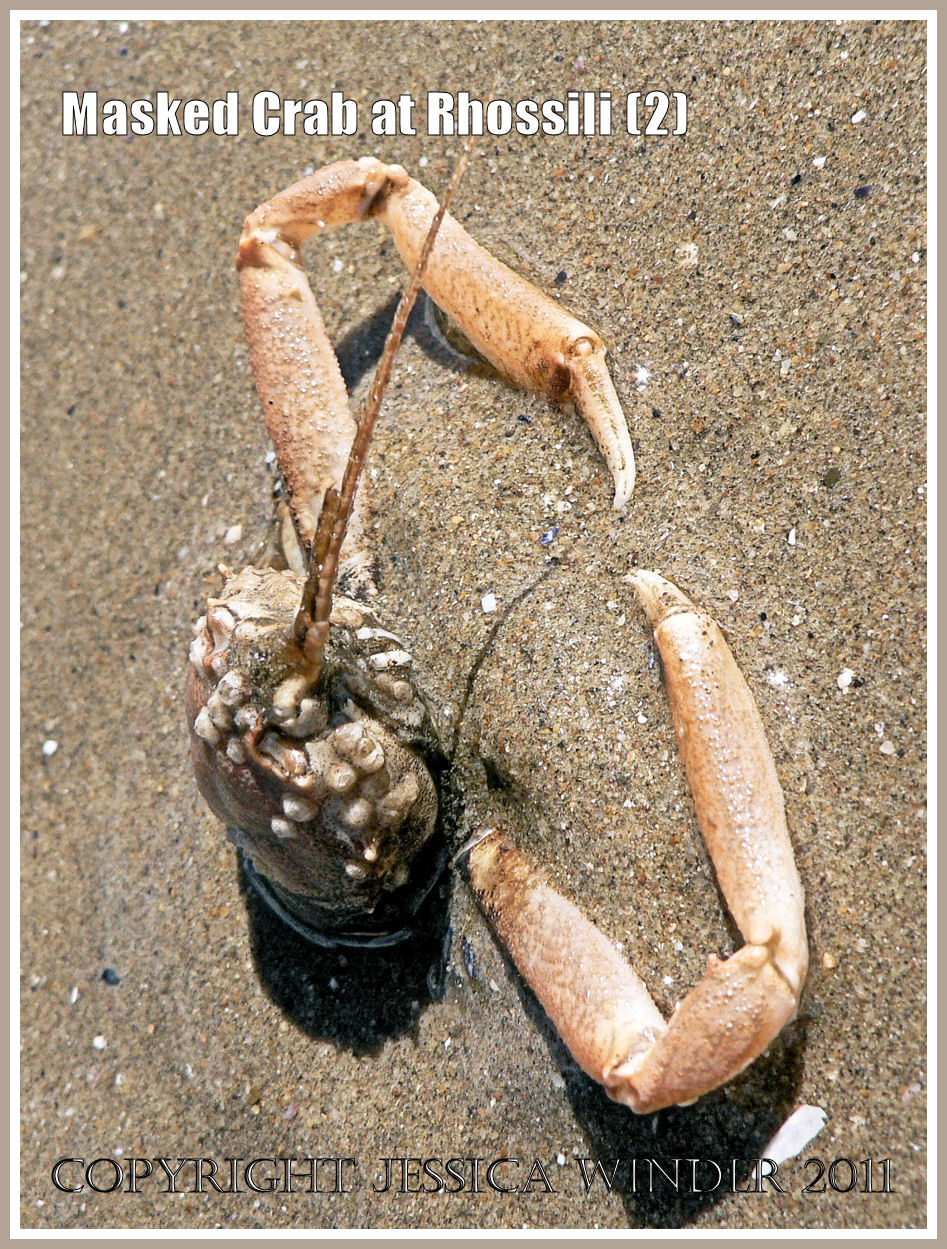
This living small male Masked Crab, Corystes cassivelaunus (Pennant), with a carapace no more than 39mm long, was sitting with its hind legs dug well into the wet sand to brace himself against the incoming waves. The chelipeds or front legs are twice as long as the body in the male crabs. As the crab holds these long limbs up in front of him, the sun seems to shine right through them. The two long antennae are held together to form a long tube which helps the crab breath when it is entirely buried in the sand.
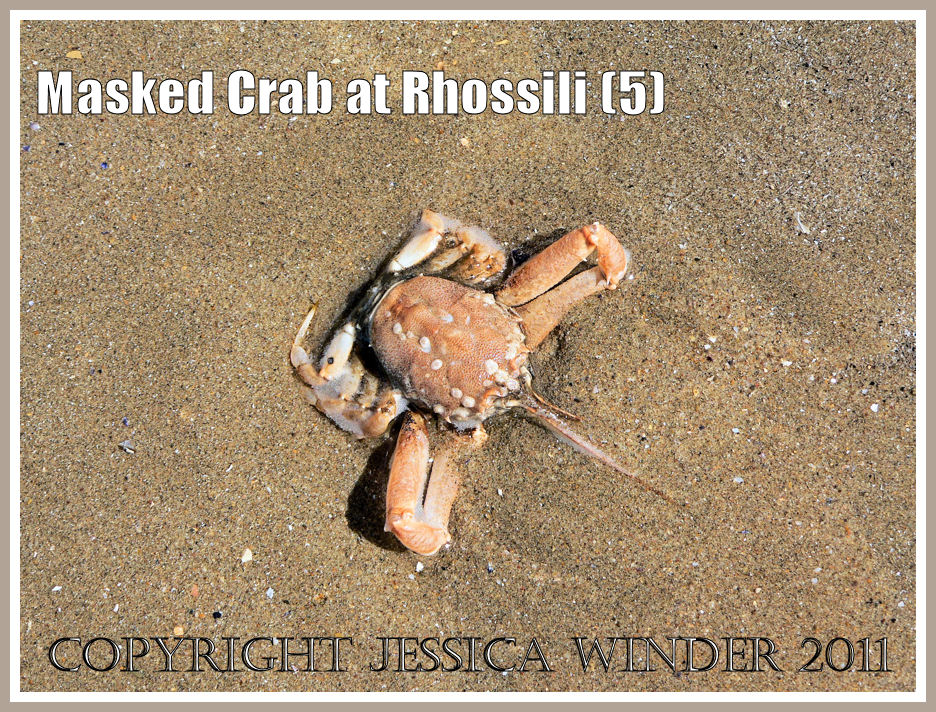
The carapace or shell has a fine granular texture. The colour can be anything from pale red, through orange, to a yellowish-white. The markings and indentations on the back sometimes resemble a face; that is why it is called a Masked Crab.
The Masked Crabs shown in these photographs were engaged in some kind of purposeful behaviour, the meaning of which I am uncertain. They were at extreme low tide level just as the tide was turning. They dug their rear end into the sand and faced the sea with their front legs (chelipeds) held up bent before them. It seemed as if they were bracing themselves to meet the impact of the incoming waves. When the waves struck, the crabs rolled over and over backwards in the water, until the wave retreated again. This had the effect of moving the creatures slowly but surely higher up the shore. It seemed a deliberate manoeuvre but I do not know the purpose of the action.
They are a very common species of British seashores where they like to live on soft, sandy bottoms from Low Water Spring Tide down to 90 metres under water. Seeing these delightful seashore creatures alive and in action was a real privilege. More frequently, it is the empty crab shells that are seen on the strandline. I will post some photographs of these later.



Revision of a post first published 19 December 2009
COPYRIGHT JESSICA WINDER 2011
All Rights Reserved
 Jessica's Nature Blog
One Reply to “Masked Crabs living at Rhossili”