

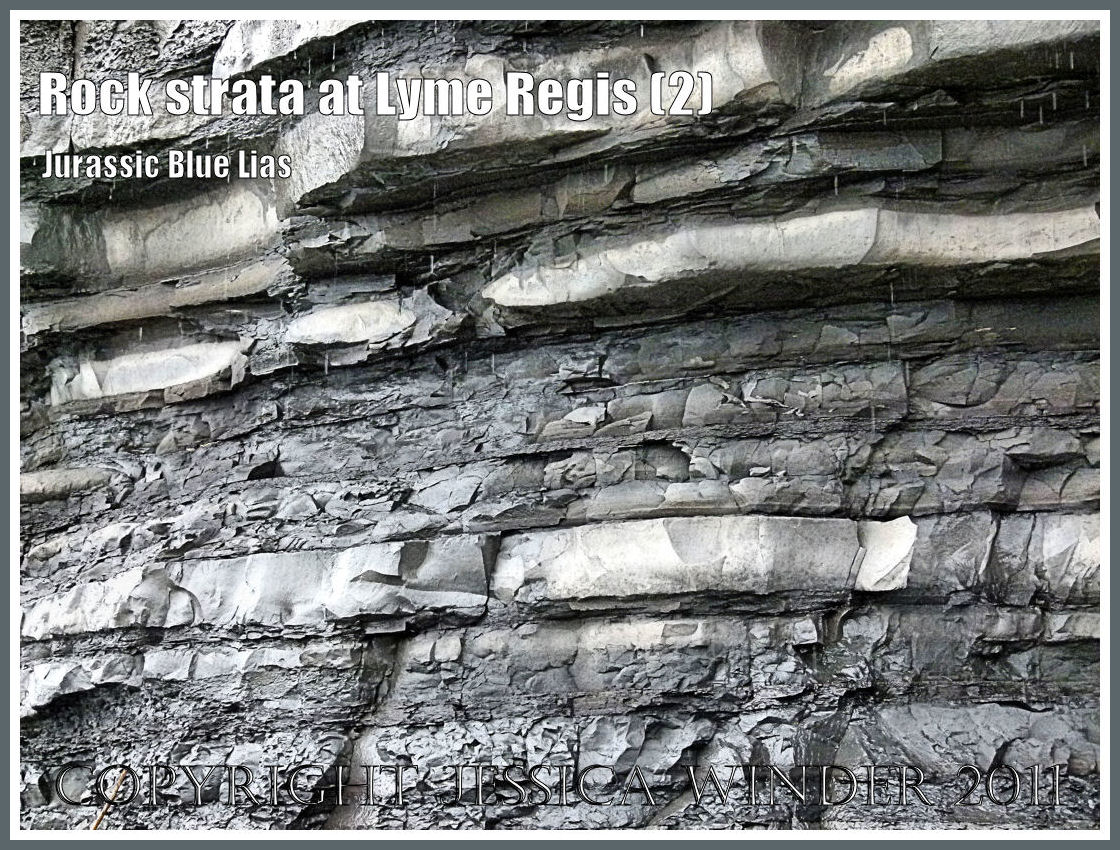
The Blue Lias rock strata of the Lower Jurassic Period consist of a thickness of 32 metres of alternating hard and soft layers which represent deposition of sediments in water during different types of environmental circumstance. There were cyclical climatic variations which resulted in more of the harder, purer, limestones being laid down in warmer conditions. The sediments of the softer shales and mudstones were deposited in shallower water nearer the shores. Both rock types were formed where the sunlight was still able to shine through the water – the photic zone.
The limestones tend to consist of massive slab-like layers of pale coloured rock. Some limestone bands can be traced over several kilometres. The darker shales and mudstones between the limestone layers are mostly made up of many finer, sometimes paper-thin, layers. The major bands of rock representing the different phases in the cycles of sedimentation have been given their own names – and what wonderful names they are! The Verity Shales, Top Copper, Best Bed, Specketty, Mongrel, Gumption, Top Tape, Third Quick, and the Rattle Shales – to name a few.
To learn more about the Blue Lias at Lyme Regis, have a look at Ian West’s most excellent web site.


COPYRIGHT JESSICA WINDER 2011
All Rights Reserved
 Jessica's Nature Blog
A question—what is the number of strata in the Lime Gigi’s cliffs?
LikeLiked by 1 person
Hello, Michael. If I have understood correctly the information in “Geology of south Dorset and south-east Devon and its World Heritage Coast” by the British Geological Survey (2011), the Blue Lias has 140 strata in all but only 119 of these belong to the Jurassic period and can be seen in the cliffs from Pinhay Bay and Lyme Regis – layer H25 at the base through to Bed 49 at the top.
LikeLike