
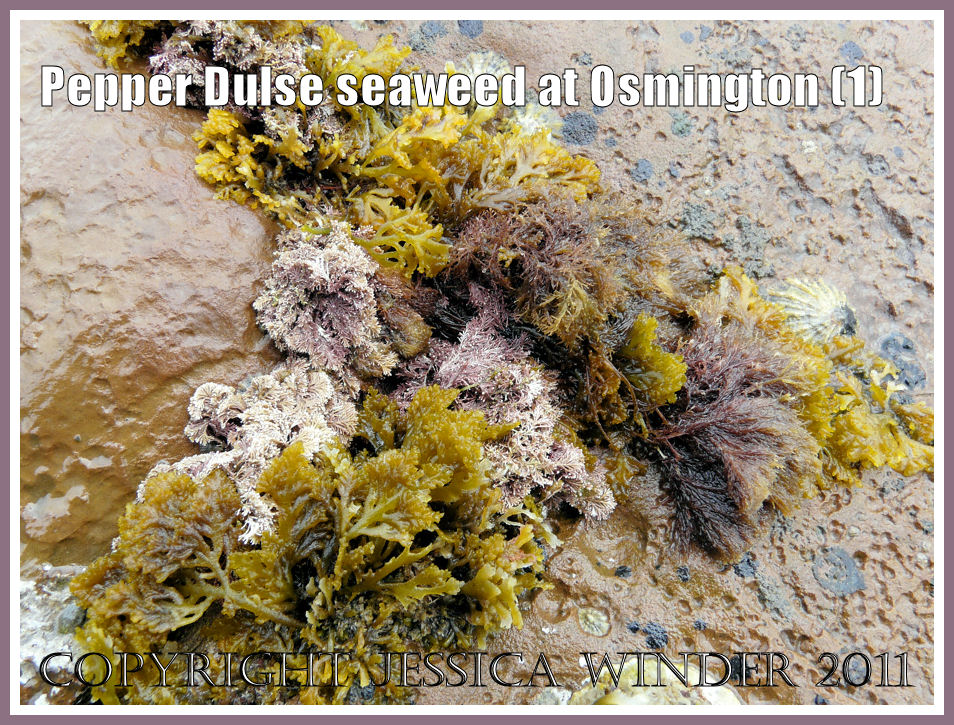
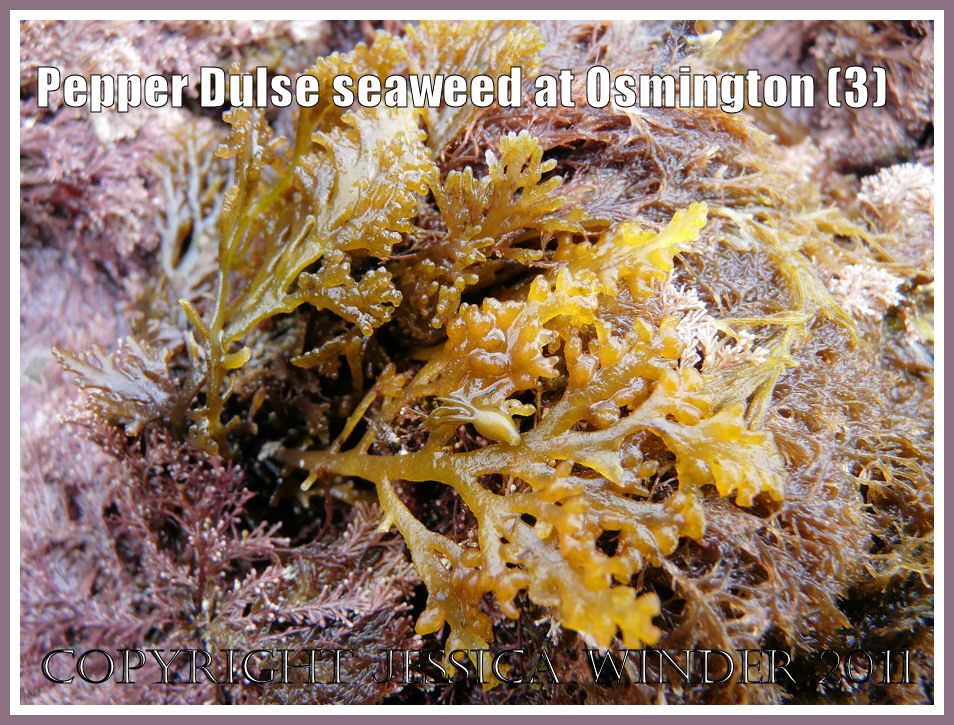
Despite the wonderful yellow colour, Pepper Dulse seaweed, Laurencia or Osmundea pinnafitida (Hudson) Lamouroux, is a member of the Rhodophycae or red seaweeds. The colour varies according to the conditions where the seaweed grows. Low in the tidal range, Pepper Dulse has a purple brown colour. In bright sunlit conditions and higher up the range this alga becomes more green than red – and in this instance looks almost golden. (I have found this seaweed washed up at Studland Bay with fronds that were half red shading to green). The plants in these photographs were growing in linear cracks on the rocks along the water’s edge at Osmington Bay in late May.

Seen here, the Pepper Dulse is growing alongside the pink and white finer fronds of the calcareous Coral Weed, Corallina officinalis Linnaeus. Pepper Dulse has alternate branching along the stem and short, stubby, and flattened branchlets. Its thick juicey-looking fronds mean that it is quite a robust alga and can resist the effects of severe wave action.
Sizes of the plants are variable depending how high or low on the shore the seaweed grows. It grows longer further down the shore; and is at its longest in shaded positions. Normally it ranges between 7cm to 20 cm high. However, high on the mid-shore in bright sunlight these examples were just a fringe of short tufts little more than 2cm.
Pepper Dulse is one of the edible British seaweeds. Sheep are said to be fond of eating it. It is reported that it is a bit rubbery to chew and tastes mostly of salt – but I am not certain if that means cooked or raw. Other textbooks say that, in the past, this seaweed was dried and ground up into a peppery powder that was used to spice food.
Revision of a post first published 15 June 2009
COPYRIGHT JESSICA WINDER 2011
All Rights Reserved
 Jessica's Nature Blog