

Gryphea dilatata J. Sowerby is a marine shell fossil found in the Corallian beds of Upper Jurassic rocks near Ringstead in Dorset on the Jurassic Coast World Heritage Site. The Jurassic Period lasted from about 200 million years ago to 135 million years ago in the Mesozoic Era. The Corallian Beds reach a thickness of about 61 metres between Weymouth and Ringstead; and this fossil can be found, for example, in the Nothe Grits and the Nothe Clay of that sequence.
G. dilatata is a bivalved marine mollusc similar in overall appearance and size to a mature present day Native British Oyster, or European Flat Oyster, Ostrea edulis Linnaeus. The shell photographed here is a particularly large, thick and long-lived specimen, and measures approximately 12 centimetres in diameter. This is especially evident in the ligament scar area on the inner dorsal edge of the shell, and by the central interior scar left by the adductor muscle attachment. Both these scars have numerous fine ridges and grooves representing growth stages.
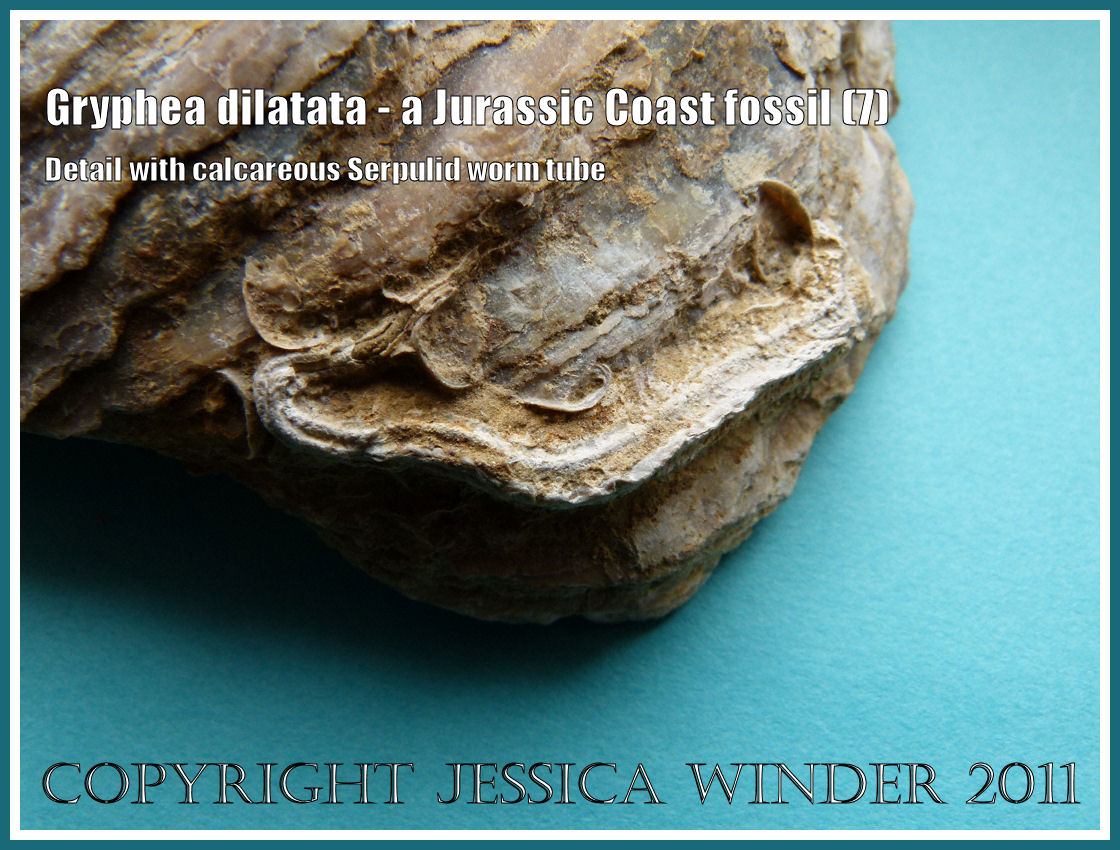
The shell was obviously empty for some time before burial in the sediments that eventually resulted in its fossilisation. This is shown by the attachment of the hard parts of encrusting marine organisms in both the inside and the outside of the shell. These include large keeled calcareous tubes formerly occupied by marine Serpulid worms – probably Serpula sulcata J. de C. Sowerby. There are also dozens of small shells of newly settled spat bivalves – possibly of the same or similar species to the main fossil shell.


COPYRIGHT JESSICA WINDER 2011
All Rights Reserved
 Jessica's Nature Blog
Beautifully photographed and explained.
LikeLike
Thank you, Ian. This fossil is one of many that my son discovered long ago, when he was a small boy exploring our local beaches. It may not be as spectacular as the Pliosaur skull that was found recently in the same area (now in Dorchester County Museum) but to me it is just as interesting and more representative of the kind of fossil that the average beachcomber is likely to find.
LikeLike
Hello Jessica, great photos and post. I’ve recently been finding a lot of Gryphaea shells in clay on a dig I’m working on. None seem to have the encrustations you found, but two have small holes, perhaps the work of a boring gastropod. Would you be able to recommend a guide to identifying these fossils?
LikeLike
Hello, Matthew. Thank you for the comments. There are two series of books that I find particularly useful when trying to identify fossils.
The first is the British Regional Geology series which are 20 HMSO publications. Each book explains the geology and associated palaeontology for a particular region of the UK. For example, my area is No. 15 The Hampshire Basin and adjoining areas . I think your area might be No. 16 Bristol and Gloucester District or No. 17 South-west England.
The second series of books are produced by the British Museum (Natural History) with three volumes of scale line drawings of typical examples of fossils from named localities and named geological strata – one book for each of the major geological eras (British Palaeozoic fossils, British Mesozoic fossils, and British Caenozoic fossils.
LikeLike
Thank you Jessica. As it happens I recently bought a cheap second hand copy of British Caenozoic Fossils. I’ll look out for the British Regional Geology series.
LikeLike
That’s OK, Matthew. Pleased to help.
I have recently discovered some more fossils that were found a long time ago. They are all from the Jurassic Coast. They’ve been hidden and forgotten in a cupboard. So I’ll soon be making some new posts featuring them. One of the other Gryphea dilatata fossils is entirely covered on the outer surface to some depth with encrusting epibionts like calcareous worm tubes and other small shells.
LikeLike