
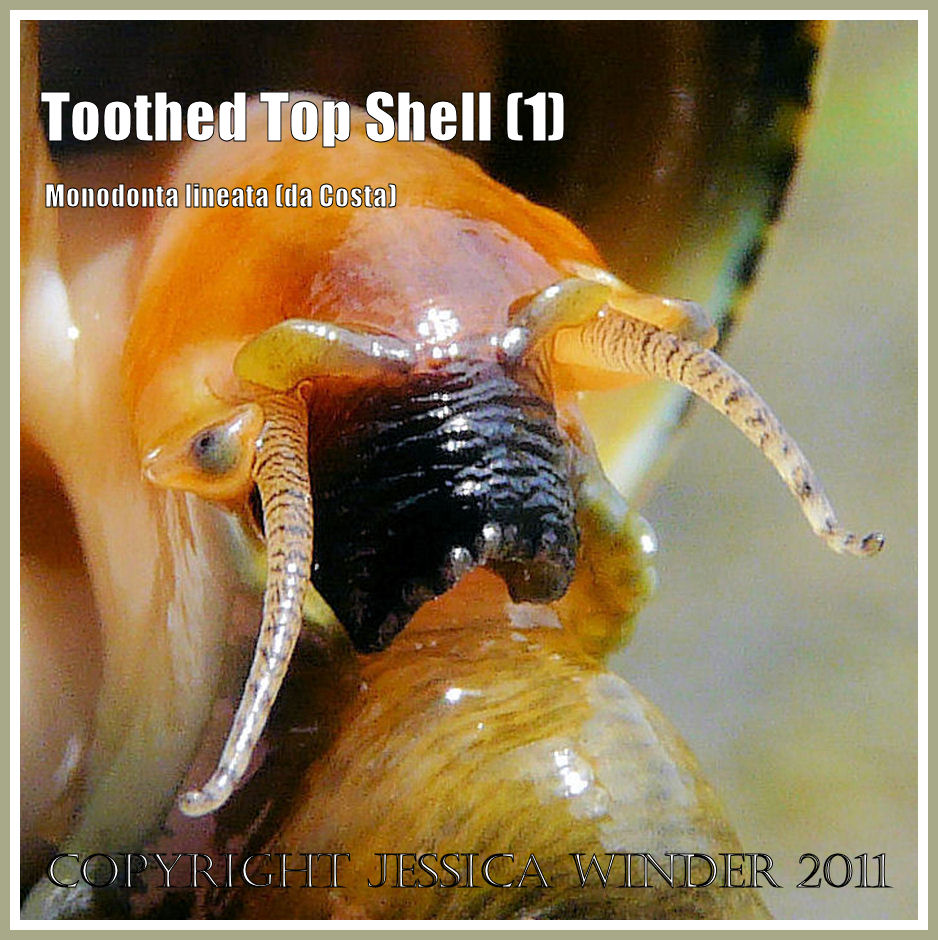
Say “Hello” to the occupant of the Toothed Top Shell, Monodonta lineata (da Costa). Looking a bit like an alien but a lot friendlier, this animal was not at all shy about coming out of his shell. As soon as you pick up a living gastropod mollusc it usually retreats to safety – but not this one.
What you see here is mostly the shiny orange head of the mollusc. A large black wrinkled snout is in the middle. Unseen, the mouth is inside the snout along with the radula – the tongue-like structure bearing rows of teeth that it uses to scrape algal films from rocks. Small black eyes sit at the tip of a blunt orange stalk on each side of the head. Next to the eye-stalks are the long, thin, tapering cephalic tentacles. The glossy tentacles are ringed by black zig-zag patterns along their length. The animal even seems to have greenish coloured eye-brows!
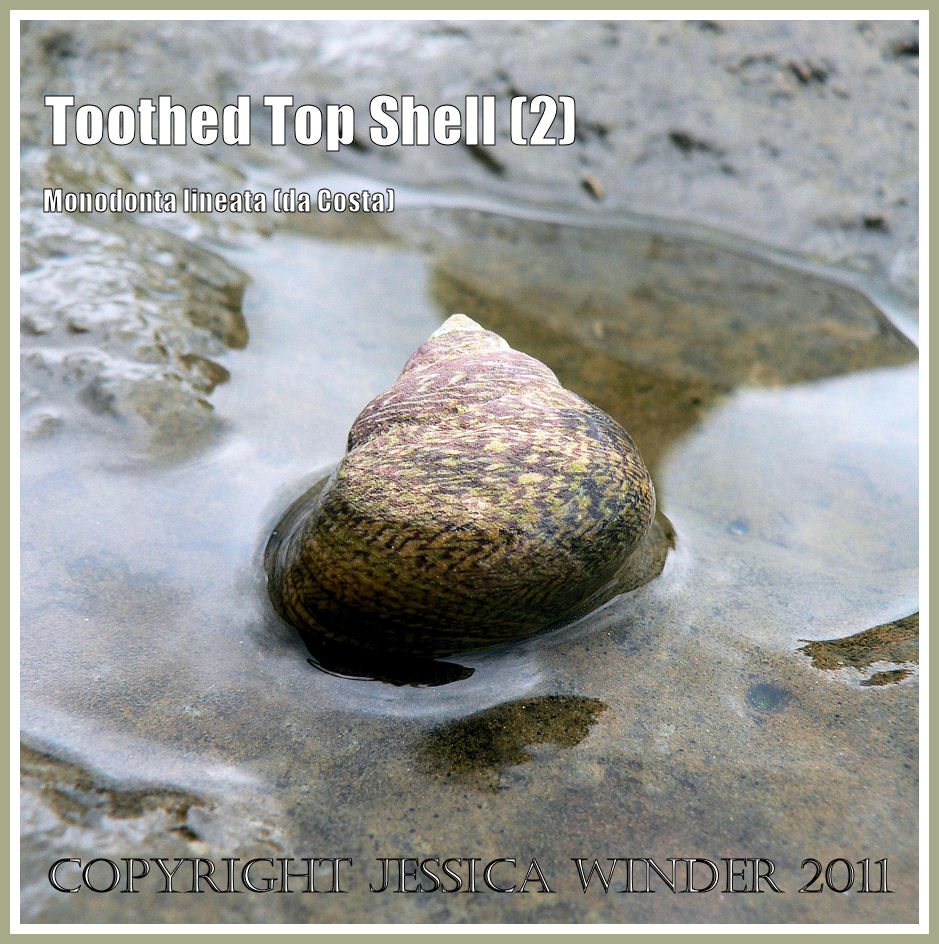
The shell itself doesn’t look anything special. It is like a large blunt common winkle and rather thick. It has a slightly convex profile and the five or six whorls that make up the 30mm high cone are not very pronounced.
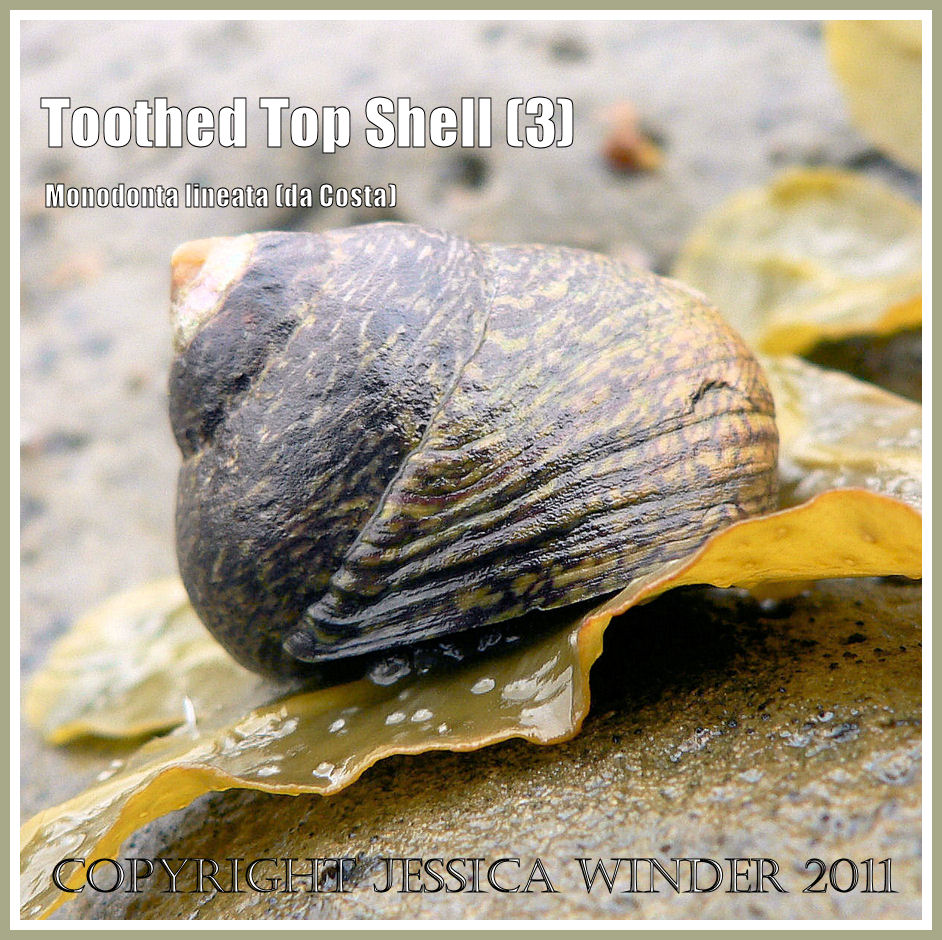
Shown here in profile, the shell is cream coloured with a design of reddish brown or purple zig-zag stripes. The surface texture of the shell is normally dull and smooth but in younger specimens there may be some fine spiral grooves and ridges. The colouring of the shell is often obscured by silt and algae so that it just looks mud coloured and undistinguished. This specimen seems to be quite old, maybe six years old, because it has a number of clear growth stages in the shell visible near the shell opening.
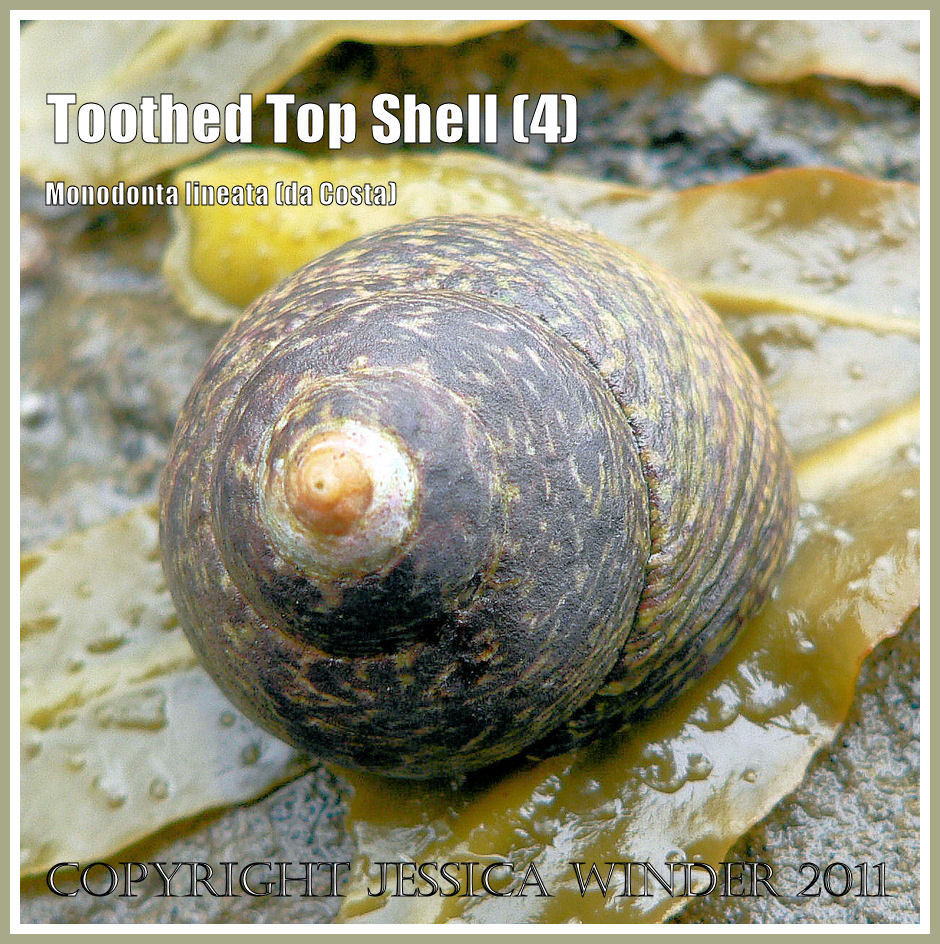
Looking down on the top of the shell in the above picture, you can see that the tip of the shell spire tends to get worn so that the inner, mother-of-pearl layer is exposed.
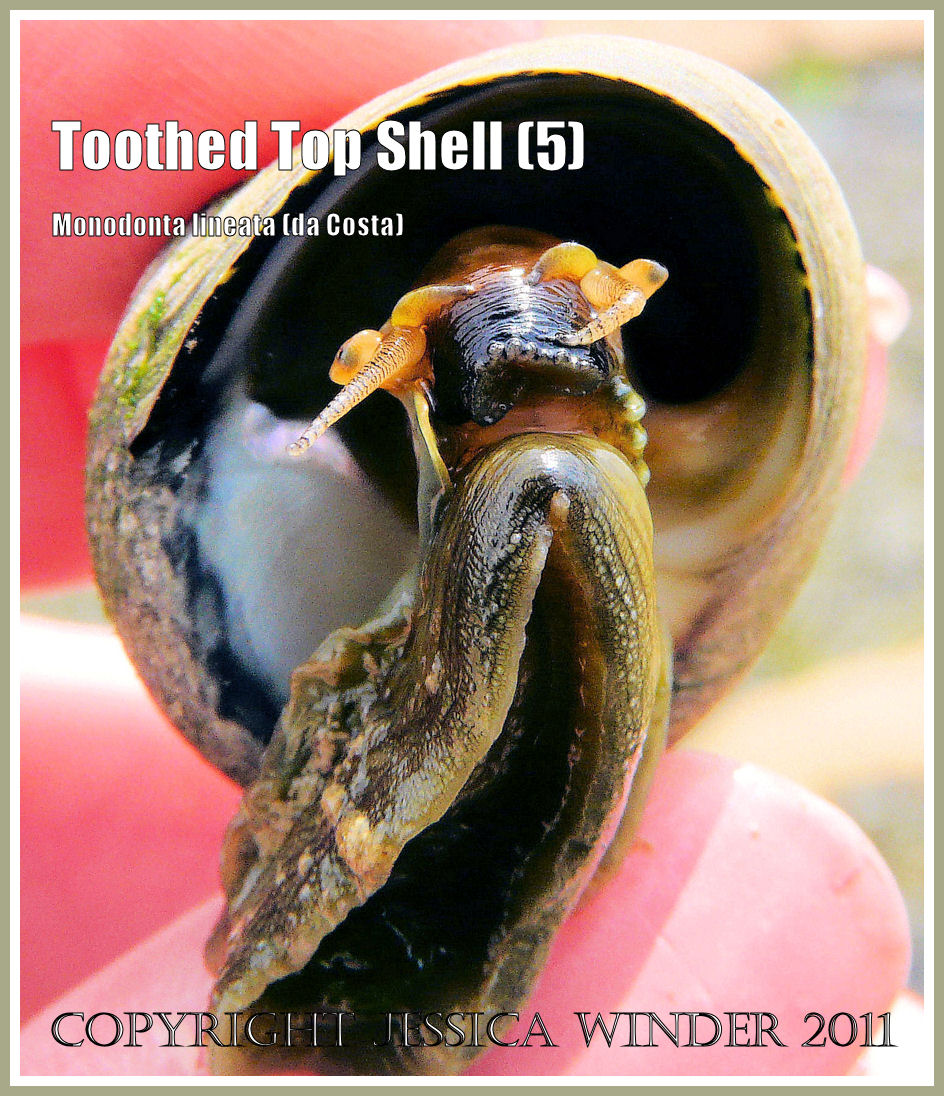
The large dark muscular foot on which the mollusc crawls over the rocks is clear to see in this photograph. Most of the organs such as the digestive system are inside the shell cavity.
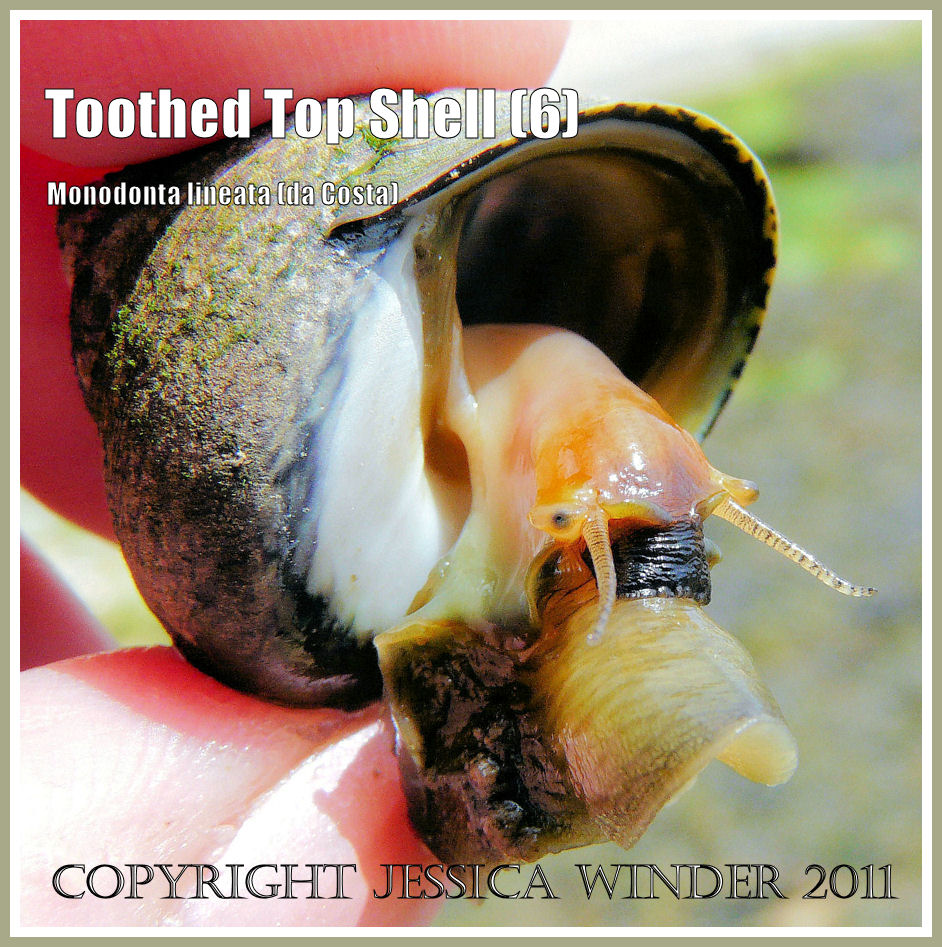
Just another view of this remakable seashore creature. It responded to the strange circumstance of being lifted from the rocks by continually moving and gyrating in an attempt to re-establish itself in a safe place with plenty of food. This behaviour would be a survival instinct for the occasions when it was accidentally dislodged by waves or, perhaps, birds. I replaced this animal in a cool, shaded rock pool after photographing it.
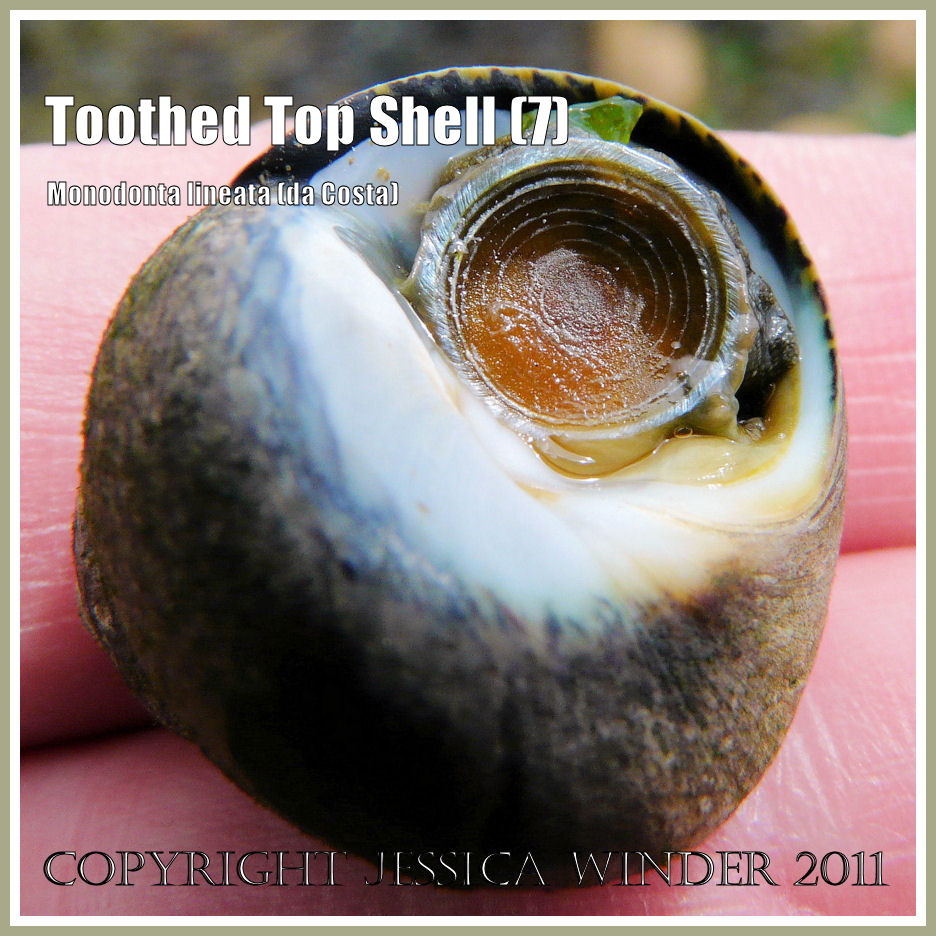
The operculum, a brown horny lid that is attached to the back of the foot, and with which the mollusc closes the aperture when it retracts into the shell, is round in outline and has a continuous circular growth line starting in the centre and extending outwards.
The last couple of features by which to recognise this seashell are not easily seen in the living specimen – so I have photographed an empty shell from the beach, below. The columella is a thick smooth, shiny, white structure at the core of the shell. At its base, on the outside of the shell, next to the mouth or opening, is the shallow cleft or dimple marking the lowermost point of the columella. The shape is characteristic for the Toothed Top Shell. The blunt protruberance or ‘tooth’ from which this species gets its name can be seen on the inner edge of the mouth of the shell.

Revision of a post first published 21 June 2009
COPYRIGHT JESSICA WINDER 2011
All Rights Reserved
 Jessica's Nature Blog
That opening shot is a superb gastropod portrait, and very illuminating on the structure of the animal; nice one.
LikeLike
Thank you, Rob. These gastropods really are lovely little creatures which are generally unappreciated.
LikeLike
What a photogenic little guy! He reminds me of a pet snail I kept for a few years as a teenager. He was the only creature in my aquarium and was absolutely magnificent. Lovely photos Jessica.
LikeLike
Thank you. I also used to love looking at the aquatic ballet of freshwater snails in my tank years ago when I worked as a natural history assistant in a museum. Their slow movements are so endlessly graceful.
LikeLike
The first, fifth and the sixth shots are lovely. Ive not yet seen such extrovert gastropods in my 1 year encounter with molluscs. Thanq for the photos. =)
LikeLike
Thank you. I am glad you liked the photos of this amazing little creature. It sounds like you have been studying molluscs yourself. May I ask what is your own interest in them?
LikeLike