

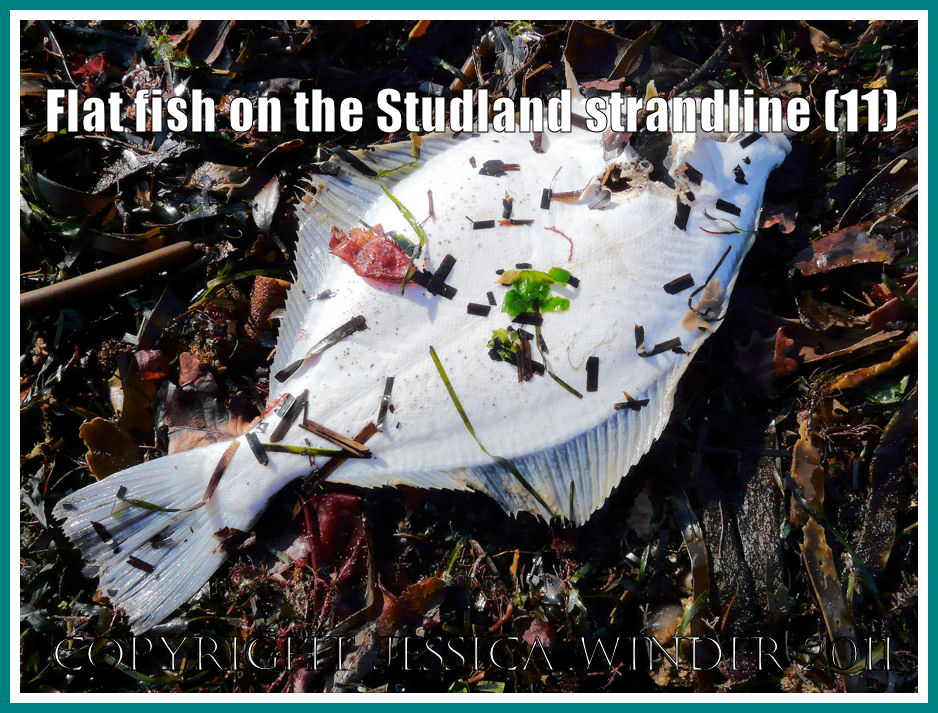
There were lots of sea creatures, seaweeds, and seashells washed up onto the strandline at Studland Bay yesterday. Amongst the multi-coloured heaps of algae I found two flat fish. Flat fish are adapted to swimming close to sandy seabeds where they feed on all sorts of molluscs like cockles and razor shells.
They start off life with the normal fishy shape but, as as they develop, they fall over to one side so that they are permanently parallel to the seabed. Instead of their tail fin waving from side to side as in most fish, the tail fin then waves up and down to propel them through the water.
Remarkably, the eye on the underside then migrates up and over the top of the head until it positions itself along side the upper eye. So both eyes are on the same, upper, side of the head. The upper surface of the body is usually dark while the lower surface of the body is pale or white. In some species of flat fish it is the right side which remains on the underside nearest the sea floor; in other species it is the left side of the body.
The two fish I discovered on the strandline looked very similar to each other. Someone on the beach told me they were plaice but I’m not sure. I’ve looked in several books but cannot decide what they are. I think they might be Flounders but, although they look more or less identical, one fish has the right side on the underside, and the other one lies on the left side.
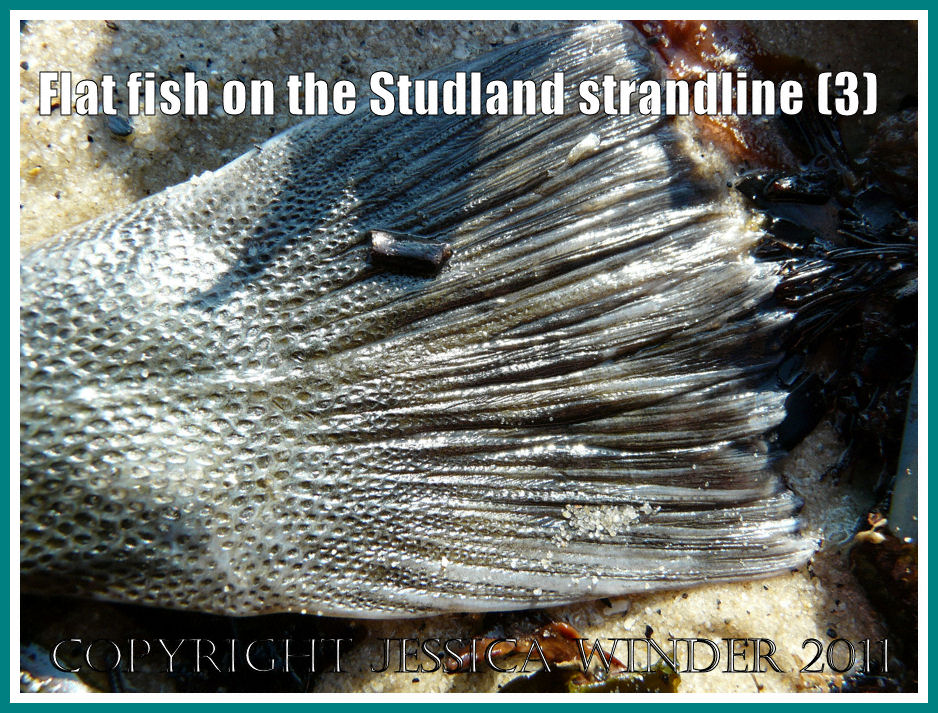
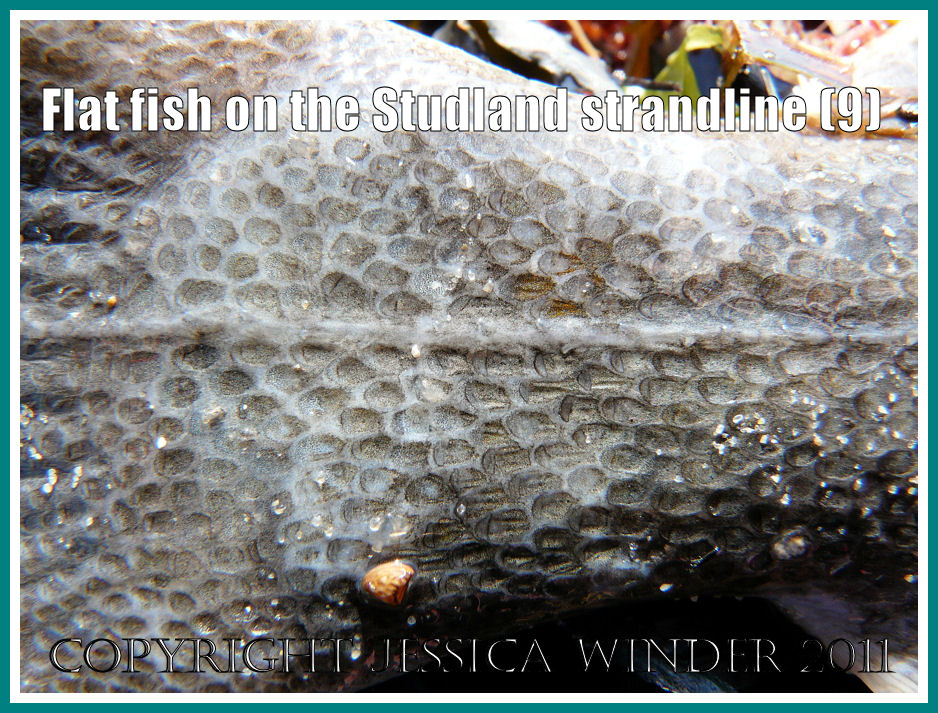
The skin was very smooth and had no markings at all. It doesn’t seem to have scales – the smooth surface looks more as if it is covered with a series of shallow pits – except for some miniscule spines along the lateral line. The lateral line is a special sense organ down the sides (top and bottom) of the body; it is responsible for balance. The shape of the line is specific in different species. In both the fish on the beach, the line was mostly straight but with a very gentle curve above the pectoral fin. The only slight difference in the two fish (apart from the side which is uppermost) is that the basal part of the tail fin (caudal peduncle) is slightly longer in one of them.
I’d be pleased to hear from anyone who could solve this puzzle for me. Do drop me a line if you can identify the fish. Thanks.




Revision of a post first published 7 March 2010
COPYRIGHT JESSICA WINDER 2011
All Rights Reserved
 Jessica's Nature Blog
This was so interesting.I liked it!
LikeLike
Very informative post. I’m glad I happened upon this site.
LikeLike
Thank you, Angelique, for leaving a comment. I’m pleased you found it interesting.
LikeLike
Thank you, Mariana, for your message. Perhaps you will visit again soon.
LikeLike
Jessica, it’s a week of synchronicity! We’re both into fish fins, LOL. This is a great post, as usual. I had some more really wild fish photos (one fish was caught with half its stomach coming up out his mouth. YIKES! I could email you that one if you like, but it seemed a little risky for a general interest blog…)
LikeLike
Hi, Kathy. I’m looking forward to seeing more of your fish pictures on Lake Superior Spirit tomorrow – but maybe not the one of the fish disembowelling!
LikeLike
One could be a Dab! See http://www.gofishing.co.uk/Sea-Angler/Section/how-to/Sea-Fishing-Advice/Fishing-Tips/Advanced-species-tactics/Identifying-flatfish/
LikeLike
Thanks, Ian. I’ll have a look at the web link you recommend and see if it helps.
LikeLike
What a fascinating Post. I’ll be back.
Sybil
Eastern Passage, Nova Scotia
LikeLike
Thank you for your comment, Sybil.
LikeLike