
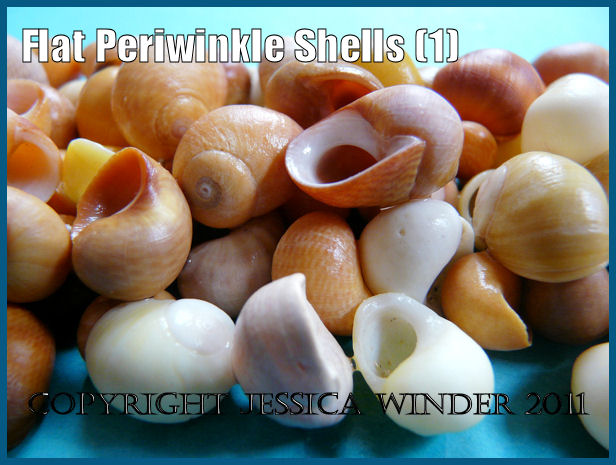
These small, colourful shells belong to the Flat Periwinkle, Littorina obtusata (Linnaeus). They are about 10 mm in diameter. The colour of the animal’s body tends to be the same as the shell, which can be white, yellow, orange, brown and sometimes even green, black, or chequered. The lighter colours are supposed to occur on sheltered shores; the darker and patterned shells on more exposed ones. Smooth to the naked eye, the shell surface is actually covered by a microscopic network of fine grooves and lines.
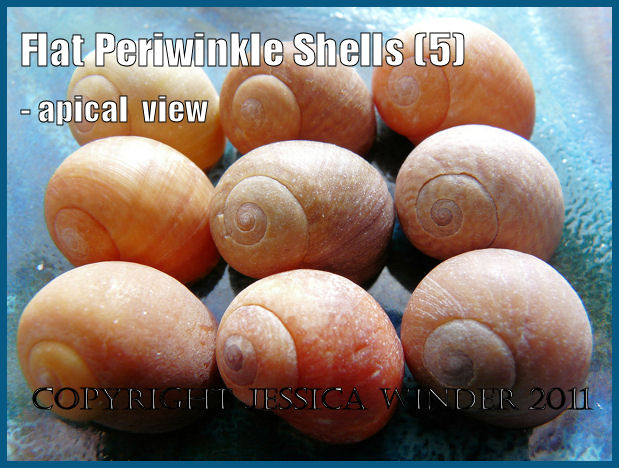
The Flat Periwinkle is easy to recognise because of the flattened spire; the shell looks as if the apex and spire have been squashed into the body whorl. The mouth is slightly to the side of the main whorl and the edge of its aperture starts thin at the top but rapidly becomes much thicker towards the bottom. The mouth is slightly smaller than the body whorl. The overall shell shape, when viewed from the aperture side, is broadly oval.
There is a similar-flat spired species (Littorina mariae Sacchi and Rastelli) which can be mistaken for L. obtusata, and I cannot rule out that one of these may have slipped into the assortments shown in these photographs. L. mariae differs in having an even flatter spire, a mouth aperture which is larger than the body whorl, and a drop-shape rather than oval in aperture view.
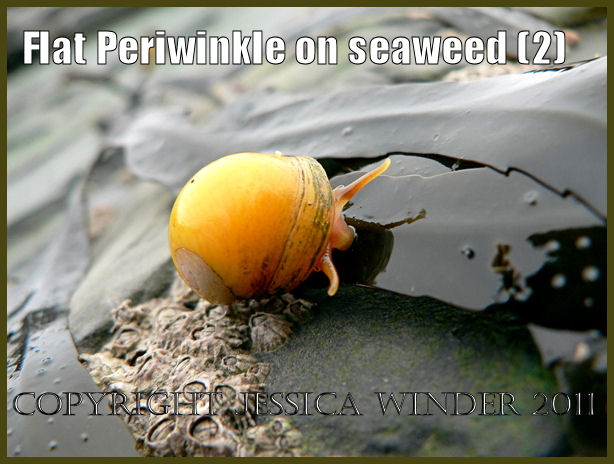
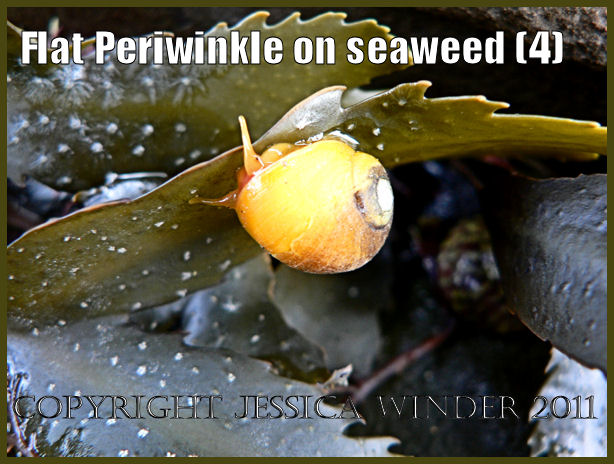
Flat Periwinkles are herbivores that eat algal films and brown seaweeds, particularly Fucus vesiculosus (Bladder Wrack), Ascophyllum nodosum (Egg Wrack), and Fucus serratus (Toothed Wrack). The globular shape of Flat Periwinkles is thought to resemble the air bladders on the Egg and Bladder Wracks. These creatures are voracious eaters. Work on an American winkle species, for example, demonstrated that the gut contents can be completely replaced up to eight times daily. Where the algal film on rock has been grazed, the gut contents also include fine mineral fragments – indicating that over a period of sixteen years of scraping and eating in the same area, a winkle could theoretically wear away as much as a centimetre deep of the stone as well.
Flat Periwinkles live on the shore between Mean High Water Neap and Mean Low Water Spring tide levels. They may be as significant as Limpets and Common Winkles in terms of the effect of their grazing habits on the environment. Together with many other less common herbivorous species, Flat Periwinkles play a major role in structuring the intertidal seaweed communities. It has been shown by carrying out field experiments in which small areas of shore at different tidal levels have been fenced off to exclude all grazing animals, that grazing activities serve to maintain species diversity. Dominant grazers like Flat Periwinkles prefer certain plant sizes but are essentially non-selective and do not depend on one or a few species of seaweed for their survival.


COPYRIGHT JESSICA WINDER 2011
All rights reserved
 Jessica's Nature Blog
Jessica, these photos are simply amazing. What wonderful little creatures they are.
LikeLike
Thank you, Amy Lynn. They are lovely little animals and the shells are really pretty.
LikeLike
Jessica, what a really beautiful collection of photos!
LikeLike
Thank you, Matt.
LikeLike
Thank you jessica! this really helped me on my project 🙂
LikeLike
Thank you, Annabelle. It’s nice to hear from someone who has found the information useful. Good luck with your project.
LikeLike