
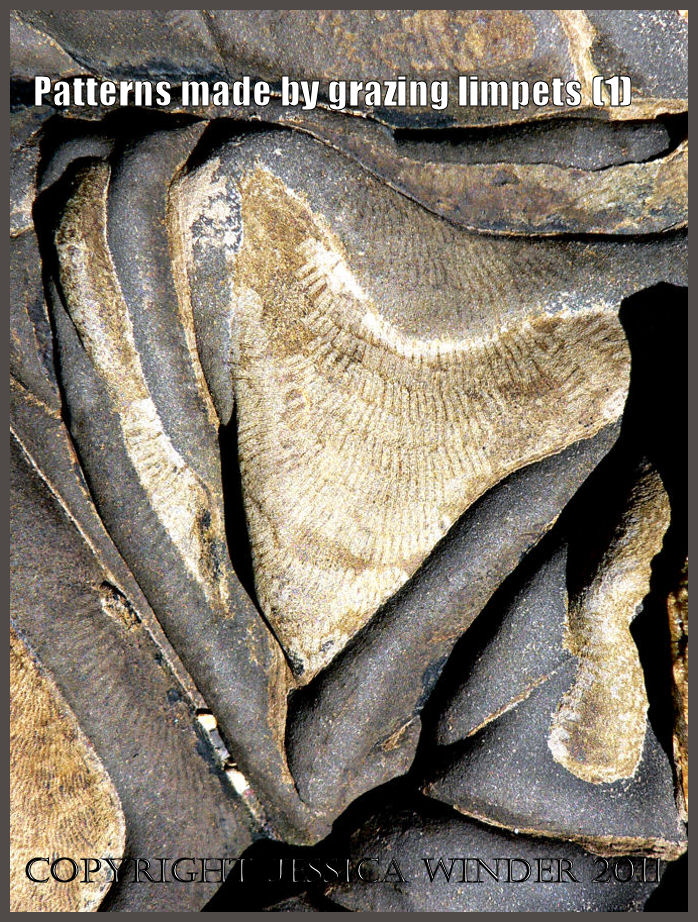
The humble limpet is often found attached and motionless on seashore rocks at low tide. However, when the tide comes in, the limpet relaxes its grip on the rock, raises the conical shell, and glides forth on its muscular foot to search of food. It has been known for limpets to take bites out of seaweed but most of the time they simply graze on the barely perceptible algal film that coats the rocks.
If you’ve ever seen the underside of a living limpet, you will have noticed that it has a distinct head part with a mouth. Normally hidden from view inside the mouth is a long ribbon-like or tongue-like structure called the radula. Many rows of sharp ‘teeth’ are arranged along the length of the radula and the limpet uses these to scrape the microscopic algae from the surfaces around it. The limpet works in a very methodical and efficient way while it is grazing – moving slowly forward and scraping strips systematically from side to side. This process leads to the formation of patterns on the rocks that you can see at low tide. Some of these patterns are illustrated in here.
During the period that it is venturing forth underwater, the limpet completes a roughly circular route so that it ends up exactly where it started. This habit, of returning to the same home base after each trip, frequently results in the wearing away or dissolving of the stone at that point into a neat shallow circular depression.


COPYRIGHT JESSICA WINDER 2011
All rights reserved
 Jessica's Nature Blog
wow, great photos of home scars! Do you study limpets? I’m a grad student studying deep-sea limpets, your description of grazing is wonderful!
LikeLike
Hello, Jenna. I’m pleased that you like the limpet pictures and descriptions. No, I do not study limpets but I am interested in all things to do with the seashore – and I have in the past undertaken in-depth research on shells of edible molluscs such as the European Flat Oyster as found in archaeological contexts. Your own studies sound really exciting. I had no idea there were deep sea species of limpet. I’ll follow your blog with interest to see how your research goes.
LikeLike