I am making an inventory of everything that lives in our local village Nature Area. The tops of cow parsley flowers are an excellent place for spotting pollinating insects because these are attracted to the plentiful nectar, pollen and sap. They are also great places for insects to meet mates. And such abundant food sources and popular breeding grounds provide good hunting territory for the creatures that eat insects.
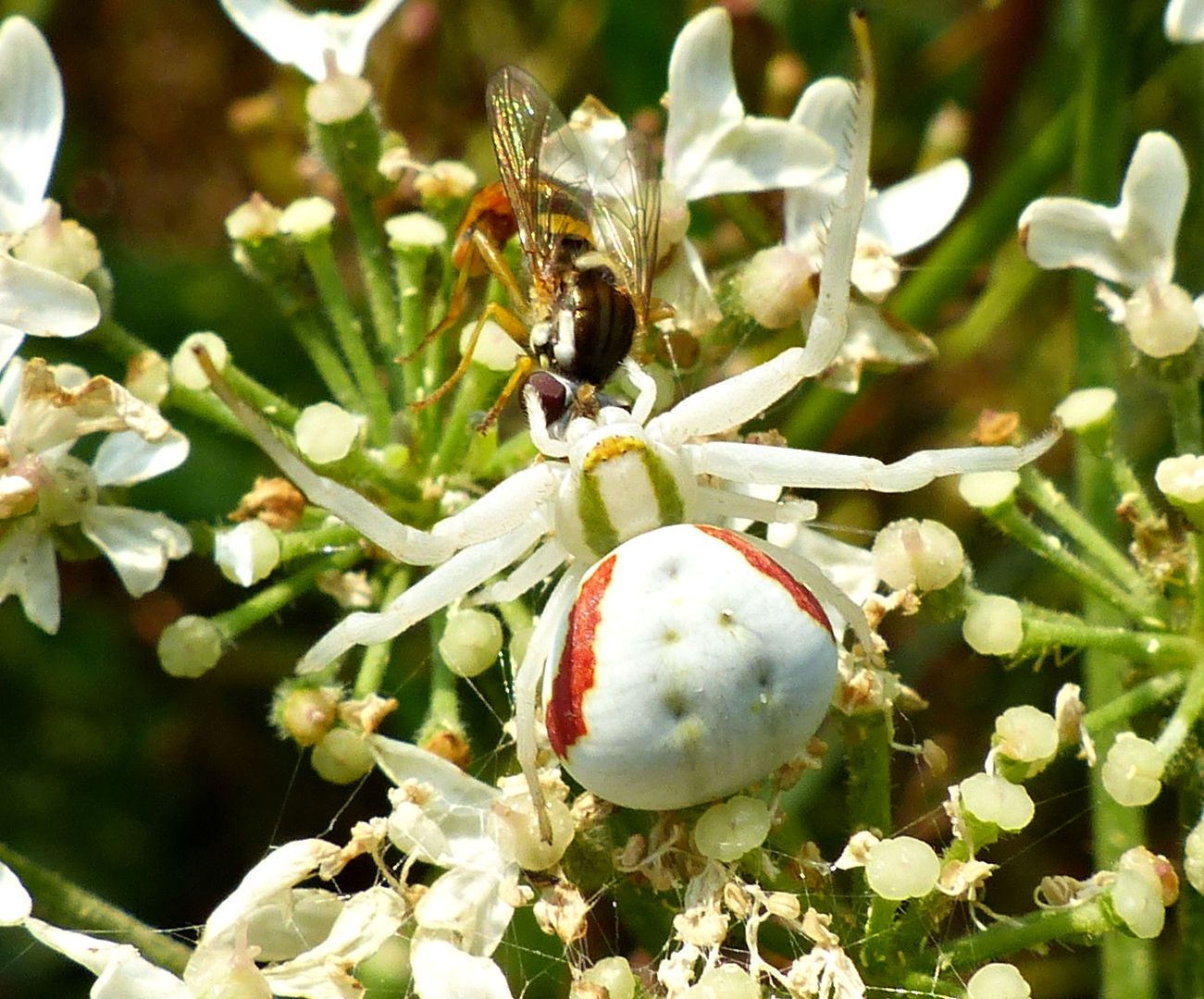
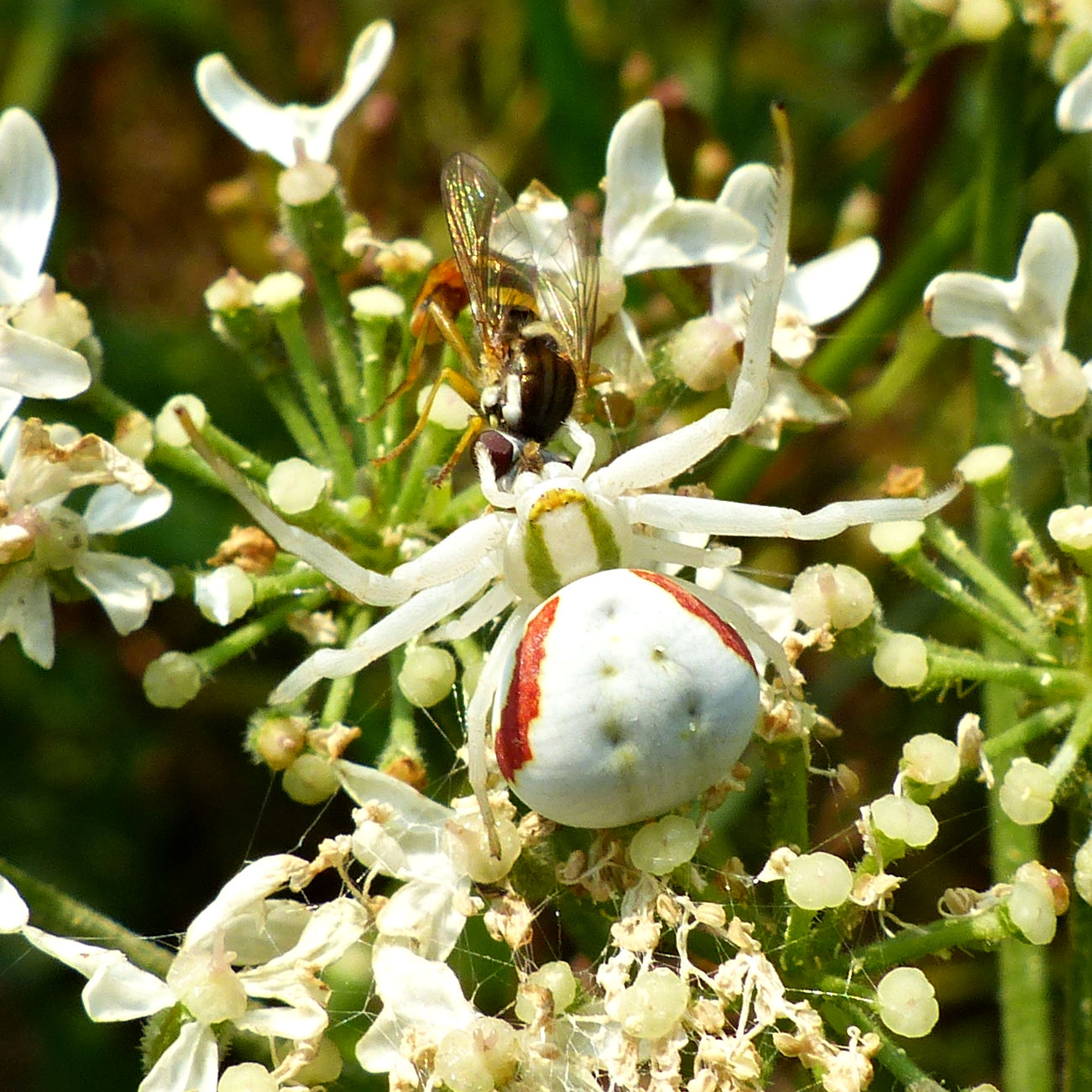
One such hunter is the Crab Spider (Misumena vatia). It is rather special because it can walk forwards, backwards, and sideways. The female, like the individual shown here, remains in the one flowerhead, camouflaged against the petals. She can change her colour slightly to blend in with the background, or even assume the colour of the prey she has eaten. This specimen is mostly white with two green stripes on the thorax, and two red ones on the swollen abdomen which also has five dimples. She likes to pounce on visiting insects and the larger the better. Here she seems to be eating a hoverfly.
The male Crab Spiders are much smaller, plain brown, and travel between flowerheads looking for females to mate with.
 Jessica's Nature Blog
Hi Jessica, good luck and recording with you new venture. My wife has been recording all the nature in our garden for about 10 years. We are lucky to live in Leicestershire and can record everything on Naturespot.org.uk It is surprising how much more you notice on your own patch due to access and familiarity. Have fun, kindest regards Tony
LikeLiked by 1 person
Impression…neuer seen before
LikeLiked by 1 person
My German autocorrect does not want to speak English. Sorry it should be: impressive, I have never seen before
LikeLiked by 1 person
What a great idea re the nature and wildlife in your community. Consider using
irecord too so that the records are available nationwide and to those who submit records for the benefit of our eco situation as a whole. I look forward to seeing more. Look out for the Cucumber spider too 😉
LikeLiked by 1 person
What an interesting find! Great picture too.
LikeLiked by 1 person
Thank you, Susurrus.
LikeLike
Thank you for the information, Gail. I’m starting this project from scratch and have only found one person in the village who is willing to lend a hand so far.
LikeLiked by 1 person
Thank you for the information and encouragement, Tony. I am definitely having fun but wish I could recruit the help of a few more people interested in nature and conservation.
LikeLike
Thank you, Ola. It is a magnificent spider and I am going to look for more on other coloured flowers.
LikeLiked by 1 person
This inventory is a good subject for another of your photo books like the lovely one you did of Rhossili. And then a seaweed book and and Autumn one………………….
LikeLiked by 1 person
What an amazing things to do!
LikeLiked by 1 person
Thank you, ArtyMissK.
LikeLiked by 1 person
A good idea but first I have to complete the inventory. A big task I think.
LikeLike
I applaud you in this endeavor. Wish I were there and could lend a hand. What an amazing creature that spider is.
LikeLiked by 1 person
Thank you, Claudia. I will do the best I can but could really do with some help.
LikeLiked by 1 person
Such a fascinating creature. Glad to see you’re back, Jessica. You were missed. Good luck with your inventory. That’s a very ambitious undertaking. 📚
LikeLike
Thank you, Markus. It is an ambitious task to compile the list but I hope that I will eventually be able to get some help. Someone has already suggested helping out by running an insect light trap in a couple of months time. That should stimulate some local interest.
LikeLiked by 1 person
I have never come across crab spiders – they look quite amazing. How big are they?
LikeLiked by 2 people
The size can vary from 2 – 22mm with the females being bigger, up to 10 times the size of the male spider.
LikeLiked by 2 people
Amazing fact. Hmm, I’m just imagining a world where women were 10 times the size of men. 😅
LikeLiked by 1 person
I would rather not conjure up that image, thank you, or think about the effects.
LikeLiked by 1 person