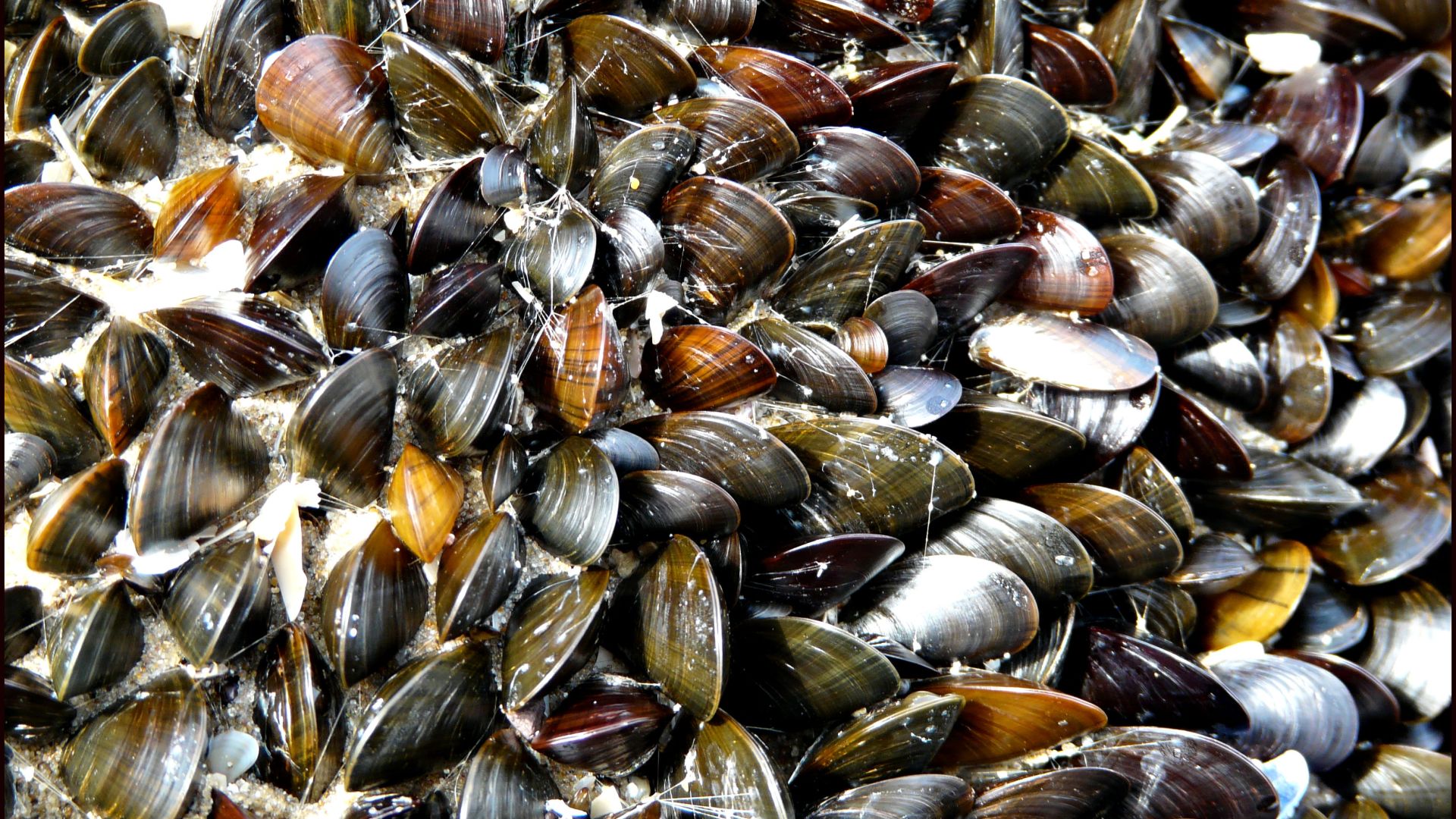
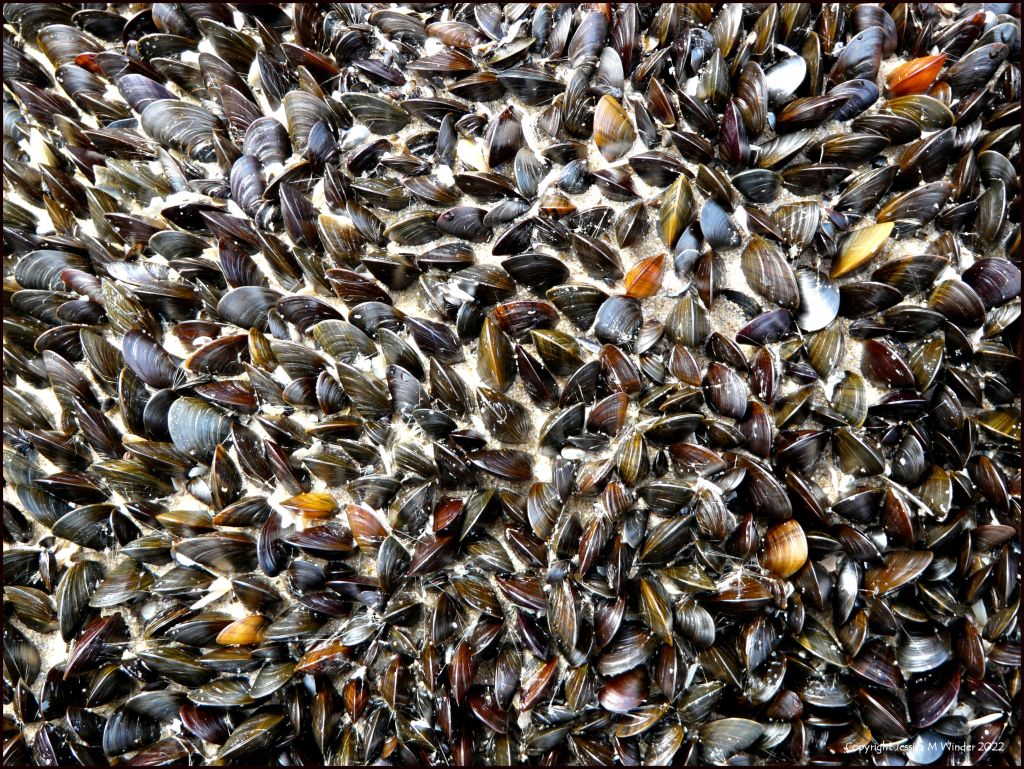

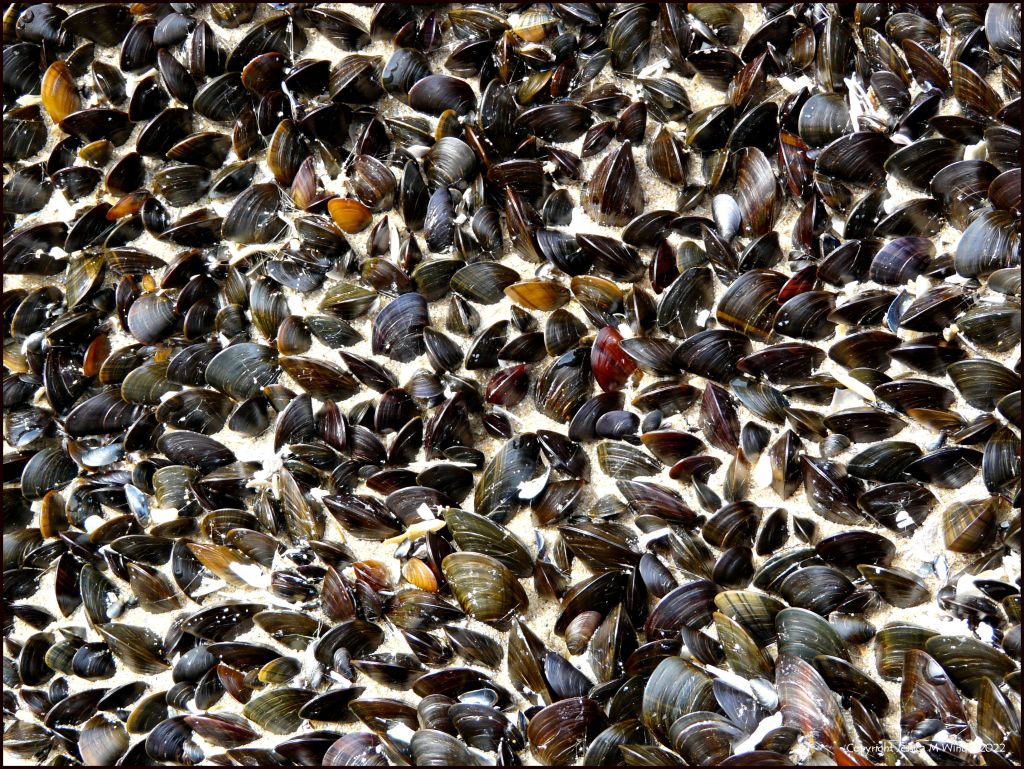
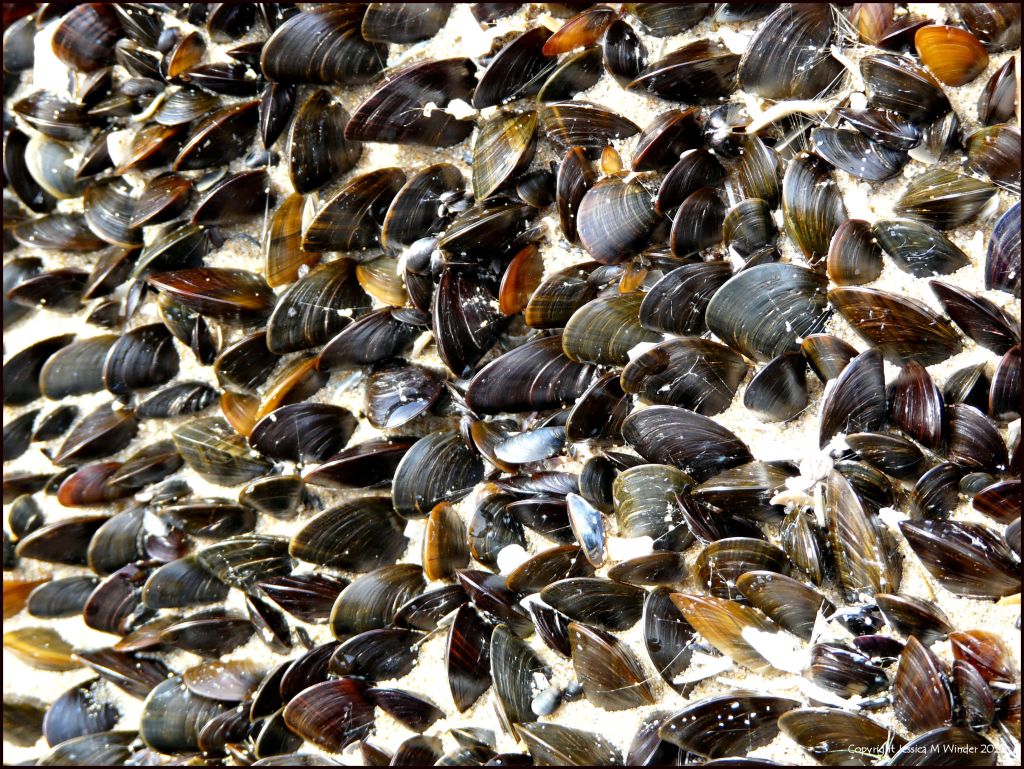
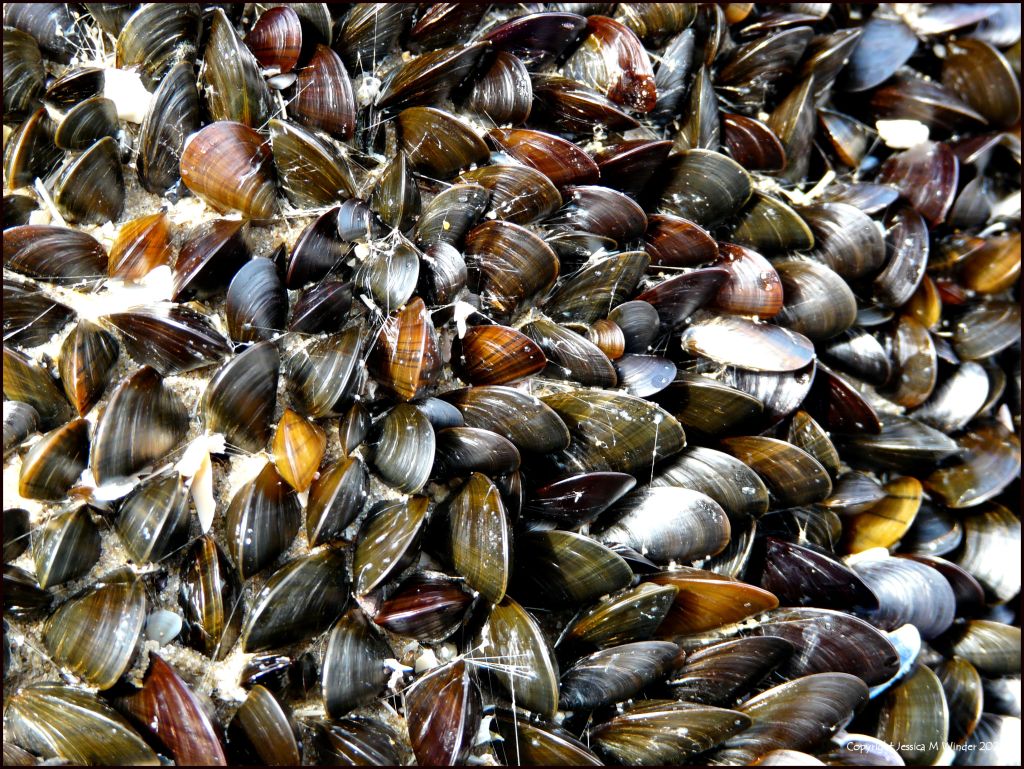
Seashell Textures Mussel 1-5 Mussels (Mytilis edulis) growing en masse on rocks at low tide level on the beach showing byssus threads used for attachment, and sand between the shells.
https://natureinfocus.blog
Seashell Textures Mussel 1-5 Mussels (Mytilis edulis) growing en masse on rocks at low tide level on the beach showing byssus threads used for attachment, and sand between the shells.


These are awesome images.
LikeLiked by 1 person
Thank you, Richard.
LikeLike
The distribution of colour is interesting. Grey, blue grey with less rust colour. Lovely.
LikeLiked by 1 person
I think there is a tendency for mussel shell colour to change as the shell matures. The young ones have translucent shells with paler colours and orange streaks and only a little bit of blue – but progressively the blue dominates and the dark brown periostracum becomes thicker and overlies the whole shell.
LikeLike
Thank you for sharing such useful information. I appreciate the time you give me.
LikeLiked by 1 person
Hi Jessica
GREAT 👍 This is quite similar to the shell art we blogged about yesterday.
We found it very interesting what you write about the change of colour. We suppose that has to do with the reflection/.absorption of light that changes with every new layer of the shell.
Keep well and thanks for sharing
The Fab Four of Cley
🙂 🙂 🙂 🙂
LikeLiked by 1 person
Thank you, Klausbernd. I noticed the similarity too.
LikeLiked by 1 person
Hi. Since The Humber sea slug mystery in March when I came across your blog, we’ve come across some mussels we think might be horse mussels. They were right out at the very extreme low water line on a big spring tide. They have brown shells, so I’ve looked you mussel photos and see brown is amongst them. Does that leave the shell shape as one of the determining factors?https://stevedixeyimages.wordpress.com/portfolio/#jp-carousel-373
LikeLiked by 1 person
Hi Steve. The brown of the shell is likely to be the outer horny layer called the periostracum which varies a lot in colour and texture. Details of shape are more important for identification.
Here is the definition of a Horse Mussel – Modiolus modiolus (Linnaeus). “Irregularly oval or rhomboidal; umbones anterior but subterminal, with anterior margin projecting beyond. Dorsal margin convex, ventral margin concave. Umbonal ridges well developed. Maximum length exceeds 200mm, commonly around 100mm long. Bluish white to slate blue, darkening in larger specimens. Periostracum very glossy, light horn to mahogany or dark brown in old shells, usually with lighter yellow brown strip along the umbonal ridges. Young shells with numerous long, smooth periostracal spines.” This definition is found in “Handbook of the Marine fauna of North-West Europe” 2nd Edition edited by Peter J. Hayward and John S. Ryland, Oxford University Press, 2017. The book also contains line drawings of all the mussel species for comparison purposes.
Hope this helps.
LikeLike