

The fossils in some of the Carboniferous limestone rocks in the drystone walls are mostly fragments of crinoids and sometimes corals. You can see the details in the picture below showing individual circular segments of crinoid stems in cross section and one longitudinal series.
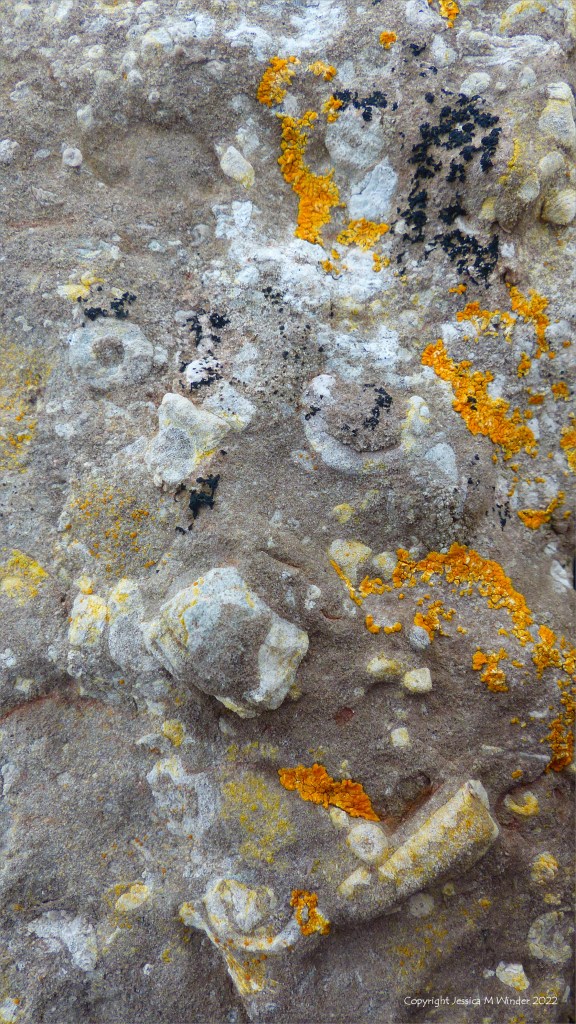
This series of photographs was taken beside the path from Rhossili village towards the Worms Head Causeway.
 Jessica's Nature Blog
Always amazing to see the relicts of the past so near and touchable.
LikeLiked by 1 person
Thank you, Puzzleblume. Thinking about the fossils can transport you back in time to millions of years ago and what the environment originally looked like.
LikeLiked by 1 person
I grew up in Tennessee which was covered by ocean in the distant past, resulting in the formation of limestone layers of great depth full of fossils, covered by a layer of soil in my era. (Very few houses had basements, for instance, because it was necessary to blast out a deep enough hole, the soil layers were too shallow). It was common for us to find fossils in any disturbed ground. And when any excavation was done such as for highways fossils came to light and it was also possible to see them embedded in any exposed rock. Your post reminded me of how we used to collect them.
LikeLiked by 1 person
Thank you, Claudia. Yes, it is surprising how often it is possible to spot fossils in accessible places. I always like to find them incorporated into buildings and pavements too.
LikeLiked by 1 person
Beautiful photos of stone walls. I particularly love the close up showing fascinating detail.
LikeLiked by 1 person
Thank you, Yvonne.
LikeLike