
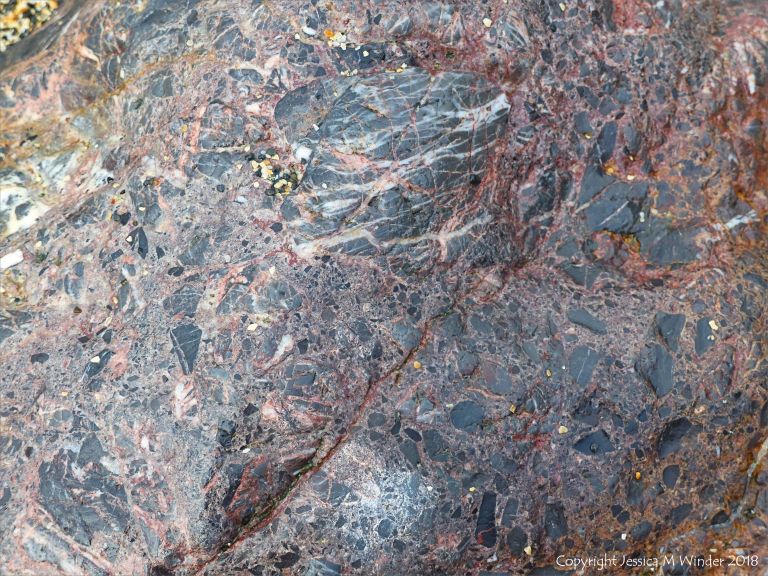
Polurrian Rocks 54 – Close-up detail of outcrop (or boulder) of brecciated rock on beach at Polurrian Cove in Cornwall in the Lizard Fault Boundary zone.
https://natureinfocus.blog
Polurrian Rocks 54 – Close-up detail of outcrop (or boulder) of brecciated rock on beach at Polurrian Cove in Cornwall in the Lizard Fault Boundary zone.
 Jessica's Nature Blog
It look like black diabase. Here in Sweden we have the worlds biggest query of black diabase. It´s called black mountain in English, Svarta bergen in Swedish. I have been there couple of times.
LikeLike
I looked up black diabase. It seems that it is a type of dark dolerite, an igneous rock that starts as a molten rock below the earth’s crust and squeezes and oozes its way into cracks in older rocks. I agree that photographs of it look similar to my rock at Polurrian. They look alike but whereas the pattern in diabase is because of individual mineral crystals (small scale structures), the pattern in this particular rock at Polurrian Cove is due to broken pieces of rock of a much larger scale. The broken pieces come from the tearing of rocks along the adjacent fault line, and they have become naturally cemented together to form this brecciated rock.
LikeLiked by 1 person
I´m a spanish geologist, I´d bet for Silurian black metacherts… White quartz veins are also very common in those rocks.
LikeLiked by 1 person
Thank you for the information. I am always interested to learn from experts – I am just an amateur who loves rocks.
LikeLike