
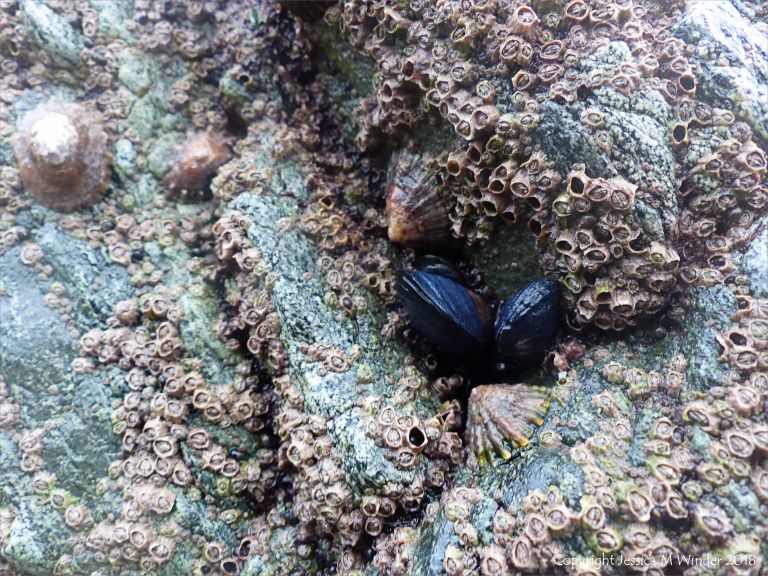
Polurrian Rocks 26 – Close-up photograph of green metamorphic hornblende schist belonging to the Traboe Formation (part of the Lizard Complex) from south of the Lizard Boundary Fault at Polurrian Cove in Cornwall, with acorn barnacles, limpets and mussels attached.
 Jessica's Nature Blog
This is something. Is this rock covered by water a lot of the time? I’m very ignorant about seaside life, just wondering at such a population!
LikeLike
What a feast you’re having with these Polurrian rocks!
LikeLike
Indeed.
LikeLike
The rock in the photo is covered by water when the tide is in. Its called the intertidal zone and its size varies according to the height which the sea reaches. Different organisms like the limpets are tolerant of exposure to the air to varying degrees, and this leads to a vertical distribution pattern of various species of animal and plant types within the zone, known as rocky shore zonation.,
LikeLike
That is fascinating. I see what you mean, each one choosing its level and creating a stacked arrangement depending on comfort and needs each one has. For some reason this is making me think of an apartment building – each level with a different experience, yet united by location as well.
LikeLiked by 1 person
Very beautiful!😊 I am impressed by your ability to get the details every time I see your photos, something I find hard.
LikeLiked by 1 person
Thank you, John. I often have an idea of what I am looking for before I start taking the picture, what features are relevant for understanding the rock, or the significance of an organism in the environment, or simply which composition looks good to my eye.
LikeLiked by 1 person
There are several earlier posts featuring rocky shore zonation on Jessica’s Nature Blog. When it occurs on steeply inclined or vertical surfaces, the zones of organisms show as horizontal bands or stripes of different colours.
LikeLiked by 1 person