
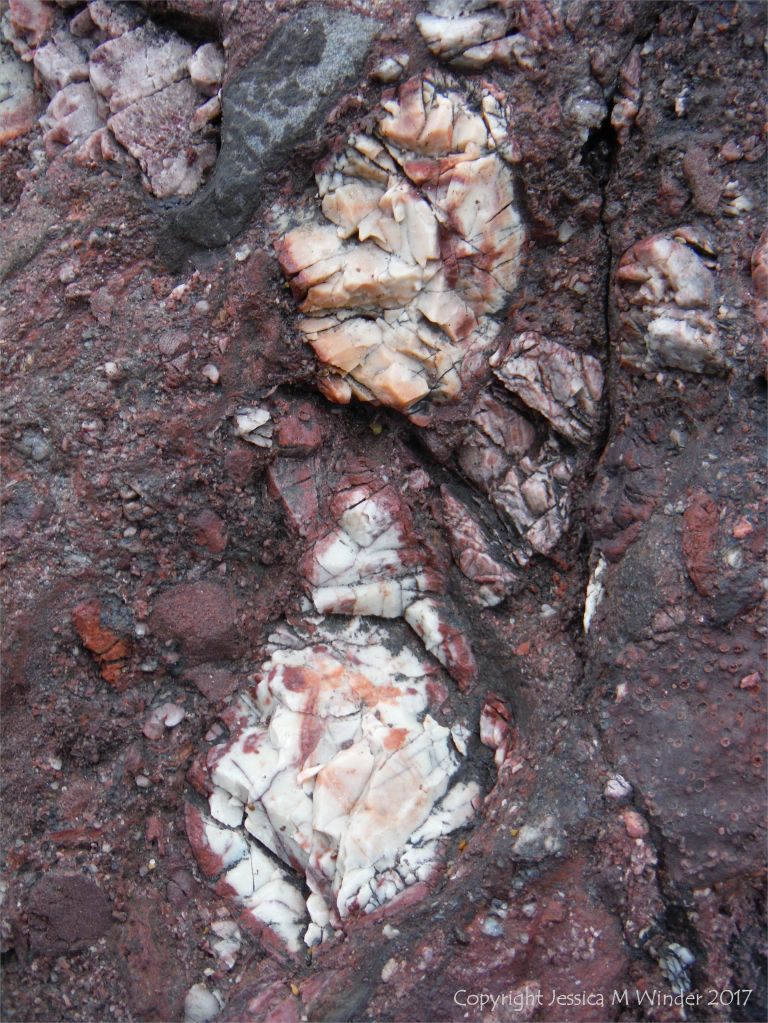
The sand looks black from a distance as you descend to the shore at Trá Chathail near An Trá Bheag (Short Strand) – otherwise known as Trabeg. The path cuts down deep through the stratified red rocks to get to the beach which is strewn with pebbles, mostly shades of red, maroon, green, grey, and white.
Trabeg is on the south coast of the Dingle Peninsula in Ireland, and is the “type section” of the Trabeg Conglomerate Formation which is exposed in the cliffs on the beach. This is place where that particular rock type was first described. The rock layers constitute part of the Dingle Group and were formed in the Devonian period between 345 and 395 million years ago. The conglomerates are composed of fairly well rounded pebbles of red sandstones and mudstones, with white vein quartz and chert. A few pebbles of volcanic rock and of grey limestone are also present.
The way in which the conglomerate rock has formed from the mass movement and subsequent accumulation of debris from terrestrial locations during, for example, river flood events, means that the pebbles are derived from a wide area covering many different geological types. The pebble beds or conglomerates are inter-bedded with layers of red sandstones and mudstones, the finer sediments of which were deposited normally by rivers during non-storm/flood times. The alternating layers are now tilted from the original horizontal orientation in which they were first deposited, and are clear to see dipping south at about 70 degrees.
As the cliffs at Trá Chathail are worn away by the action of waves and weathering, the pebbles contained in the conglomerate matrix are freed up and remain the shore below – an instant pebble beach. Added to these are pieces of other rock or matrix that became rounded into pebbles after they arrived on the beach. Some pebbles and rocks may have been transported by wave action from further along the coast were the geology is quite different: from the Eask Formation, West Cork Sandstone, Bulls Head Formation, and the earlier Silurian rocks of the Dunquin Group.
REFERENCE
Horne, Ralph R. (1976) Geological Guide to the Dingle Peninsula, Geological Survey of Ireland Guide Series No. 1, reprinted 1999.


 Jessica's Nature Blog
These are lovely. I do like the spotted one when I assume it started to rain and there was a pink one with elongated stones caught up in the general rock mixture. The whole effect was of a downward movement. Another place to add to my list of beaches to go and find.Best wishesAngela Gladwell
LikeLike
I love all the different colours and textures you can find at the coast – great images!
LikeLike
These are beautiful images as always on your blog Jessica. I always learn so much, Thank you.
LikeLike
it has been a pleasure to discover your blog and your photographs of pebbles, rocks and scenery. I have collected beach pebbles since i were a teen and recently (40 years after) had the chance and time to polish them with my dremel tool. Its beautiful to discover their inner soul. You are a great photographer!
Cecilia Estrada
Guayaquil, Ecuador
LikeLike
One for my list of places to visit Jessica. The colours in the pebbles are fantastic, especially when wet as you’ve captured here.
LikeLike
Thank you, Angela. I am pleased that you like the pictures. The unidirectional alignment of the rounded pebbles in the strata is because they were deposited by the flowing water of a flooded river on the outer (distal) reaches of an alluvial fan.
LikeLike
Thank you, Evelyn. I am endlessly fascinated by the way rocks look and how they were created.
LikeLike
Thank you, Julie. I am always pleased to share my own learning process.
LikeLiked by 1 person
Thank you so much, Cecilia. It is amazing that pebbles can give so much enjoyment to so many people worldwide. Your pebbles must look beautiful when they are polished. Collecting can get obsessive – I have had to stop collecting anything but photographs of them.
LikeLike
There’s an abandoned “paint mine” in Port Eynon. Early railway carriages were cotead with a paint made from the mineral. Some of these rocks remind me of that mine.
LikeLike
It is a great place. Not far from the town of Dingle itself. I would like to go back some day.
LikeLike
Hello Jessica. My name is Patriq and I am from Trans Canada Trail. I am looking to reach you because I would like to use one of your photo for our social Media. We have what we call #WednesdayWisdom and sharing quotes on the Trail (or inspired by). Can you write me at pchenier@tctrail.ca so I can be able to sent you the photo we would like to use.
LikeLike
Hello, Patrick. Thank you for getting in touch. You can contact me directly by e-mail at winderjssc@aol.com to send the photograph that you would like to use on your Trans Canada Trail website.
LikeLike
The haematite creates a paint with a kind of maroon colour characteristic of the former train livery for I think thecGreat Western Railway – but I can’t find the reference for it to check.
LikeLike
your new post” Protected: Hemarina Lugworm Casts” will not allow viewing coming up as pasword protected ?
LikeLike
Everything is OK, Andrew. These pictures are for private viewing. I was not sure the company had a DropBox account for transfer of the images and it seemed quickest to post them on the blog for private access. Sorry for the inconvenience.
LikeLiked by 1 person
so there is no way to look at them? So sad. I am an Obsesive Compulsive Rockologist. Cecilia
LikeLike
Hello, Cecilia. Are you having difficulty viewing the images in the post about the rocks at Trebag? It is set to public view. There should be no problem. (It is only today’s post about lugworm casts that is private view). I would not deny a fellow rockologist a look at all my rock pictures. New post arriving soon on the rocks at Dunquin Harbour.
LikeLike