
Clarke Head near Parrsboro in Nova Scotia, Canada, is famous for its melange of fault zone rocks. It lies on the Cobequid Fault Line that runs approximately parallel to the north shore of the Minas Basin, part of the Bay of Fundy. Clarke Head is the most southerly exposure of the fault and the area is characterised by smaller fault strands coming off the main fault, dividing different ages of rocks into adjacent blocks and giving rise to much breccia. Breccia is the deposit that is often generated at fault zones and is comprised mostly of angular broken rock fragments. Some of the breccia has massive stones measuring up to 1.5 meters in diameter and is known as megabreccia. Three main rock types are represented at Clarke Head. These are the Blomidon Formation of Triassic red sandstone and siltstone; the North Mountain Formation basalts of Jurassic age; and light gray Windsor Group limestone of Carboniferous age. However, extensive areas are so affected by faulting action that the constituent rocks are all jumbled up.
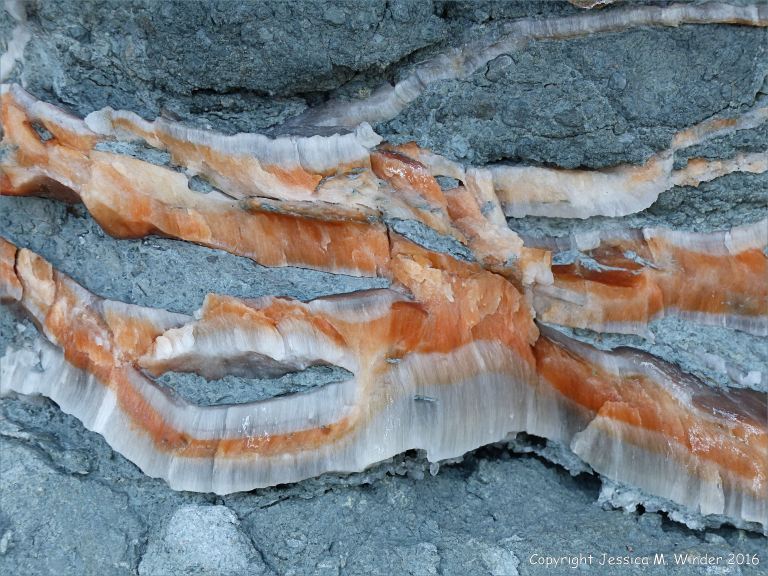
The fibrous satin spar gypsum in the images shown here permeated the brecciated areas where it crystallised in deep cracks extending through the deposits in twisted sheet-like form.


I love that “icy ridge” in image 14
LikeLike
What delicious looking rock! 😀
LikeLike
It is an amazing fibrous crystalline structure and looks especially ice-like when held up against the light.
LikeLiked by 1 person
You mean like fruit sorbet or ripple ice-cream made with peach or orange? My mouth is watering.
LikeLiked by 1 person
You got just the right angle 👍
LikeLiked by 1 person
Haha, both! 😀
LikeLiked by 1 person
Very similar to the wonderful colourred gypsum bands of late Triassic age at Blue Anchor Bay, Somerset..
LikeLike
Thank you, Kevin. I must try to get over to Blue Anchor Bay some time to see them for myself.
LikeLike
Wow, how very striking
LikeLike
Thank you, Frogenddweller
LikeLike
Weirdly octopedal (octopoid?) or squid-like. Sorry, not getting sorbet. RH
LikeLiked by 1 person
Thanks for reposting, it is always nice to see your geological pictures and as a geologist who specialises in gypsum it is great to see places I will never visit. Kindest regards, Dr Anthony Cooper
LikeLiked by 1 person
Thank you for commenting. I wish I could still travel to these fabulous places with their incredible geology but my photographs bring me happy memories. I have to stick closer to home these days.
LikeLike