
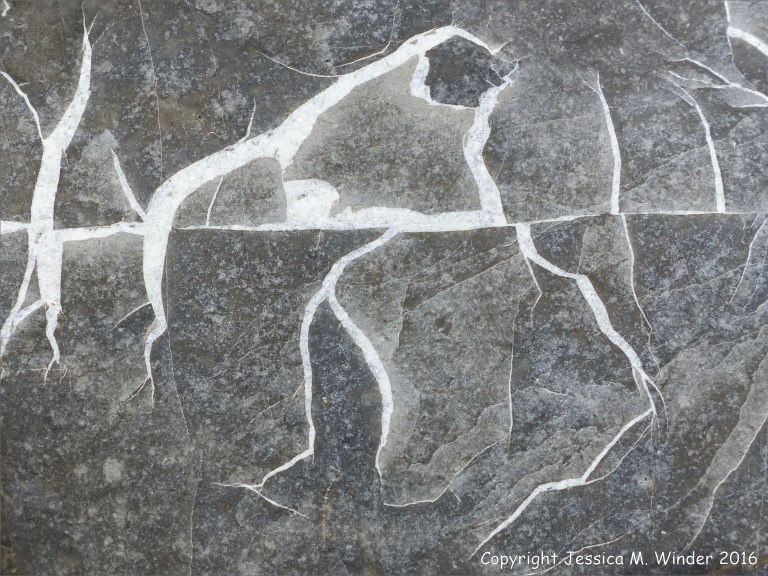
Just east of the outlet of the River Char on Charmouth beach, in the area close to Raffey’s Ledge, the upper shore is strewn with many large irregular stones. Amongst these, the most noticeable are those with white patterns and lines, which on closer inspection turn out to be crystalline calcite-filled cracks in the matrix of the rock. I have been looking at these strange stones over the years and wondering what they were (see the earlier post Pebbles with white lines on Charmouth beach). Now I think I have the answer. They are the worn remnants of the inner cores of Birchi Nodules. Birchi Nodules appear high in the cliff above this section of shore and have a complex structure resulting from a series of processes in the sediments that took place millions of years ago before the sediments compacted into rock. The large ovoid or discoid Birchi Nodules can be seen scattered along a line below the more continuous stratified rocky Birchi Tabular Bed at the top of the cliff. The rest of the cliff below is mostly composed of darker thinly-bedded shales.
These remnants of the inner cores of Birchi Nodules are also a kind of septarian nodule. The stones illustrated here from Charmouth are partial remains that have been worn smooth by rolling around on the beach for a long time. Further east along the coast at Ringstead I have seen complete septarian nodules that have freshly fallen from the cliff face of a different type of rock formation (Septarian Nodules at Ringstead).
[I found out about Birchi Nodules from the most excellent on-line resource for the geology of the Dorset Coast written by Ian West. This is a veritable cornucopia of information but requires that you continuously scroll down the page to locate the items in which you are interested. It is well worth the effort if you really want to find out the information.]


 Jessica's Nature Blog
Lovely selection.
LikeLike
Very striking patterns Jessica, and always more interesting when you know the origins.
LikeLike
These looks so tactile and beautiful, fascinating post Jessica.
LikeLike
Thank you, BeautyWhizz.
LikeLiked by 1 person
Thank you, Aidy. I am pleased to have solved the mystery of how the patterns get there – but the actual processes involved are very complex. Perhaps more details of Birchi Nodule Formation might follow.
LikeLike
Thank you, Julie.
LikeLiked by 1 person
They are beautiful. Do you know whether the ammonite boulders nearby are the same composition?
LikeLike
Beautiful.
LikeLike
I’ve seen rocks similar to these in Michigan’s Upper Peninsula, but perhaps not as beautiful. Thank you for your narrative about them, as well as the photographs. In Ohio I find septarian nodules along the Vermilion River that look like this: http://www.wiltshiremuseum.org.uk/galleries/index.php?Action=4&obID=101&home=1.
LikeLike
I think that the boulders with the large ammonite fossils found at Charmouth do in fact come from some of the levels of rounded calcareous concretions at the top of the Shales-with-Beef cliffs, and the composition of the rock in which they are embedded must be similar or the same.
LikeLike
Thank you, Bob.
LikeLike
Thank you for that information, Linda. It seems that septarian nodules can occur in different rock types. In the ones from which these patterned Charmouth stones originated, the calcite and the carbonate limestone are about the same hardness. In those from along the Vermilion River on your side of the Atlantic, and those turtle stones shown in the Wiltshire Museum, the calcite is harder than the matrix in which the veins formed so that the network of veins stands proud of the boulder as the softer matrix weathers away. Very interesting.
LikeLike
Oh, wow! How wonderful! These are precious finds, and a very interesting explanation. I found something very similar on the beach at Seacliff below Tantallon Castle, and in fact it was someone on Twitter that offered me an explanation. It’s now gracing my bookshelf! Lovely pictures, as always!
LikeLike
Thank you, Jo. I guess stones with white lines and patterns in them, including those with sheets or veins of calcite, must be a common occurrence – but the origin of stones and the processes from which they are formed is likely to differ from place to place. Not all stones with white or calcitic patterns would have been formed in the same way as those from Charmouth. I need to write about the specifics of that particular type of nodule formation in the Charmouth lithology some time.
LikeLiked by 1 person
I think we’ve noticed stones with distinctive white patterns like these on the Chesil (Portland end). Might that fit, geologically speaking?
LikeLike
One of the great characteristics of the pebbles on Chesil Beach is their variety which is due to their many different origins. Pebbles can be composed from rocks from the nearby Isle of Portland or far down the Devon coast. There is an idea that the pebbles are transported along the sea bed by currents, storms, and longshore drift (although there are some problems with that theory). So it is entirely possible that the distinctively marked stones that you found at the Portland end of Chesil were washed along the coast from Charmouth or somewhere with the same type of outcropping rocks. The biggest stones always occur at the Portland end of the beach, the size of the stones gradually decreasing to the other end of its length. Your comments remind me that I haven’t been to Chesil for a while and should pay it a visit. I have photographed many beautiful stones there on previous occasions. Chesil beach pebbles
LikeLiked by 1 person
Thanks Jessica, very intriguing. The Chesil stones certainly look remarkably varied to the untrained eye. I remembered your pebble post. Now I need to remind myself (wiki-assist?) why the stone sizes decrease from east to west…
LikeLike
Ian West’s site about Chesil pebbles is very informative.
LikeLiked by 1 person
How many years of surf erosion to transform a jagged stone to a smooth round beach stone?
LikeLiked by 1 person
Sorry, Wayne. I have no idea how long it would take. I would think many centuries or even thousands of years depending on the hardness of the rock.
LikeLike