
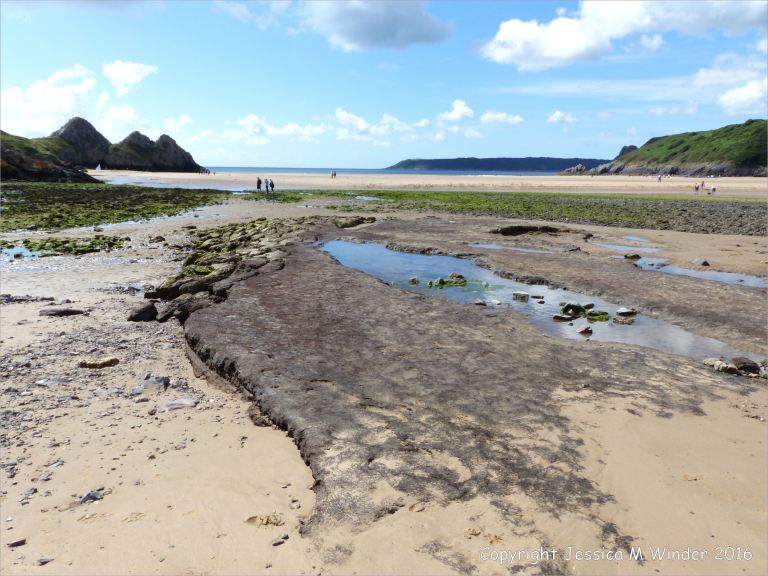
About 10,000 years ago at the beginning of the Holocene Period, sea levels began to rise and drown coastal areas. It didn’t happen all in one go but episodically over time. At the maximum extent of the Devensian ice sheet around 21,000 BP the sea level was about 100 m below present levels (Howells 2007). The melting of the ice sheet and isostatic rebound caused the relative sea level changes. Present sea level was achieved about 5000 years ago. The deposits laid down on the coast during the period of sea rise are made up of layers of soft blue-grey marine clays and silts inter-bedded with freshwater peat. This reflects the way that during the overall time of sea level rise the level rose and fell many times, depositing marine clays and silts when it flooded inland, and allowing salt marsh and peat to develop when the sea receded.
Many coastal areas have these ancient peat beds and boreholes in the UK have shown that they can exist in some places at depths up to 18 m below Ordnance Datum which provides the evidence that sea levels were once lower and the sea level has since risen. However, in the coastal zone near Swansea the peat more typically occupies depths between 2 m above and 2 m below OD, deepening southwards. Offshore the peat lies 16 – 20 m below OD (Barclay 2011).
Here at Threecliff Bay (also known as Three Cliffs Bay) on Gower, South Wales, a bank of storm beach stones and pebbles, now isolated from the shore by a large intervening dune of wind-blown sand, has covered and protected the old peat beds until recent times. The storm beach deposit and underlying peat lie in the final meander loop of the Pennard Pill before it skirts the dune and flows over the shore to sea. Now exposed, the layers of peat and clay are eroding fast. Large lumps are detached around the margins of the bed.
All over the surface of the peat there are random branching patterns of dotted lines. Each “dot” is the cross-section of a stem of salt marsh vegetation preserved in situ. At the edges of the bed, the constituent layers of soft clay and peat are revealed in cross-section. Perfectly preserved remains of plant stems and roots can been penetrating through the strata in their original life position. Rusty staining and deposits in the peat bed are caused by decomposition of the organic matter.
REFERENCES
Barclay, W. J. (2011) Geology of the Swansea district – a brief explanation of the geological map Sheet 247 Swansea, British Geological Survey, Keyworth, Nottingham, NERC, ISBN 978-085272581-8, 24-25.
Howells, M. F. (2007) British Regional Geology: Wales, British Geological Survey, NERC, ISBN 978-085272584-9, 195-196.


 Jessica's Nature Blog
Another fascinating entry on your blog! I wonder if the rusty stains and deposits are from oxidized iron itself, rather than from decomposing organic matter. Peat beds contain iron called bog iron. (See https://en.wikipedia.org/wiki/Bog_iron and https://en.wikipedia.org/wiki/Peat.) The stains look remarkably like the stains I see on rocks in Ohio’s Vermilion River, so they may even have something to do with the iron bacteria. P.S. My biologist husband thinks the plants are rhizomaceous sedges, which probably still grow nearby.
LikeLike
Many thanks, Jessica.
LikeLike
What an odd looking sight Jessica, so recognisable as peat, but looking stone-like at the same time. Would it crumble like peat, or has it started to harden and form rock?
LikeLike
I am not too certain about bog iron. I have never personally encountered hard nodules associated with the peat areas that I have seen on the coast of the Gower Peninsula. I think there might be “hard pans” which are layers of iron that have accumulated from seepage and have been prevented from further downward movement by layers of the marine clay and silts that are inter bedded with the peat. The only reference I have been able to find about the iron in the peat on Gower beaches says that the iron comes from decomposition of the peat. Maybe I should investigate the phenomenon in more depth. Certainly the seepage of iron bearing water from peat deposits in that area is a common occurrence – as mentioned in a couple of other posts on the blog about Broughton Bay and Whiteford Sands.
LikeLike
Although there are distinct strata, Aidy, the layers of peat and clay are still soft and the plant remains within them resemble wet decomposing straw. The peat on the surface is quite compact though, from the downward pressure of other (former now absent) layers above and the weight of the storm beach stones. People also walk across the area regularly, as you can see from the dog walkers in a couple of the pictures, and that adds to the compression. The peat is easily broken off in lumps especially around the edges of the patch – partly from footfall but also by water action. The river levels rise at high tide and during storm events. The peat has not begun to form rock despite any superficial resemblance to that. But who knows, if the deposit survives and becomes buried by other sediments in a future sea rise, in a couple of million years it could become a stratum of coal- and iron-like rock.
LikeLike
A very interesting blog. Thanks for sharing.
Are these ancient peat beds protected by law? The reason I ask is because they are clearly visible at Tata Steel’s deep water harbour in Port Talbot (more so when the tide is out).
The harbour is owned by Associated British Ports (ABP) who have recently floated a development plan for a wind farm which include enormous wind turbines to be sited there, as shown in this link…..https://www.abports.co.uk/media/ad4px2sn/abp-future-ports-port-talbot-online-final.pdf
This is likely to have a detrimental effect on the ancient peat beds.
LikeLiked by 1 person
Hello Robert
Thank you for your enquiry. I am afraid I can’t help you. I don’t know whether these peat beds are protected by law. I suspect not. They are being naturally eroded on shores anyway, and that process on shores cannot, I think, be stopped until perhaps the sea levels rise in the not too distant future. Maybe an organisation like CADW (the Welsh archaeological/historical body) might be in a better position to advise you, especially with regard to the proposed developments at Port Talbot.
LikeLiked by 1 person
Hi Jessica,
Thanks for your reply.
I’ve since done a little research and it doesn’t look like this type of ancient onshore peat bed is protected by law. As you’ve said, they are being naturally eroded on shores anyway. It seems the protection applies more to blanket bog, raised bog, and fen.
Because of their environmental interest and importance, some bogs are designated as ‘Special Areas of Conservation’ (SACs). The nearest one to where I live is ‘Crymlyn Bog’ in Jersey Marine (east of Swansea) https://naturalresources.wales/days-out/places-to-visit/south-west-wales/crymlyn-bog-nnr/?lang=en This is the largest lowland fen in Wales and its extensive reed and sedge beds are home to a wide variety of wetland plants, birds and insects. It is one of the most important wetland sites in Europe and they say its survival is remarkable considering its location being next to industrialised areas.
I think the recently proposed wind farm development at Port Talbot’s deep water harbour will probably get the green light even though the peat beds are there and wetland birds feed and nest in the area.
LikeLiked by 1 person
Thanks, Robert. That is interesting to know. I must visit Crymlyn Bog sometime when I am next down that way. I went to the wetlands in Llanelli last time we were in the area – before the trip was abandoned by being “pinged” by the Covid track and trace app! Maybe better luck next time we visit.
LikeLiked by 1 person