
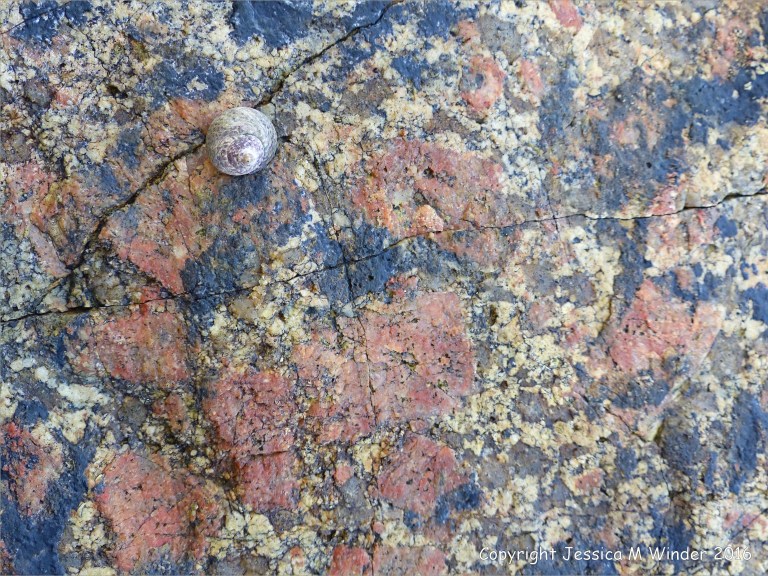
The special thing about the L’Erée Granite is the presence of distinct large pink/orange crystals. I mean big. Some of them are a up to 4 centimetres across. They are magacrysts of feldspar which are thought to have grown very slowly deep within the earth’s crust when the bulk of the granite had already crystallised (Pomerai & Robinson 1994). The action of hot gases fed these feldspar crystals that sometimes have concentric rings of dark inclusions (as you can see in some of the photographs) marking stages in their growth between 646 + 25 million years ago in the early Cadomian Age.
REFERENCES
British Geological Survey Classical areas of British geology: Guernsey, Channel Islands Sheet, 1 (Solid and Drift) Scale 1:25,000. NERC, Crown Copyright 1986.
De Pomerai, M. and Robinson A. 1994 The Rocks and Scenery of Guernsey, illustrated by Nicola Tomlins, Guernsey: La Société Guernesiaise, ISBN 0 9518075 2 8, pages 30 – 32.
Roach, R. A., Topley, C. G., Brown, M., Bland, A. M. and D’Lemos, R. S. 1991. Outline and Guide to the Geology of Guernsey, Itinerary 9 – Jerbourg Peninsula, . Guernsey Museum Monograph No. 3, Gloucestershire: Alan Sutton Publishing. ISBN 1 871560 02 0, pages 11 – 12, & 75 – 78.


 Jessica's Nature Blog
Nature’s own abstract art – truly beautiful!
LikeLike
Thank you, Alastair.
LikeLiked by 1 person
Not for the first time, I’ll recognise and know more about something I’ve often seen before but knew nothing about, thanks to your blog! Thanks for all the enhancements you’ve facilitated on my ramblings.
LikeLike
I am happy that my own curiosity and learning process about the natural world has helped you as well.
LikeLike