
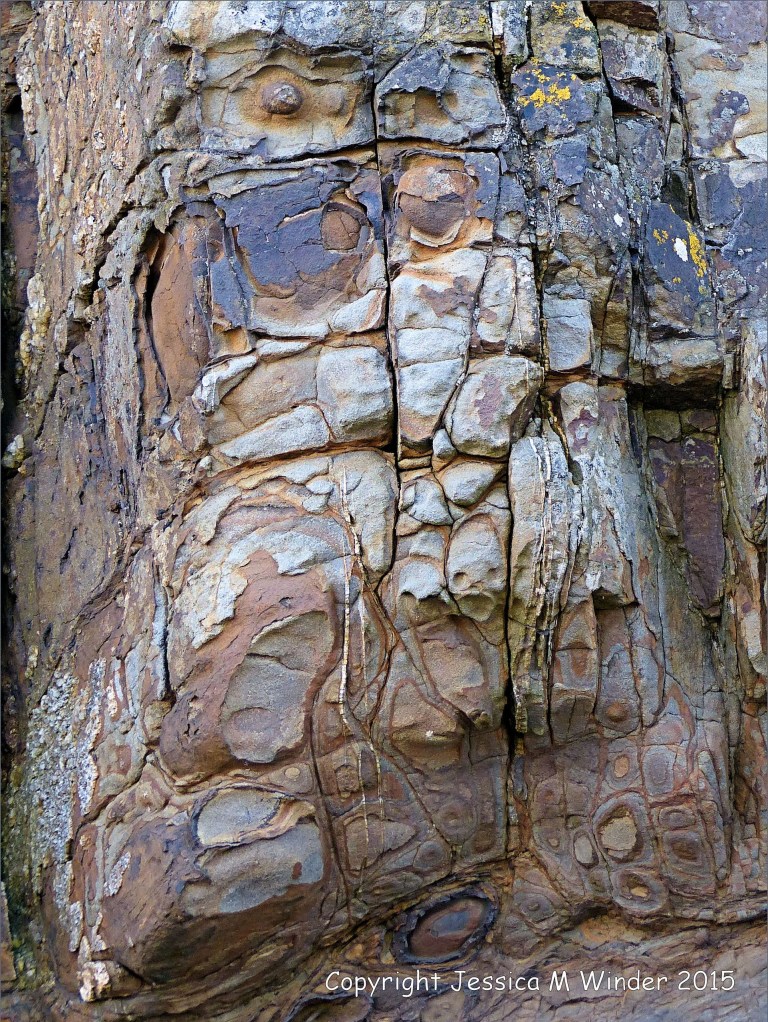
The natural textures and patterns in the cliff rock strata near Coppet Hall at Saundersfoot, South Pembrokeshire, Wales, really caught my eye on a first visit to the location. The stratigraphy is intriguing and complicated – and I have yet to work out exactly what I am looking at. I need a detailed geological map of the area and access to published papers for that. However, I think it fairly safe to say that they belong to the Upper Carboniferous Period, probably the Namurian, also known as the Lower Coal Measures, comprised of sandstone and mudstone layers, with coal seams and layers of iron nodules. I’ll check it all out when I can. High quality anthracite coal was open-cast mined not far away, and there used to be a local iron smelting industry.
My key guide to the geology of Gower and South Wales (George 2008) only describes in detail the geology of the stretch of beach immediately north of this place, and immediately south of it, leaving me a bit stumped as to an explanation for its peculiarities. I am definitely going back to this coastline to spend some quality time exploring the intricacies of its geological history, and photographing some of its marvellous natural abstract compositions.
REFERENCE
George, G. T. 2008, The Geology of South Wales: A Field Guide, gareth@geoserv.co.uk, 978-0-9559371-0-1.


The rock formations are really beautiful Jessica, we visited Saundersfoot briefly and dipped in and out of some of the surrounding Welsh coastline in October for the first time. We would like to go back too and were quite surprised at how geographically interesting the area is.
LikeLike
Beautiful! Oh, yes, do go back and show us more.
LikeLike
Wow!
LikeLike
Thank you, Robert.
LikeLike
Thank you, Linda. I have a few shots left from the last visit and look forward to taking some more next year. The presence of iron in the strata leads to some interesting effects don’t you think?
LikeLike
I had only been to the area once before when I was on a geography field trip staying at Orielton Field Studies Centre. I was 16. I can remember that it was really hard work, we had to walk miles, the scenery was spectacular but I can’t recall any of the geography.
LikeLike
Beautiful textures and shapes, and quite fascinating. Am looking forward to learning more about this special place.
LikeLike
That first shot looks so organic. I thought is was bark to begin with, with the layers and cell-like structure.
LikeLike
Absolutely! Seeing the iron made my heart beat faster (and I’m not exactly kidding).
LikeLiked by 1 person
What interesting textures and colours – the first pic looks almost like tree bark.
LikeLike
Thank you, Julie. I will see if I can find some more information.
LikeLiked by 1 person
Thank you. Allison. It is complicated, isn’t it? Can you see the ‘face’ in that first image. I could see several along the stretch of rock face.
LikeLike
Thank you, Jo. It is certainly an odd set of fractures and weathering exfoliation. I’ll try and find out more in due course. (By the way, there are lots of tree bark texture pictures as well as rock texture in this blog if you are interested).
LikeLiked by 1 person