
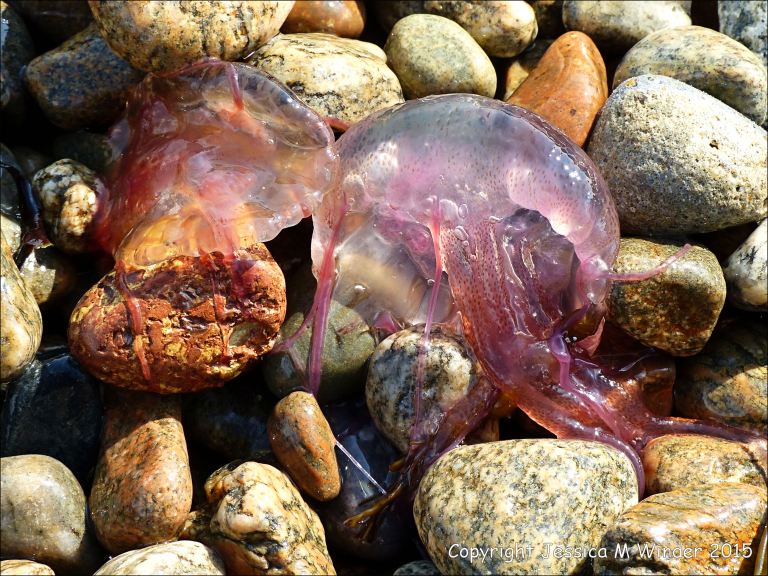
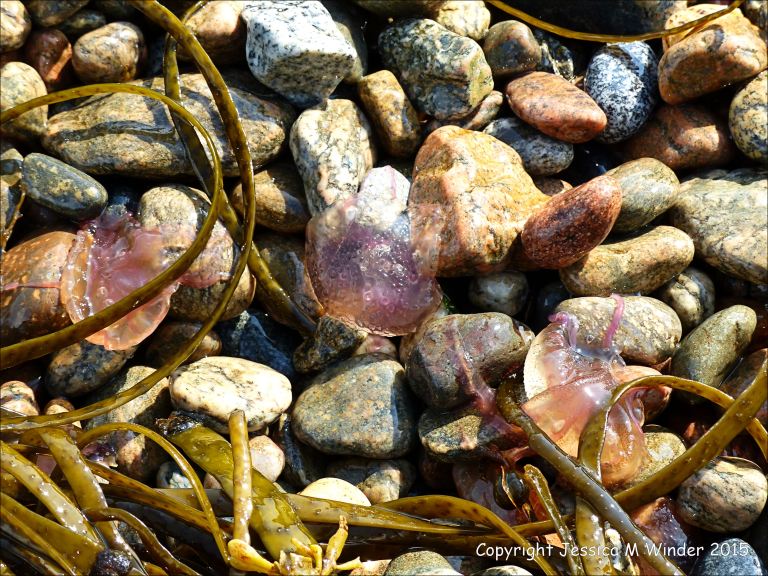
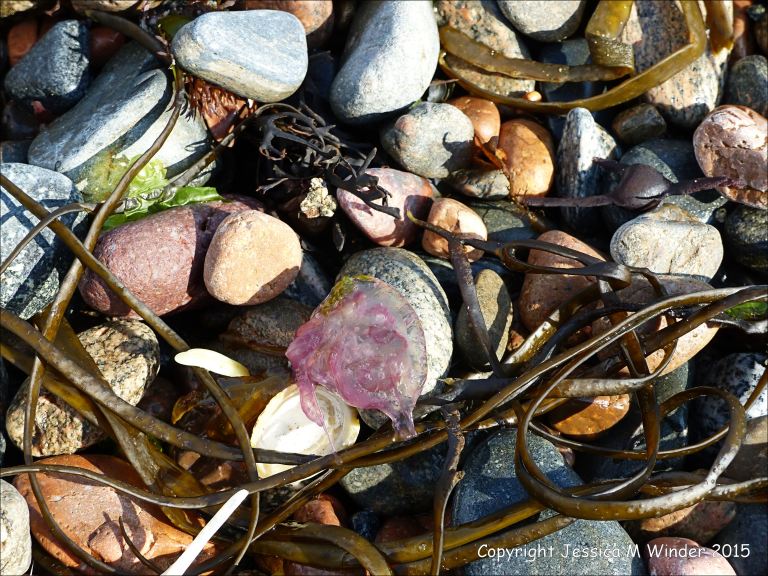
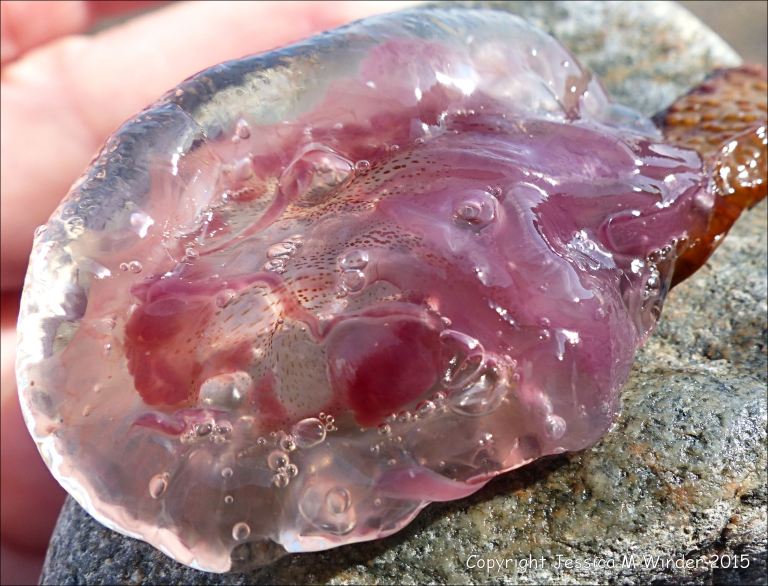
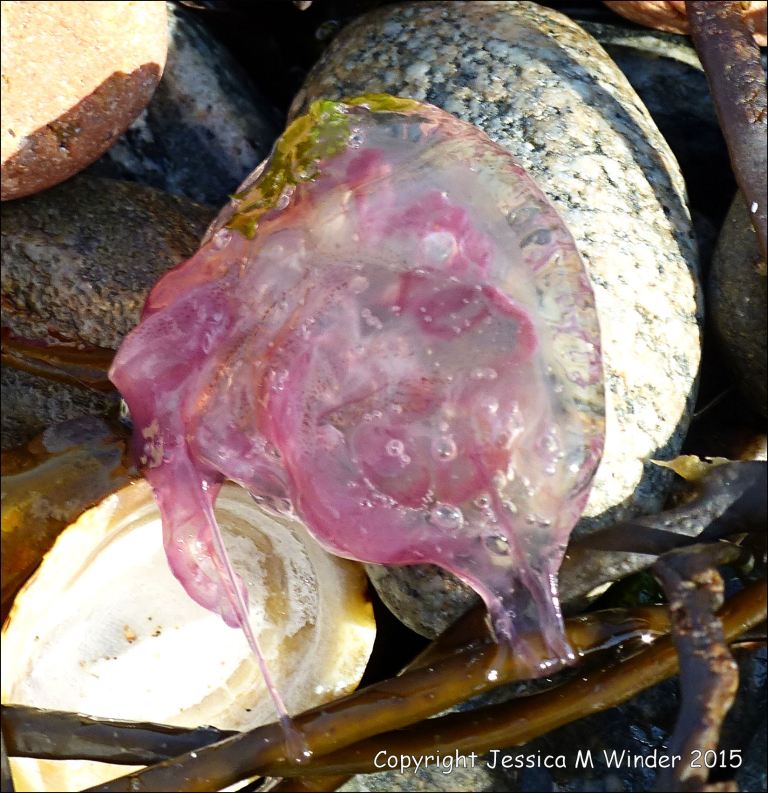
 Jellyfish like small bright jewels littered the strand-lines along the St Peter Port shore in Guernsey last September. At first the bright pink parts in the clear jelly made me think they were immature Moon Jellyfish (Aurelia aurita) but a closer inspection revealed they were very different and not something I had encountered before. They were Mauve Stingers (Pelagia noctiluca) all about 5 centimeters diameter (2 inches) across the bell; mature specimens can reach 10 centimetres in diameter. The pinky-mauve features are the unbranched gastric pouches and the four frilled oral arms surrounding the mouth. There are also numerous tiny purple spots grouped within the transparent jelly.
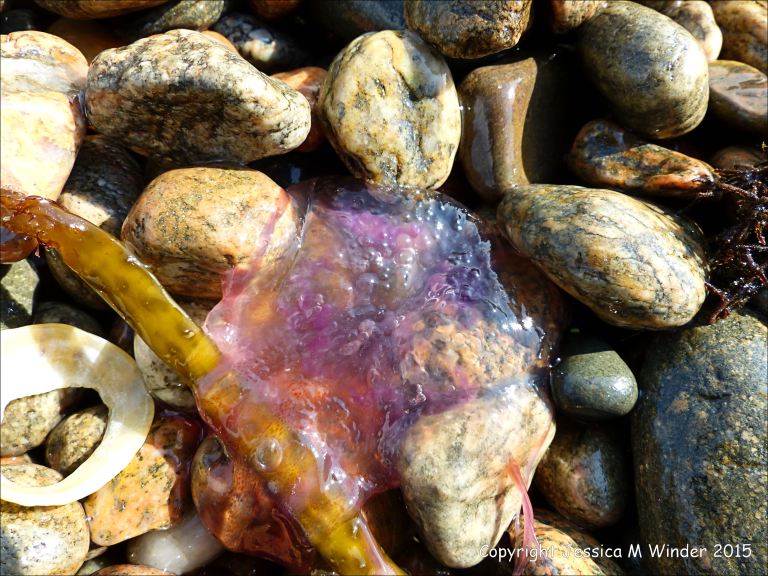
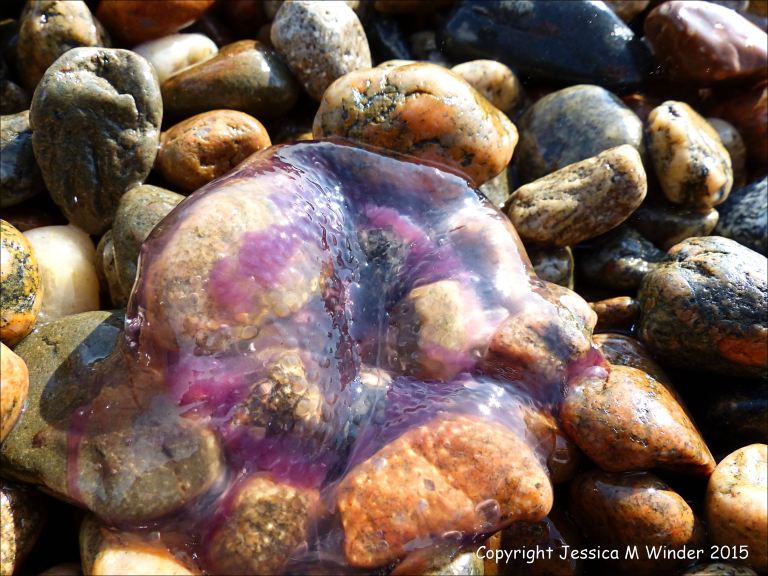
There are sixteen lobes around the margin of the bell. The bell or umbrella when supported by the water column would look quite deep compared with the flattened stranded examples washed ashore and shown in these photographs. Eight long thin marginal stinging tentacles trailed from the jellyfish and adhered to adjacent pebbles where they lay on the beach. In this species it is not only the tentacles that are dangerous but also the entire outer surface of the bell (exumbrella surface) which has a characteristic bubbly texture created by nematocyst-bearing warts. The projectile stingers within the warts are triggered by touch.
Mauve Stingers are unusual in not having a sessile stage. The adult releases miniature medusae in the autumn, and the size of these increases until the following late summer. They feed on free-floating ascidians (sea squirts) and maybe other small jellyfish.
REFERENCES
Hayward, P., Nelson-Smith, T. Shields, C. 1996. Sea Shore of Britain and Europe, Collins Pocket Guide, ISBN 0 00 219955 6, p 48.
Hayward P. J. and Ryland, J. S. 1995 Handbook of the Marine Fauna of North-West Europe, Oxford University Press, ISBN 0 19 854055 8, pp 65-67.
 Jessica's Nature Blog
A fascinating creature, and lovely color. Your photos show it very well.
LikeLike
Thank you, Julie. I realise when jellyfish are photographed on the beach, they lose their shape but at least you get to see the details and textures up close. There is a plague of these hazardous jellyfish washing up on my local Dorset beaches right now.
LikeLiked by 1 person
Such a shame they’re washing up, but it does give the curious something to see without having to go diving for them.
LikeLike
I am new to your work and I love it. Thank you for teaching me more about the edge of sea and water, which I love. As relative newcomer, I had to look up what “nematocyst-bearing warts” are. Thank you.
LikeLike
Sorry that I wasn’t more explicit about the nematocysts. I try not to assume any prior knowledge in the readers while I’m writing …….but sometimes I get it wrong.
LikeLiked by 1 person
Don’t think I’ve seen those before Jessica – nice shots.
LikeLike
Thanks, Aidy. It seems that they are quite common but I have never seen them before myself. Apparently the north Cornwall coast has thousands coming ashore right now.
LikeLike
You are brilliant to identify these, Jessica – do they still cause harm when touched, even when they have been beached for a while?
LikeLike
My father-in-law was Medical Officer of Health for Llwchwr and Gower. He used to get calls at the weekend like this: “There’s a big Portuguese Man of War on the beach at Oxwich!” One was seen in Gower the other day. Bob
LikeLike
Thank you, Jo. It was the small bumps all over the surface and the small groups of purple spots in the jelly that alerted me to the fact that this was a different kind of jellyfish. I looked it up in the literature and identified it from the photographs when I got home. It is my understanding that these will still sting when out of water.
LikeLiked by 1 person
This seems to have been a bonanza year for swarms of jellyfish of all sorts on southern coasts at least, along Dorset, Devon, and Cornish shores as well as Gower. The big barrel-mouthed jellyfish and moon jellyfish are relatively harmless but many others like the Portuguese Man o’ War and the Lions Mane are downright dangerous. If changing weather and climate conditions are causing the increasing numbers of jellyfish on British shores, then maybe we will soon be providing special first-aid stations and safety netted swimming areas on beaches like they do in Queensland Australia where swarms of Box Jellyfish are a great and hazardous nuisance in certain seasons.
LikeLike