

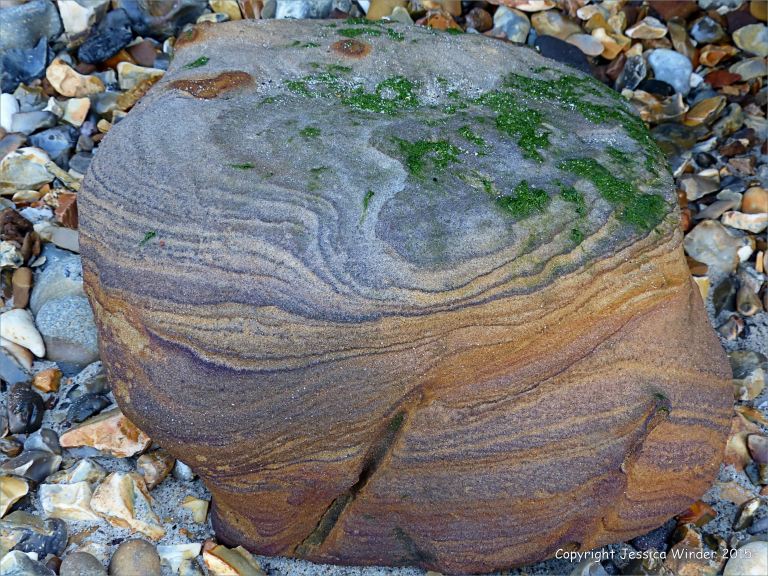
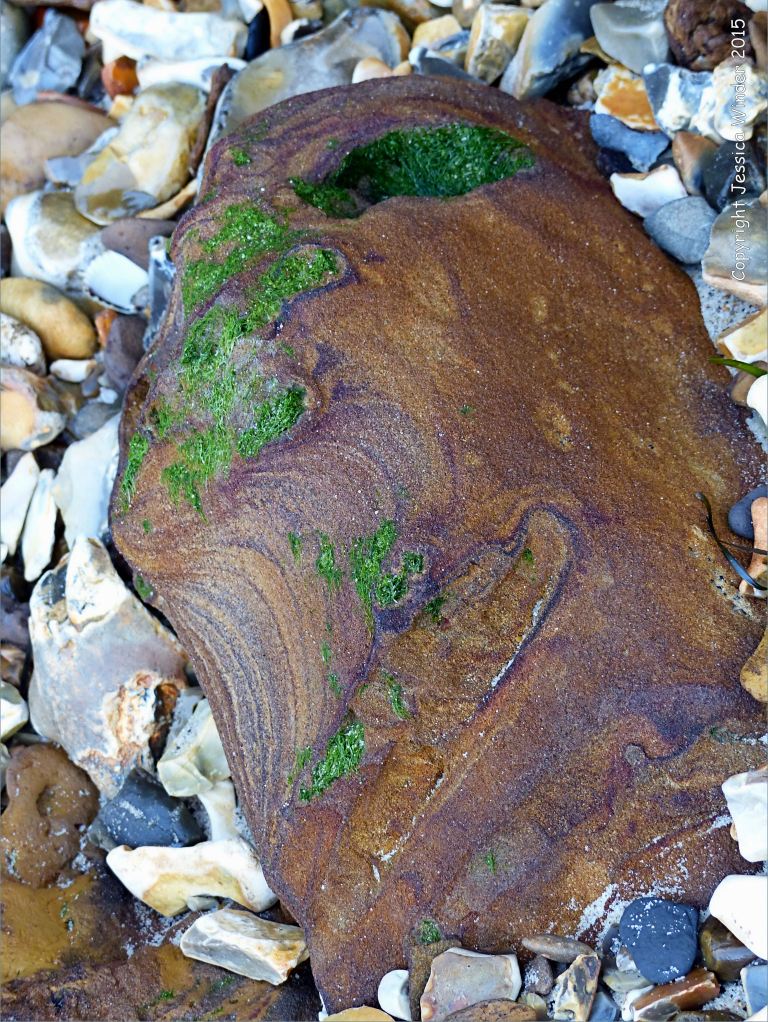
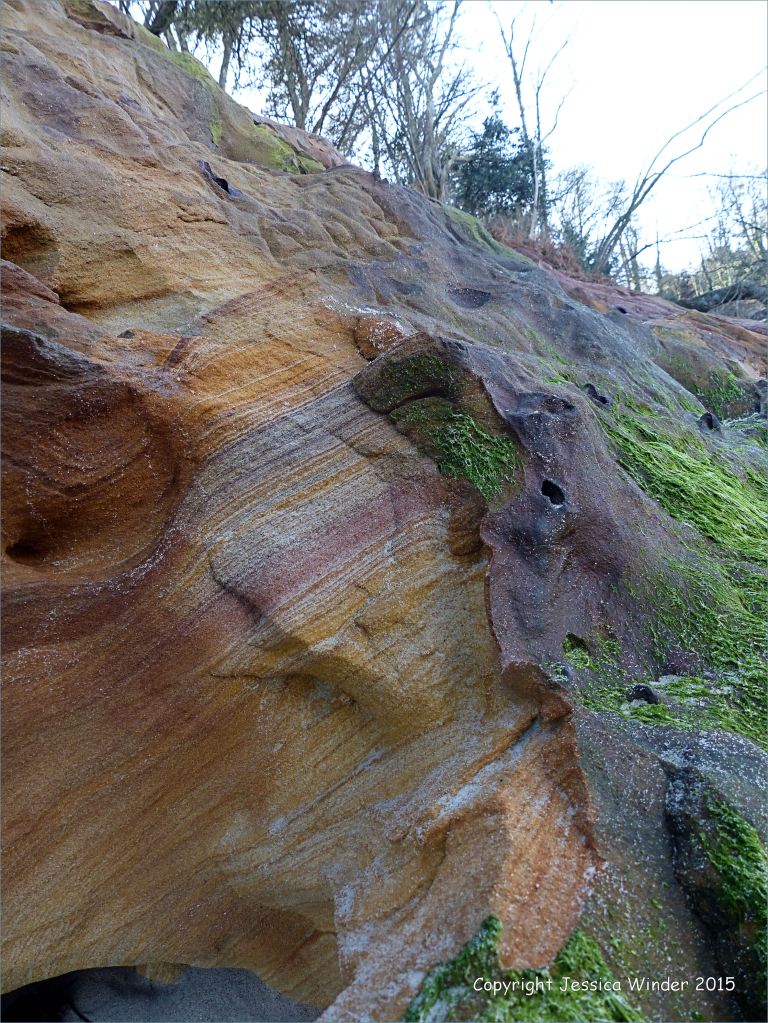
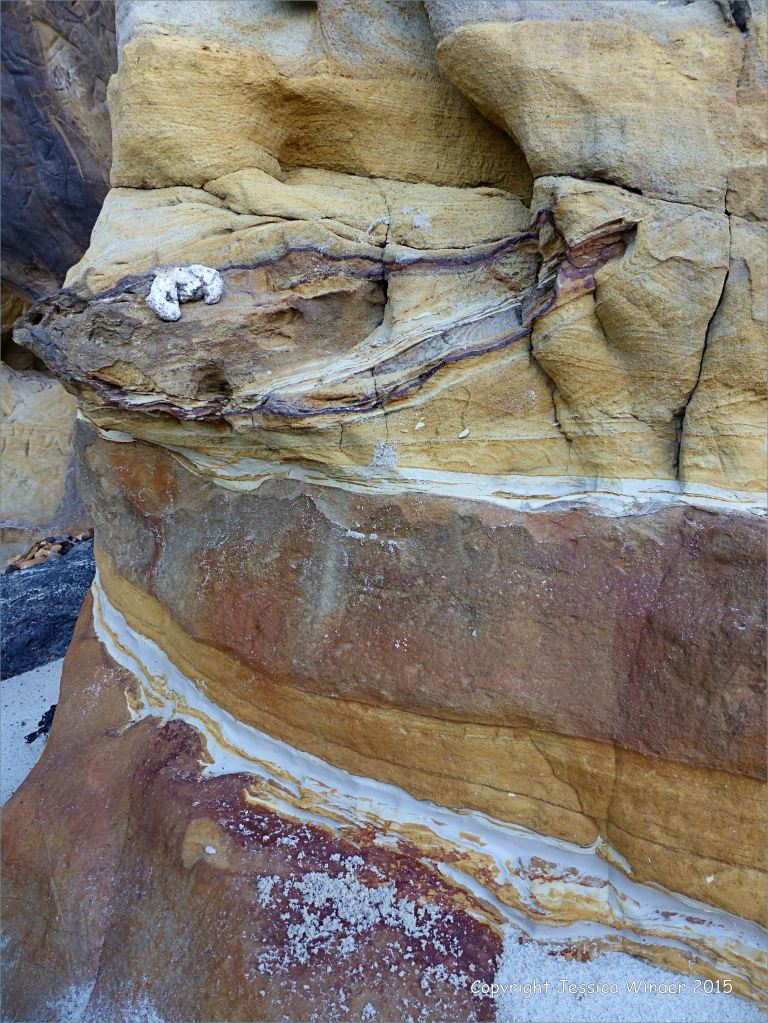
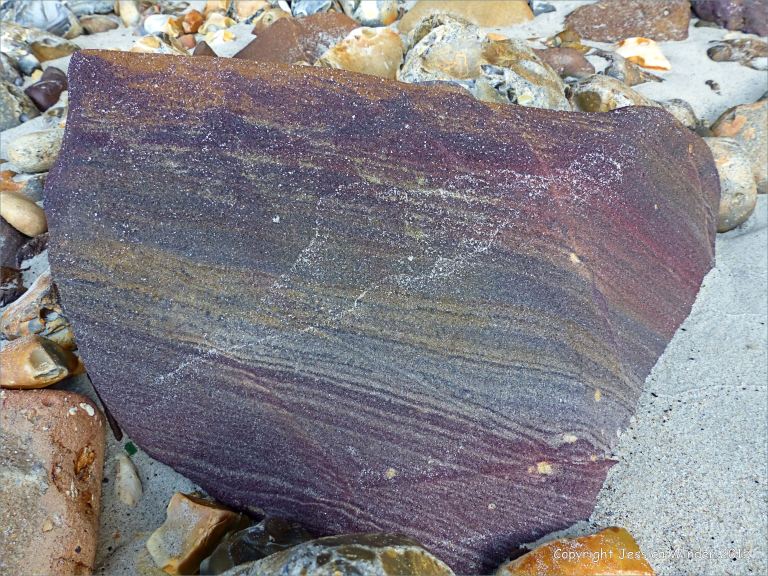
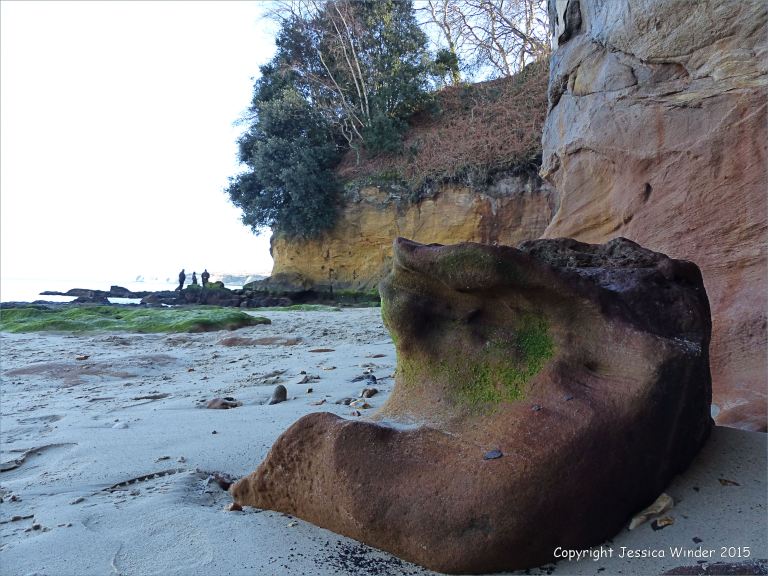
I revisited Redend Point at Studland in Dorset yesterday for the first time in several years. Here are some of the pictures I took. I was only able to look at the north side of the Point because of the state of the tide. The colours seem different from my last trip there. This could be to do with how much rain there has been but also possibly to do with the weathering affect on the iron. [The part of the Point with the wonderful pink and yellow stripes and patterns was further on – to the south of the Point which I could not reach].
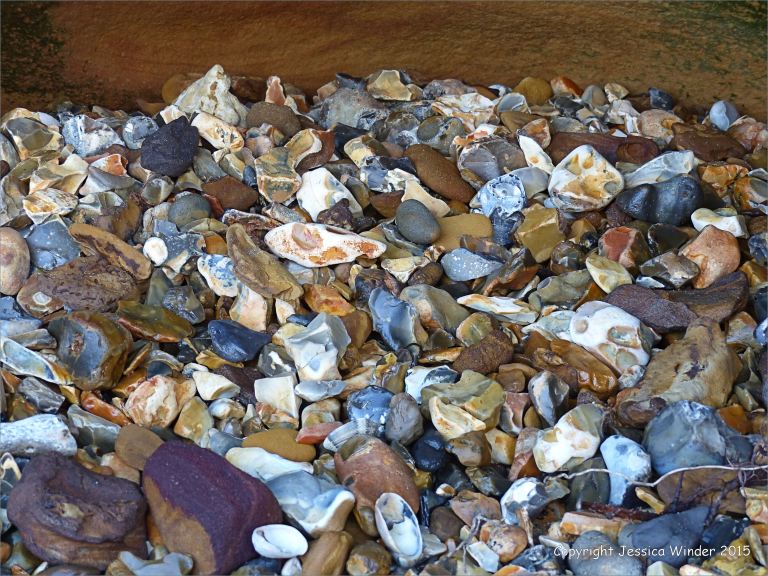
More rocks have fallen from the ferruginous sandstone and from the overlying clays. This has brought down a large tree which now lies across the beach. In some areas the sea has undercut the sandstone to produce small caves. These have floors composed of a mixture very fine pale sand, rust-stained flints from the nearby chalk strata around the corner, and bright orange sandstone with pot-holes and eroded channels draining seawards. In this northern part of the Point the colours manifest by the Redend Sandstone seemed less varied than four years ago, and the carved graffiti was much greater than previously noted. Such a shame that almost every surface was disfigured.





 Jessica's Nature Blog
Fascinating…
LikeLike
Loves these rocks. It was a Sunday. We found a piece of pink and white quartz the size of a Sunday roast on the beach near the Causeway, Worm’s Head. We took it to a relative’s. My young sons said, “Look what we found on the beach!”.
The relative in question did not have her glasses on exclaimed: ‘A side of beef?’
LikeLike
I have often thought that the patterns of red haematite in the rocks at Limeslade Bay makes them look like sides of bacon.
LikeLike
Thank you, Judith.
LikeLike
Beautiful colours Jessica.
LikeLike
Thanks, Adrian.
LikeLike
I love the patterns in sandstone too. Some great examples here.
LikeLike
Thank you, DodgySurfer. It’s just such a shame that people cut ther initials into the surface. These rocks are like the coloured sands at Alum Bay on the Isle of Wight where a whole industry developed around the artistic use of the coloured sands. In the 1950’s It used to be a free-for-all with visitors climbing to cliffs and collecting sands to take home. I expect is a great deal more controlled and conserved these days.
LikeLiked by 1 person
It is unfortunate that humans have the need to disfigure beautiful natural formations. Seems to be something we’ve been doing for some time and the problem now is that there are more of us.
LikeLike
I understand your concern at the graffiti. It’s a funny thing, perspective. As a climber I and my climbing partners would dismay at graffiti, yet graffiti that lasts often becomes an interest in itself. And as climbers our very actions eroded the rocks we so loved for their appearance and tactile qualities. And who are we to say who may use as they choose?
But I too prefer to let nature do as it does, rather than human nature, which so often spoils.
The sandstone around where I live has some beautiful markings, ironstone deposits, cross-bedding, and so on, but often more is revealed where the sea erodes and the hard outer skin of weathering that often hides the colour at inland outcrops doesn’t have a chance to conceal the original features beneath.
LikeLike