

The most readily available literature on the Silurian of the Dingle Peninsula does not provide enough details to enable me to understand what has specifically caused the different compositions seen in the sequence of strata in the Dunquin Group at Ferriters Cove (Cuan an Chaoil) itself. I can say though that these sedimentary rocks were deposited approximately 410 million years ago during the Silurian Period in a shallow sea with active volcanoes on its shore and hinterland. The sediments include pale brown, yellow, grey and red mudstones, siltstones and sandstones (frequently very fossiliferous) interbedded with volcanics such as lithic tuffs and lavas.
The sediments were no doubt laid down in this shallow sea in a series of episodes, each reflecting changes in that environment brought about in some part by increase and decrease in depth of the water. The polar ice caps increased and decreased in size during that time resulting in more or less water in the sea, and greater and lesser incursions onto the land. Volcanic ash and fragments would also have periodically rained down on the water and settled to the sea bed.
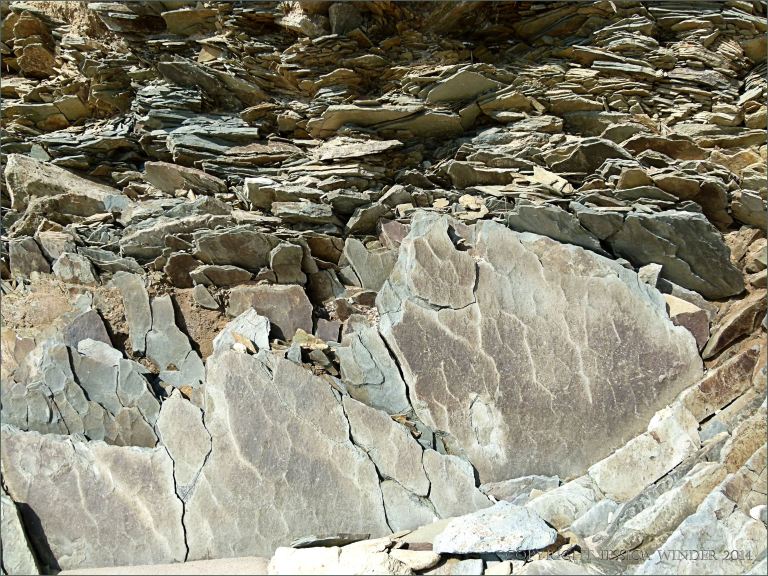
The photographs in this post show what I think is a particularly attractive group of rock layers. The colours are remarkable – though on another day and in a different light they might not look the same. I wondered if the polygonal pattern was dried cracks in the original soft sediment – but maybe not because the origin of the rock is from sediments laid down in a shallow sea – at this stage I don’t know how feasible an explanation drying out of the sediments by exposure to air would be.
I was only able to investigate a small part of this series of Silurian strata. Greater variations in composition and type are exposed further north along the shoreline in the locality. They include, for example, dark purple porphyritic lava, with large platy phenocrysts with flow alignment – the oldest unit of the Dunquin Group. I would have loved to have seen that. I really will have to go back to Ferriters Cove and discover more of its fascinating geology another time.



Perhaps relevant to the dried cracks in the original soft sediment of the Dingle Peninsula rocks (and perhaps not), I wondered about cracks in the shale along the shore of the Vermilion River in northern Ohio. A geology-professor friend thinks that the cracks are a recent feature, produced when rushing water erodes covering layers of shale and earth. The cracks, he says, are an adjustment to the new, lowered compression rather than being due to dewatering in the early stages of compaction.
LikeLike
That’s right. Not so very far from Ferriters Cove lies Dunquin Harbour with an exposure of Drom Point Formation Silurian rocks from the Dunquin Formation, rather than the Ferriters Cove Formation of the same group of Silurian strata, in which there is an exposed bedding plane of coarse mudstone with a pattern of irregular polygonal cracks that is roughly equivalent to the one I saw at Ferriters Cove. These are described in the literature as “shrinkage cracks formed when shallow water covering this mud surface dried out and the mud cracked in this crudely hexagonal pattern as a result of shrinkage. This affect can be seen on the margins of muddy ponds today when their level drops in hot weather” (Horne R. R. 1999).
Horne R. R. (1976) Geological Guide to the Dingle Peninsula, Geological Survey of Ireland Guide Series No. 1, reprinted 1999,
LikeLike
Fascinating information. I have enjoyed reading the your posts in reverse from # 8. Both photos and text ring with the poetry of the place. You make geology sound like prose.
LikeLike
Thank you so much for your comments. I am pleased to share with others my experience of rocks, part of which is an emotional response and an almost spiritual feeling, as well as an intellectual curiosity.
LikeLike