

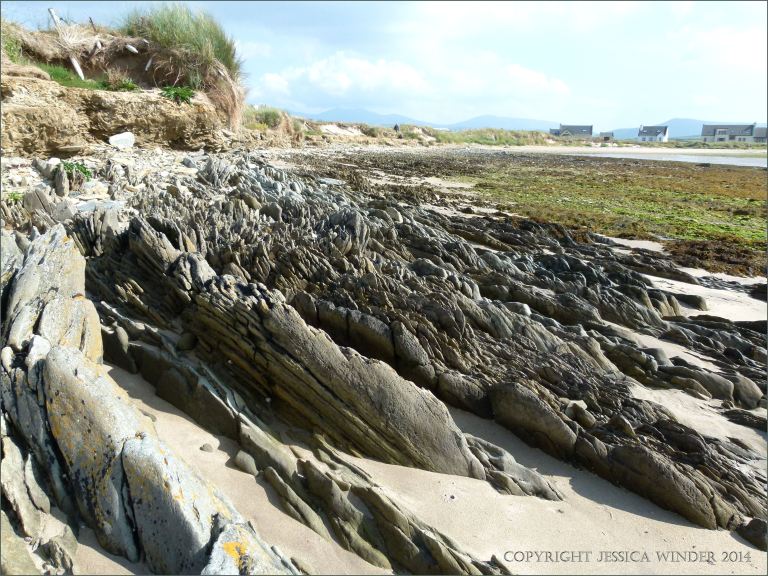
Continuing my geological excursion around Ferriters Cove, the standing height of the jutting strata on the shore increases steadily from ankle height to shin, to knee, and then hip height. It is interesting to note that a few of the exposed rock layers have been eroded in a strange way, maybe because the sediments of which they are composed are softer than the other layers. The weathering of them has resulted in an irregular surface sculpturing, as shown in some of these pictures.
The patterning in this instance is vaguely reminiscent of the large trace fossil burrows that I have previously seen, for example, in Jurassic rocks on the Dorset coast at Winspit and Lyme Regis. I am not sure about these at Ferriters Cove. I think the texture is probably just a reflection of the uneven hardness of the rock. I have found definite “chondrites” fossil burrows in Silurian rocks elsewhere on the Dingle Peninsula at both Smerwick Harbour and Clogher Bay but those trace fossils were distinct and on a much smaller scale.


 Jessica's Nature Blog
Wish I’d gone on to that beach Jessica – I wasn’t far away. Natural sculptures.
LikeLike
It was a lovely tranquil spot with a sandy beach for lazing and rocks for exploring. You have to branch off from the Slea head Drive near Ballyferriter to find it.
LikeLike
Your post actually provoked me to look it up on google earth too Jessica. Next time…
LikeLike
You’re lucky, Adrian. There will be many next times in Dingle for you. It is such a lovely place and far exceeded all my expectations but I don’t know if and when I would be able to return.
LikeLike
Really pleased you enjoyed your time in Ireland Jessica. You never know what’s in store, or when you might be back.
LikeLike
I would love to see more of Ireland’s beauty some time.
LikeLike