
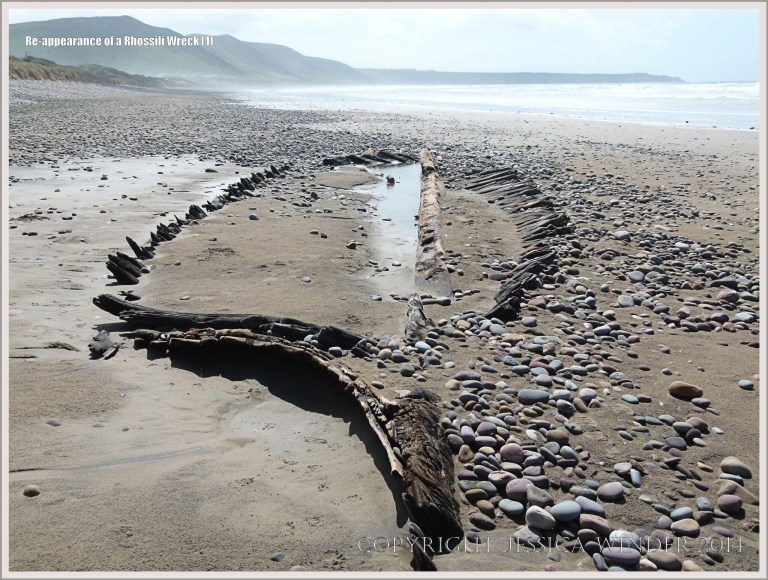


The shifting of the sands at Rhossili Bay has uncovered a wrecked wooden ship quite high on the shore between Diles Lake and Spaniard Rocks. I last saw this ship’s timbers emerge from the sand about seven years ago. It comes and goes and seems to be a fairly rare sighting. Mostly, the remnants of the keel with its attached ribs lie hidden from view, buried under the sand. However, following the weather events of the winter just past, the sands have moved around to a significant degree and revealed once more this elusive piece of history. I am not even sure of its name.
Of course, Rhossili Beach has seen many ships come to grief. The most famous of all is the Helvetia which features so prominently in all the postcards, pictures, and publicity material for the beach. However, there are many others: the stark rusty metal girders and plate of the Danish ship Vennerne at the base of Rhossili Cliffs; the massive anchor of the Norwegian barque Samuel lying on the Worm’s Head Causeway; and at low spring tides, the engines of the wooden paddle steamer City of Bristol – these are all easy to spot.
My favourite wreck though is this particular one lying near the dunes of Llangennith Burrows. I am delighted when circumstances conspire to enable a view of its old weathered and worn timbers. Wooden pegs form part of its original construction but these were reinforced later with iron nails which have now rusted and stained the woodgrain. Beach pebbles form a drift against the outside of this skeletal hull, and stick between the ribs; while the hollow within makes a transient tide pool.
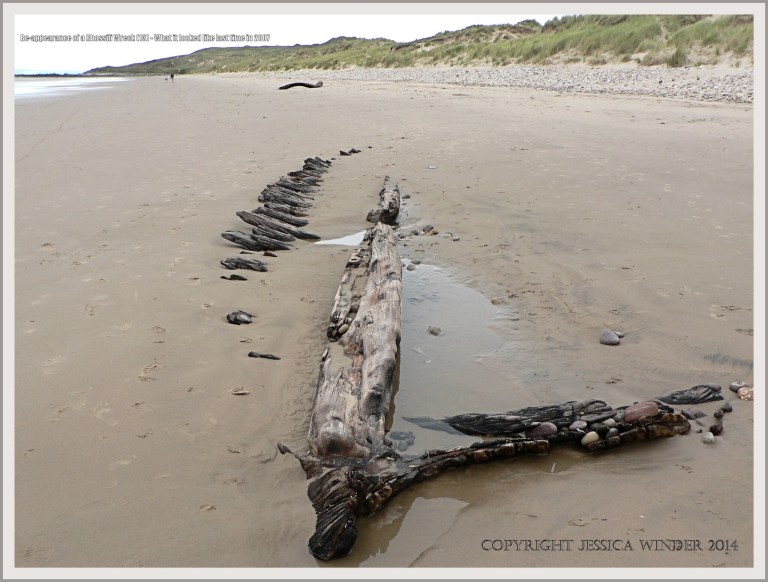
See the image below for a view of the wreck when I last saw it in 2007.
COPYRIGHT JESSICA WINDER 2014 All Rights Reserved
 Jessica's Nature Blog
An amazing revelation, Jessica. Makes one long to see what the ship originally looked like… RH
LikeLike
I think it might be possible to find out if I could relocate the correct sources. If my memory serves me right (?) this was a late 19th century ship carrying a cargo of potatoes when it foundered.
LikeLike
Wonderful photos Jessica -nice to be back and catching up on your travels and discoveries. This seems amazing – so intact and surprising the timbers haven’t been taken away at some point.
LikeLike
Thanks, Chas. I suppose it is because the wreck timbers can disappear again so quickly – potentially from one tide to the next. A person would not only have to be in the right place at the right time – but also have incidentally packed a chainsaw in their rucksack. People do bring chain saws to the beach for cutting up driftwood. However, not many people would be allowed to bring a vehicle onto the shore to carry the wood away – and it’s a long walk to any road.
LikeLike
Hi Jessica. My wife and I moved to College House in Llangennith a few years ago. In the past couple of days I have been scanning in some very old glass negatives that a previous owner had taken One is of a wreck… I am convinced it is the wooden framed one in your pictures. If you look in the background you can see Burry Holmes. I can’t find info on the name but it does look like this is the one. The glass negatives are generally from the late 1800s so it seems to fit in… Tim Evans
Do you have an email to which I could send a digital copy? I tried to copy and paste into the comments box but it does not seem to work that way.
LikeLike
That’s really interesting, Tim. You can send an image to me at winderjssc@aol.com. I would love to see the picture of the wreck.
LikeLike