
Just some musings and sketches.
I have been trying to understand how the patterns have been created in the White Strand Formation rocks on the southern part of the beach at Garrettstown Strand in County Cork. The rock that I have been looking at is basically composed of alternating sandstones and mudstones and the surface layer along the bedding planes, once exposed, has been worn and weathered to reveal deeper layers of the sediments.
 If the bedding planes of the alternating layers of mudstone and sandstone were both parallel and horizontal then a cross-section through the rock might look like this … and on the surface there would be a continuous layer of either the sandstone or the mudstone.
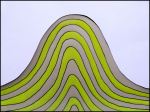 If the layers were originally formed as, or subsequently were heaved up into, a regular rounded mound then a cross-section of the mound would look like this although I am not certain exactly how a mound like this would be formed in reality. I suppose it is far more likely that a single ridge rather than a domed mound would be formed by folding. Perhaps it’s a possibility that a mound with layers like this might form from certain types of sediment accumulation on the seashore.

If the top of the mound was removed by weathering, erosion or scraping then maybe the resulting pattern on the surface would look like a series of concentric rings – a bulls-eye pattern. This circular design is found in the Garrettstown rocks but may be another phenomena entirely – like sphaeroidal weathering for example?
 If the parallel and horizontally arranged layers were in the form of regular, linear ridges, then a cross-section through the strata would look like a series of wavy lines – wavy lamination. If the ridges were later eroded then striped patterns would perhaps be visible on the surface aligned with the axes of the ridges.
 Depending how much of the surface deposits were removed by the subsequent erosion then there would be variations in the patterns of stripes revealed on the surface (the stripe pattern at A would be different from the one deeper down at B).
However, given that the White Strand Formation rocks are composed of sediments formed in shallow water on a former coast, with cycles of deposition of sand from the sea and mud from the land, and subject to the influence of tides, waves, and currents, the patterns within the rocks are a bit more complicated.
 Sand ripples come in all sorts of shapes and sizes depending on where and how they were made. Frequently, the ebb and flow of the tides, together with the way they migrate or move along a shore, results in a complex internal structure with cross-bedding or cross-lamination as shown here. It is easy to visualise how intricate would be the surface patterns produced by weathering of rocks composed of layers like this.
 Where mud brought down by water courses from the land is the dominant sediment forming the ridges of whatever shape on the shore, sand can be washed in so that smaller quantities come to lie in the furrows between the ridges. These can remain as small lenses of sand in an otherwise mud-based matrix in the consolidated rock. These sand lenses would look like this in a rock cross-section. This is called lenticular lamination or linsen bedding.
 If the opposite was the situation, predominantly sand ripples with small amounts of mud brought in, perhaps by storms, to lie in the furrows between the sand ridges, then the resulting rock would look something like this. This phenomenon is called flaser lamination or flaser bedding.
There are also many different kinds of surface sculpturing visible in sand and mud ripples that would contribute to patterns and shapes in rocks that develop from them. See the next post in Jessica’s Nature Blog for photographs of beach sand ripple formations from several locations showing some of the variety of types that might in the past have contributed to sandstones like those at Garrettstown Strand with their wonderful weathered patterns.
COPYRIGHT JESSICA WINDER 2014
All Rights Reserved
 Jessica's Nature Blog
Thanks for the explanation!
LikeLike
Thank you for commenting.
LikeLike
Oooh, that took me back to the geology courses I did years ago at uni. I loved doing cross-sections from maps – visualising 3-d from 2-d. I hadn’t heard of linsen and flaser bedding before – fascinating.
LikeLike
Thanks for the feedback, Hedwigia. I hadn’t heard of flaser and linsen bedding myself until I looked for an explanation for the wonderful patterns in beach bedrock at Garrettstown Strand in County Cork. Interesting to discover new information, work things out, never too late to learn.
LikeLiked by 1 person
Thank you for taking the time to explain. Kindest regards.
LikeLiked by 1 person
That’s OK. I am glad that the explanation was useful.
LikeLike
What puzzles me is how the bed of sandstone lies on the bed of folded, crushed eroded mudstone layer and ripples. It is as if the sandstone bed slid on the folding mudstones and maybe mechanically eroded them at the same time. The beds of sandstones are smoothly folded over a difficult to understand (if it was not for your kind explanation) bed of very messed up mudstones, ripples etc.
Yahoo Mail: Search, organise, conquer
LikeLiked by 1 person
I am always puzzled by what I see in the rocks. It is difficult to interpret. I guess we have to remember that because of the way that sea levels rise and fall throughout geological time, it is possible for strata to be relatively uplifted and exposed to aerial erosion and weathering before the next episode of sediment deposition. I wrote this particular post many years ago, and had arrived at an explanation which I understood at the time, but have long since forgotten that understanding.
LikeLike