
Sixty miles due west of Eugene the Suislaw River hits the Pacific. From here, where the town of Florence straddles the mouth of the river, the U.S. Highway 101 follows the shoreline south to San Francisco, and northwards all the way to Washington State. We were headed north as far as Yachats.
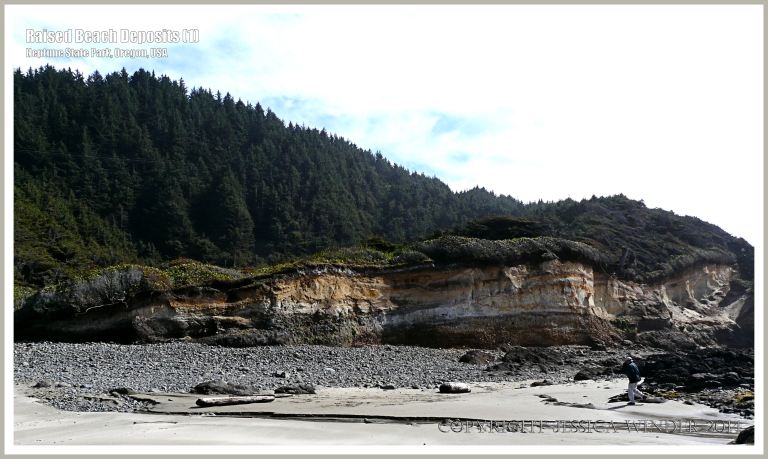
The views along the coast road were stunning. At first, sand dunes on both sides. Thereafter, accompanied all the way by the seashore and pounding ocean to our left, and forested slopes of the Cascade Range to our right. The shore was unlike anything I had previously encountered at home in Great Britain, because the Oregon shore had been greatly influenced by relatively recent volcanic activity. However, one element was familiar: an ancient wave-cut platform and accompanying raised beach or terrace deposits.
The terrace deposits were once extensive along the Oregon Coast but are now present only as segments in more protected areas of the shore. They were formed during the Late Pleistocene period when the sea level was higher than it is today. The sea at that time cut away or levelled the basalt bedrocks on the beach and created a layer of sediment including rounded pebbles and sand which remained in an elevated position, marking the site of the Late Pleistocene beach, when the sea level subsequently lowered.
The raised beach or “terrace sediments range in thickness from a few feet to tens of feet and have been weakly consolidated into sandstone and conglomerate capable of maintaining a vertical sea cliff on the seaward side” (Lund 1971). The pictures below illustrate the appearance of segments of terrace and sea cliff at Neptune State Park on the central Oregon Coast.
Earlier posts in Jessica’s Nature Blog have described aspects of the rocky shores in the region of Yachats, just a few miles north of Neptune State Park. Most of the town of Yachats (population 650) is built on a segment of Late Pleistocene raised beach or terrace. Raised beach deposits occurring on the Gower Peninsula in South Wales have also been described in a previous article in this blog. Raised beach deposits containing abundant shells and pebbles with holes made by sea creatures will be discussed in a following post.
REFERENCE
Coastal landforms between Florence and Yachats, Oregon by Ernest H. Lund, February 1971, The ORE BIN, Volume 33, No. 2, pp 21-44.


COPYRIGHT JESSICA WINDER 2014
All Rights Reserved
 Jessica's Nature Blog
These cobbles appear to be from many different strata eroded from further up (eastward) and water transported to that layer catastrophically.
LikeLike
Thank you for adding that information, Paul. Here in Dorset we have a more recent phenomenon which brings pebbles from much further along the coast to rest, not in raised beach deposits but in a massive pebble bank called Chesil Beach many miles long. Nobody is absolutely sure how the stones from various geological periods and strata actually reached this position but currently the spit joins the Isle of Portland to the mainland in Dorset, UK. See posts on Chesil Beach on Jessica’s Nature Blog at https://natureinfocus.blog/?s=Chesil
LikeLike