

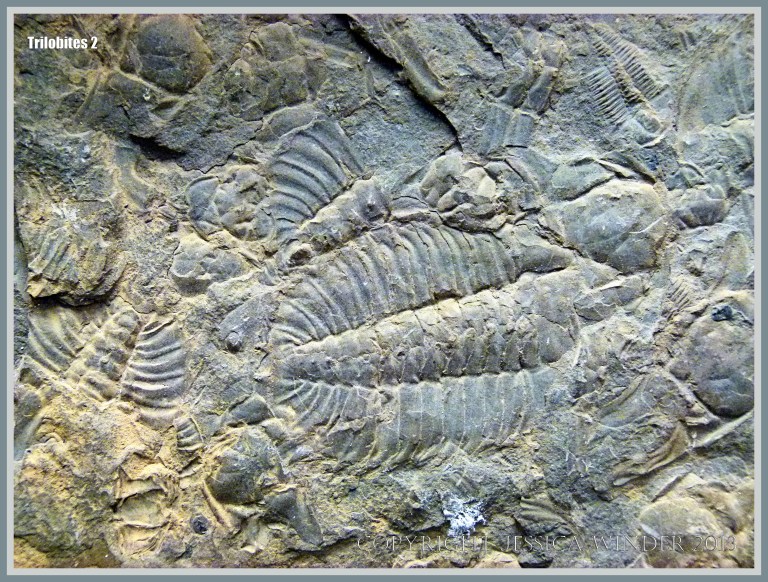
Trilobites are probably the best known fossils after the dinosaurs. These photographs show details of Ogygopsis and Paradoxides trilobites in a slab of mid-Cambrian Rock from British Columbia that was collected by T. H. Clark in 1924 and is now on show in the History of Life Displays in the Dawson Gallery at the Redpath Museum, McGill University, Montreal in Canada.
The Redpath Museum is a delightful place with traditional style displays. The fossil exhibits in the Dawson Gallery are arranged in a sequence that makes it easy to understand their role in describing the history and evolution of life on earth. A beautifully illustrated guide book accompanies the displays, and I can do no better than quote about the trilobites from this source as a taster of the guide which is an up to date and easy to understand reference on the role of fossils in unravelling the history of life on earth.
Trilobites are the most diverse group of extinct animals with about 15,000 known fossilised species described so far and new species are still being discovered. They ranged in length from less than 1 mm to over 70 cm, and occupied many habitats and adopted many modes of life. They included predators, scavengers, grazers, filter feeders, and swimming plankton feeders. Their diversity reached its peak in the Late Cambrian and Early Ordovician periods (they represented as much as 60 per cent of animal life in the Cambrian), but afterwards they quickly declined, suffering heavy losses in both the Late Ordovician and Late Devonian mass extinctions. They surviving species finally became extinct at the end of the Permian.
The Fossils’ Tale – A Gallery Guide – The History of Life Displays in the Dawson Gallery by Torsten Bernhardt (2010), RedpathMuseum, ISBN -978-0-7717-0700-1.
Redpath Museum online at http://www.mcgill.ca/redpath


COPYRIGHT JESSICA WINDER 2013
All Rights Reserved
 Jessica's Nature Blog
They look awesome! Fossils are cool. I used to take my kids on fossil hunting trips. There’s a part in Maryland, USA, where we used to go to. Mostly we collected fossilized shark’s teeth. So much fun!
LikeLike
I’m not usually very lucky when it comes to finding good specimens of fossils although the are loads on the beaches near where I live. It’s called the Jurassic Coast because of its special geological significance, a World Heritage Site. Most of the fossils I see are embedded in the rocks but I have found a few fragmentary ammonites, belemnites, and oysters. My son has had better luck – he and his Dad found part of the skeleton of a Jurassic turtle!
LikeLike
Wonderful images, Jessica. RH
LikeLike
Thank you, RH.
LikeLike