

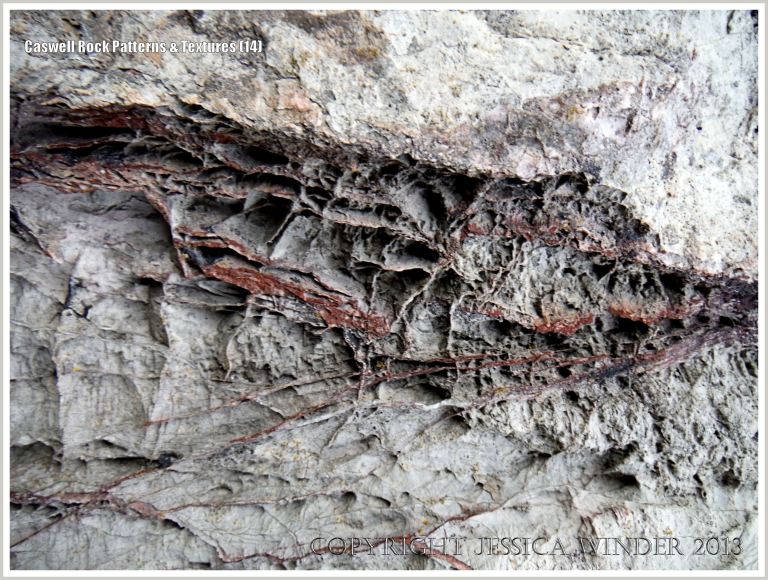
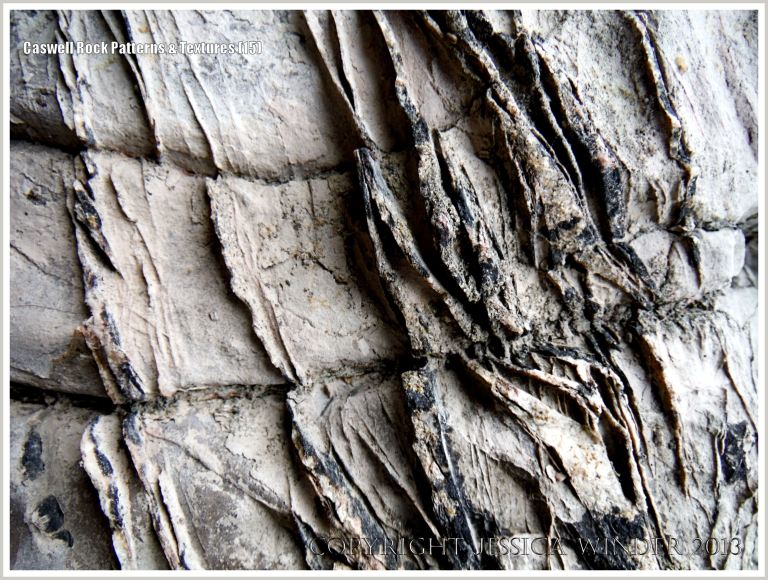
There are curious surface textures on some of the limestone rocks at Caswell Bay on the Gower Peninsula. They are made up of three dimensional patterns consisting of sharp raised intersecting lines defining all sorts of shapes including triangles and rectangles – sometimes almost like petrified cobwebs.
So what are these structures in the rocks? The “lines” or veins are obviously a harder material than the limestone matrix. They seem to be mostly crystalline calcite with the reddish-coloured addition of iron. How do the veins of calcite get into the rock? Well, when the rock strata were deep underground, millennia ago, they were subjected to great pressures caused by movements in the earth’s crust. The pressures made the limestone crack. There would have been more than one cracking event. The resulting cracks would have been in many different planes and angles – parallel to the bedding plane, at right angles to it, and every other direction.
Then, the gaps created by the cracks would have allowed percolating groundwater to circulate. This would often be a solution of dissolved minerals, minerals that crystallised out along the surfaces provided by the walls of the cracks – crystals like calcite. The repeated pressure cracking and sealing with crystals over time produced a three-dimensional network of hard veins hidden deep in the rock.
Much, much later, the rock layers were again subjected to massive earth movements and changes in sea level that raised the rocks to the surface where they were subjected to weathering and erosion. Where strata with enclosed calcite networks of veins were exposed to the elements, like here at Caswell Bay, the softer limestone matrix is preferentially eroded by both abrasion and solution, leaving the harder calcite veins standing proud of the overall surface.
Extreme examples of these weathered out vein networks are called “box-work” – because of the fairly regular “compartments” defined by walls of protruding calcite or other crystalline mineral revealed by the erosion process. Spectacular examples are sometimes found in caves, like the Wind Cave in the National Park of South Dakota in the United States – and are a great tourist attraction. Although the patterns and textures in the rocks at Caswell are of an altogether more modest extent, they are a noteworthy feature of the geology of the Bay.
REFERENCES
http://geologicalintroduction.baffl.co.uk/?p=111
http://en.wikipedia.org/wiki/Boxwork
http://www.nps.gov/wica/naturescience/speleothems-boxwork-origins.htm
(NB If I have misunderstood or misrepresented the geological process giving rise to these rock patterns and textures, please do get in touch and let me know. I do wonder if my suggestion for the origin of the patterns has a different explanation because I have read in The Geological Society Field Guide to Caswell Bay that the Laminosa Dolomite on the east side of Caswell Bay (my photographs were taken on the short low promontory on the west side of the bay known as Redley Cliff) has a “honeycomb” texture due to incomplete conversion of calcite to dolomite – and I am considering whether it is a reference to the same kind of phenomenon as the one that I photographed.




COPYRIGHT JESSICA WINDER 2013
All Rights Reserved
 Jessica's Nature Blog
rock can be so ‘delicious’, great photos!
LikeLike
Thank you, I just love the artistic possibilities of rocks as much as I am curious about their geological origins.
LikeLike