
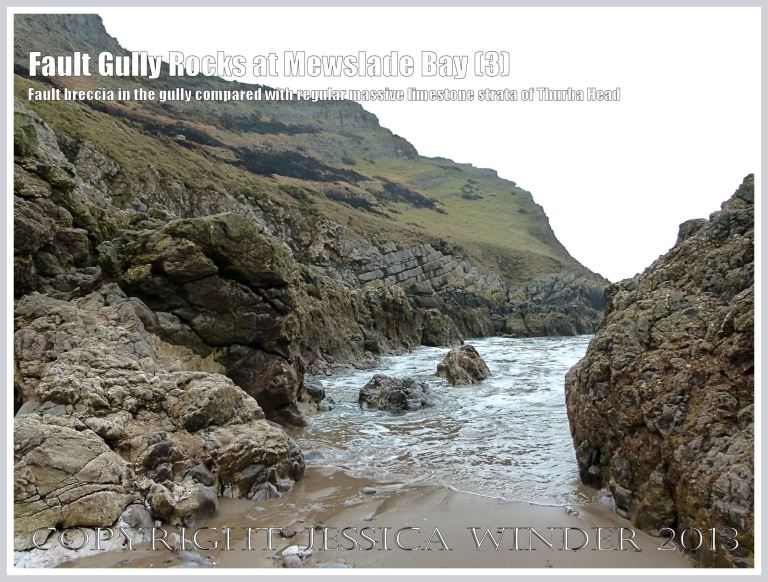
As you arrive at the narrow gully that forms the entrance to Mewslade Bay, you cannot help but notice just how different the rocks are from those that outcrop on the hills around. Up on Thurba Head to the left and to the high cliffs and outcrops on the right, thick grey layers of High Tor Limestone from the Carboniferous period are clearly visible. However, down in the gully, there is nothing but a jumble of assorted broken rocks of all kinds of origin, which in some places have been cemented together with white crystalline calcite.

The reason for the unusual geology at this point is an ancient rupturing and tearing of the rocks – faulting. The steep-sided dry valley that leads from Pitton village down to Mewslade Bay follows the line of a fault. In fact, two faults converge here. The fault line itself extends inland and North-north-east across first the High Tor Limestone which appears as cliffs along the South Gower shore in this locality, then passes across Hunts Bay Oolite (the next in the succession of Carboniferous Limestone strata), and possibly other rocks in the series such as Gully Oolite. Further north, around and beyond Pitton and Middleton, superficial drift deposits of glacial till, like gravelly clay, mostly cover and obscure the solid geology below. Beneath this layer of till deposit lies the solid Old Red Devonian Sandstone rock.
Faulting occurs as brittle rocks crack when they can no longer bend and fold to accommodate earth movements. Once the rocks break, there can be major movements of the strata on each side of the crack. One side may move up or down in relation to the other. The two sides may slide and tear against each other horizontally. The friction of the rocks grinding one side on the other often breaks up the rock into smaller pieces. Compared with the solid rock strata, the area of smaller fragments is very water permeable.

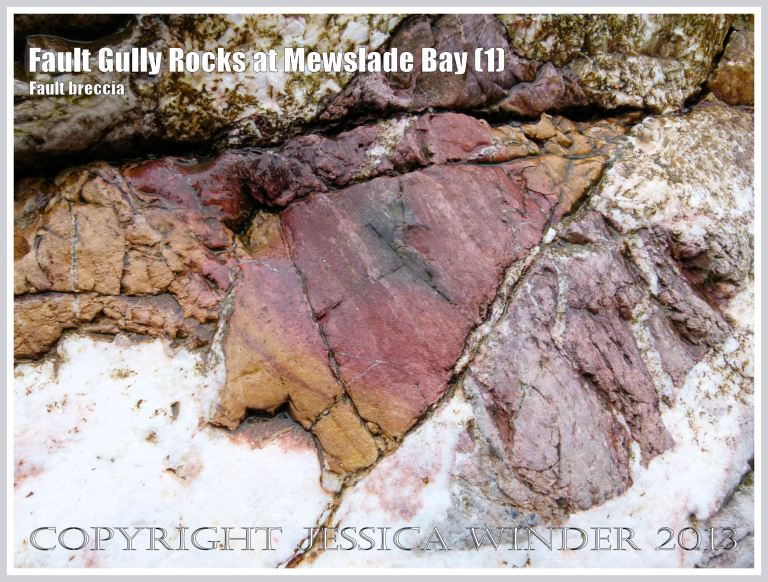
It is thought that the entrance to Mewslade Bay is a fault gully, which has probably been eroded out by glacial meltwater during a period of permafrost when an ice sheet covered most of the Gower Peninsula. The various rock types represented in the gully structure would have been derived from both the Carboniferous Limestone and the Old Red Devonian Sandstone geology fractured by the fault and carried down towards the sea by water. The name for this type of deposit is Fault Breccia when the pieces are large, and Fault Gouge when they are much smaller. Secondary minerals such as calcite can precipitate from groundwater circulating around the loose fragments, filling the empty spaces or voids and cementing rock together.
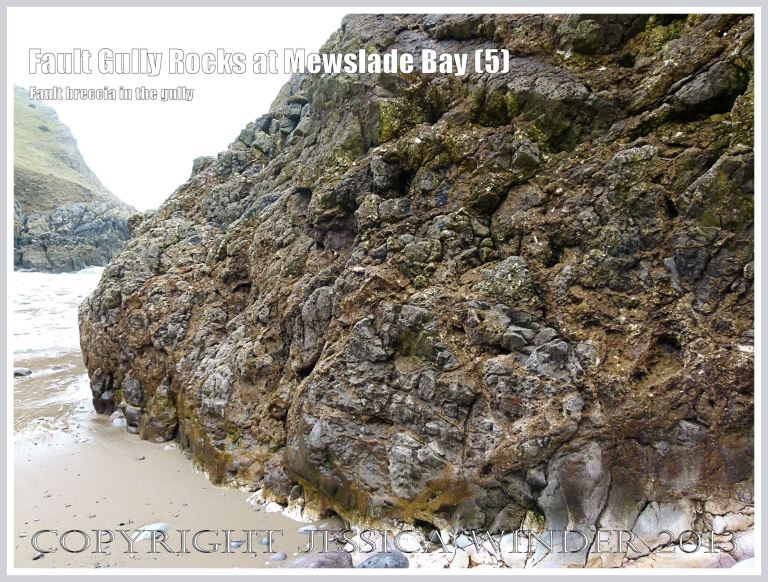
Low down, nearest the ground, the fault breccia looks like tutti-frutti ice cream with rock fragments coloured pink, red, brown, yellow, and grey embedded in a crystalline calcite. Higher up, the fragments are consolidated – but without the all-encompassing white matrix.


Gallery of fault breccia rocks in the fault gully at Mewslade Bay
Calcite occurs in different forms. There are neatly formed crystal clusters as veins or in pockets. Most are basically white but some are stained orange with iron. Superficially, the crystals are often coated with green or brown algal bio-films. In some places, especially in tunnels and low down in the deposit, where the the rocks are washed by the sea and abraded by debris at high tide, the calcite is worn down to a smooth surface with just an outline pattern of the crystals and cleavage.
Slide show of crystal calcite from the fault breccia at Mewslade Bay

COPYRIGHT JESSICA WINDER 2013
All Rights Reserved
 Jessica's Nature Blog