

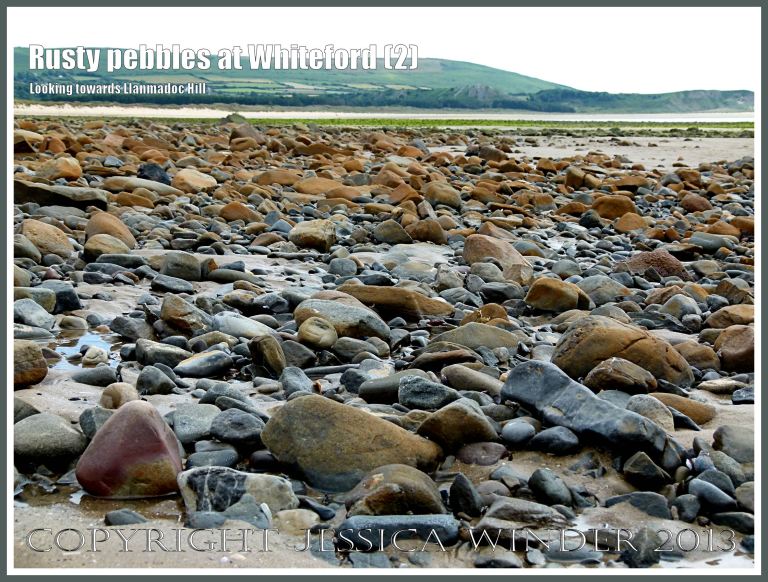
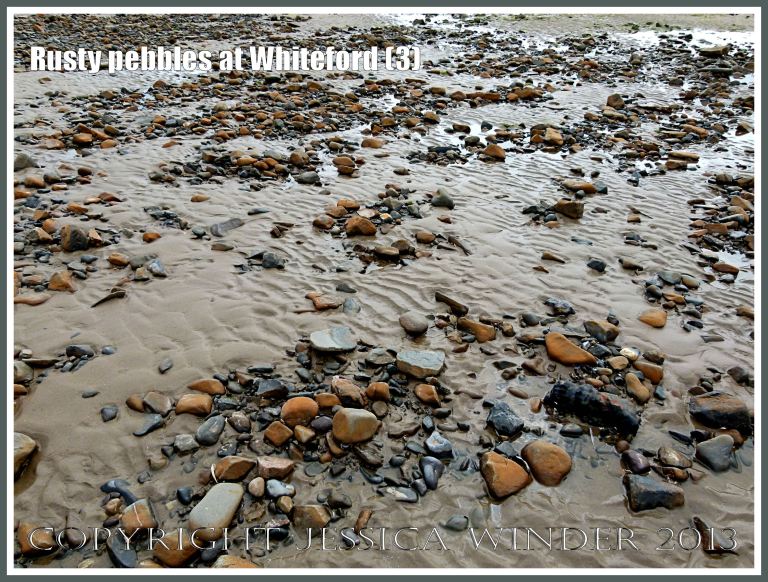
Vast swathes of pebbles on the beach at Whiteford in Gower are coloured orange – or at least they were the last time I looked. (The beach sediments there are very mobile so it cannot be guaranteed that you will see exactly the same thing on each visit). These coloured pebbles are found in a band stretching from the base of the sand dunes at the eastern end of the beach towards the disused Victorian Whiteford Lighthouse.
The pebbles seem to be coated in rust rather than rusty because of their intrinsic composition. I guess the first couple of times that I noticed the orange pebbles I vaguely thought that they were stained by rust emanating from the decomposing remains of the old iron causeway that linked the lighthouse to the shore. You can often find pieces of the iron framework of the walkway – sometimes supports still in situ and other times single pieces of the structure lying free.
However, lately, I have been discovering more and more about the Quaternary geology of the Gower – a relatively recent geological period dating from about 2.5 million years ago to the present. This includes the Pleistocene with a variety of glacial, peri-glacial and inter-glacial deposits; and the recent Holocene (from 11,800 years ago) with peat and submerged forests, marsh, dune, beach and alluvial deposits. As I read more, I am gradually reaching something of an understanding about some of the natural phenomena that I observe and photograph on Gower beaches. So I now tentatively consider that the rusty pebbles are not related to the dilapidation of the old lighthouse but are the result of a much older natural geological process.
I have already mentioned in Jessica’s Nature Blog the remains of the submerged forest at Broughton Bay which lies to the west and adjacent to Whiteford Sands. These ancient tree trunks are embedded in peat deposits. While I was reading George (2008), I learnt that the peat decomposes to form a hard ferruginous layer called an iron-pan or hardpan. This has led me to wonder if the iron compounds that coat the pebbles at Whiteford are derived from an iron pan layer.
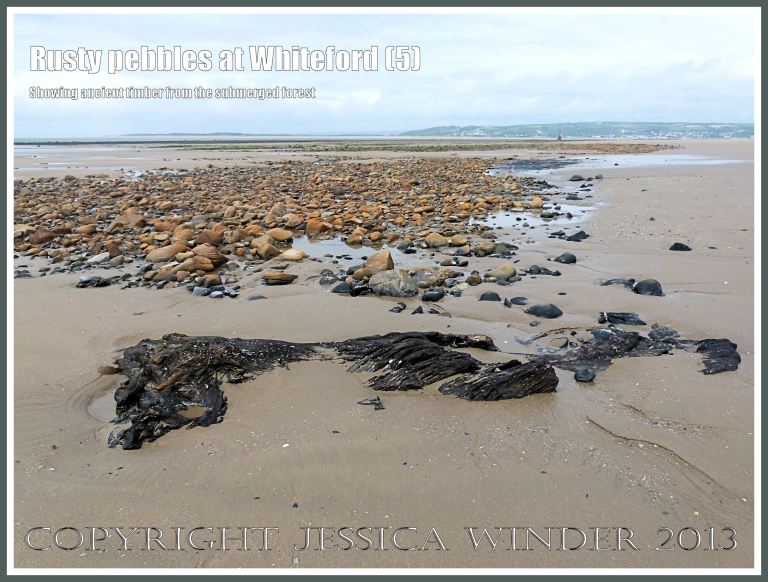
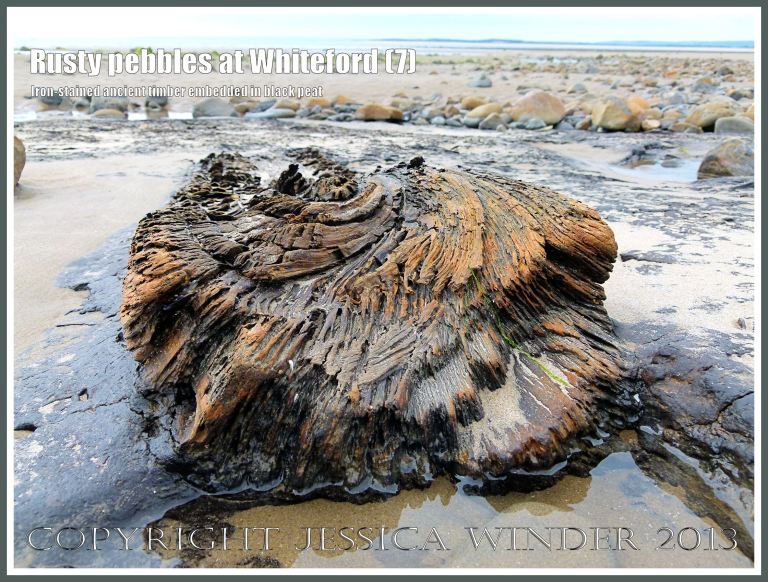
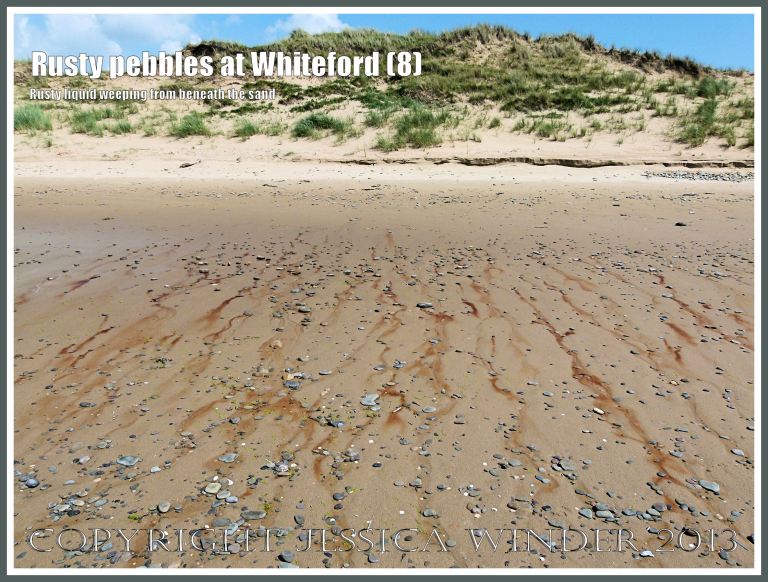
Supporting evidence for this idea comes from the presence of ancient tree trunks emerging from black peat deposits close to the rusty pebbles – similar to those stumps found at Broughton. The old waterlogged wood is also stained with rust – as you will see from the photographs below. Additionally, slightly higher on the beach, closer to the dunes, the shore is strewn with pebbles around which orange-coloured watery ‘tears’ rise to the surface and weep across the surface of the sand – making me think they might originate from a concealed ferruginous hardpan below.
Then again, I suppose the rust could come from buried decomposing munitions as the beach was used for firing practice in the Second World War!
Reference:
George, Gareth T. (2008) The Geology of South Wales – A Field Guide, G.T.George at gareth@geoserve.co.uk , ISBN 978-0-9559371-0-1, p 70.



COPYRIGHT JESSICA WINDER 2013
All Rights Reserved
 Jessica's Nature Blog
There’s a lot of old red sandstone from the Devonian period in Gower. Could it be masquerading as iron oxide?
LikeLike
Nice try, Ian. You’re always looking for the Devon connection! In this case, the substance is definitely iron-based. Where the Old Red Devonian Sandstone seeps out in liquid form, as at the base of Rhossili Down, the substance is almost red – not orange – and it does not stick and permanently coat or stain objects.
LikeLike