

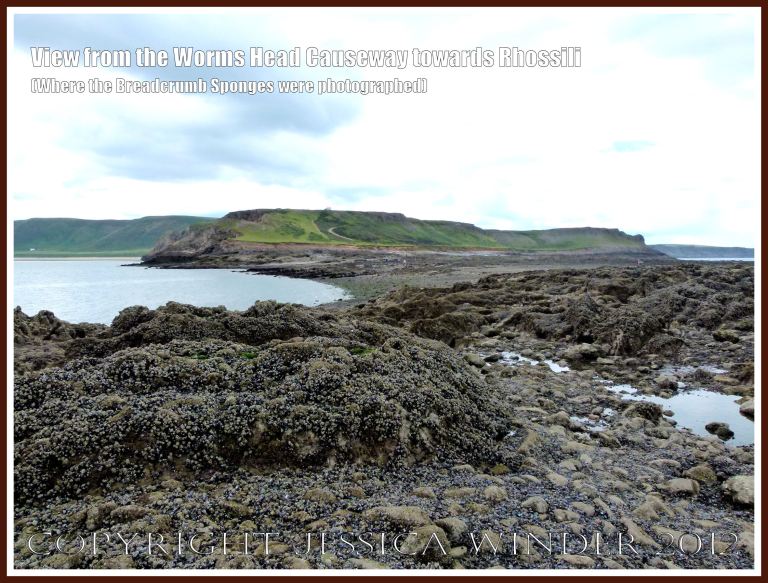
 The jagged rocks along the spine of the Worms Head Causeway, exposed for longer periods of time at low tide, are mostly covered with mussels, barnacles, and winkles with little in the way of algae except in the tide pools. At the wetter edges of the Causeway, spending less time out of water, the boulders are covered with seaweed – and kelp beds lurk underwater just off-shore.

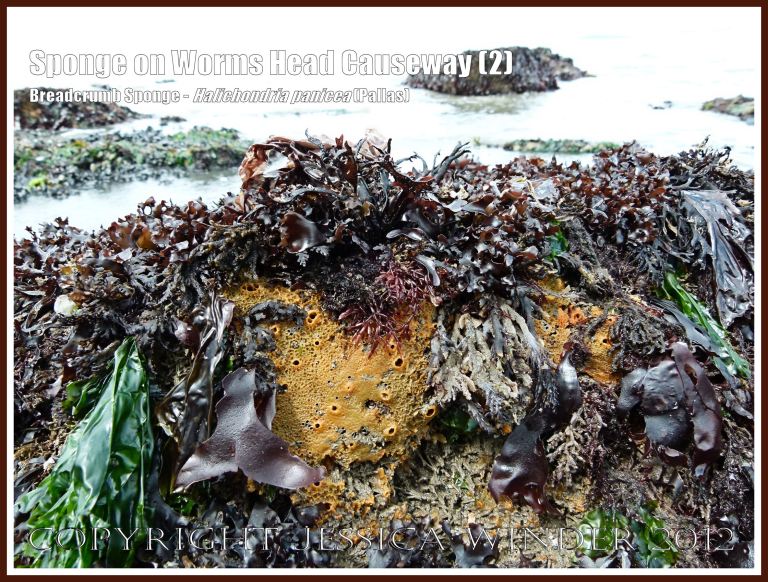
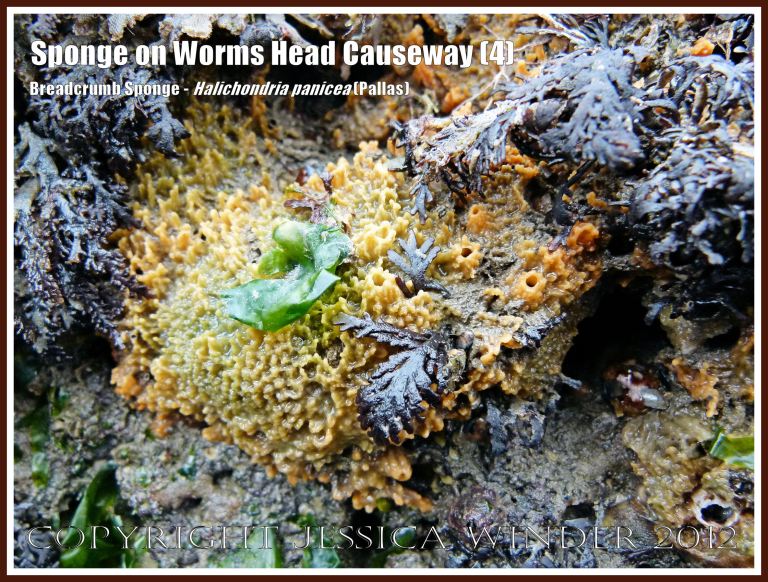
It is under this seaweed that you can find many interesting seashore creatures either attached to the rocks or simply sheltering in the damp places amongst the weed. Brightly coloured sponges can be discovered here – and one of the most common is the vivid yellow, orange or green Breadcrumb Sponge – Halichondria panicea (Pallas).
 A great variety of red, green and brown seaweeds live alongside the sponges. As well as the common brown fucoids like Toothed and Bladder Wrack, Green and Purple Laver grow, and interesting small red algae like Pepper Dulse and Lomentaria. Sea squirts, anemones, and tube worms abound. The mud and mucous tubes occupied by marine polychaete worms can be found around the sponges if you look carefully (see the adjacent thumbnail image); and the dark mud tube entrances of the worms that have built actually into the sponge can be seen scattered among the in-halent and ex-halent pores.
In later postings I will be publishing pictures of some of the richly coloured sea anemones and glistening gelatinous sea squirts that also I recorded in this particular location.



 Jessica's Nature Blog