
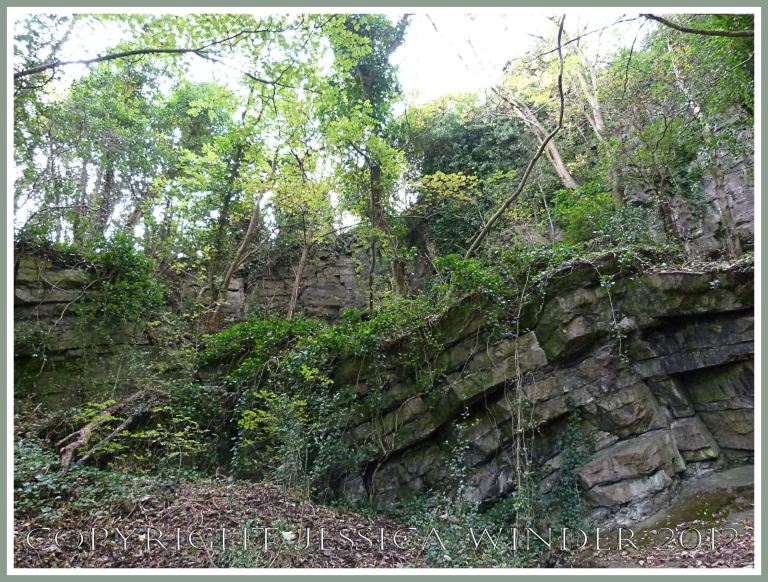
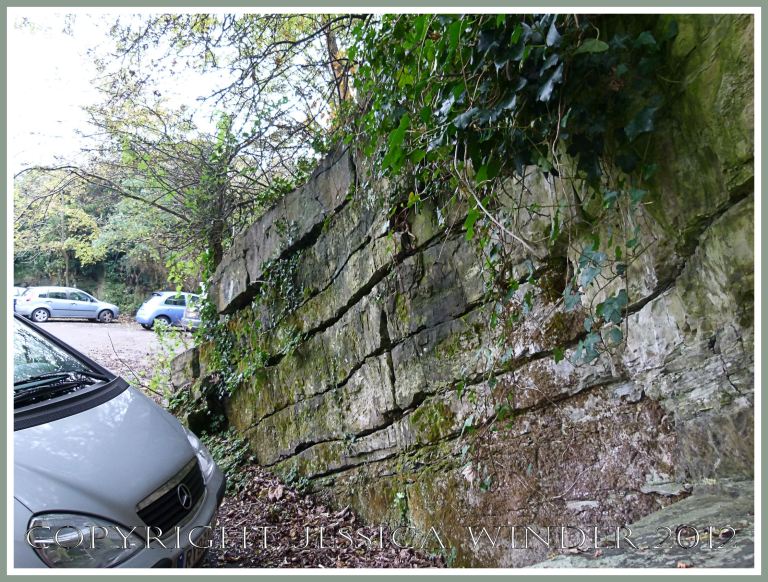
Surprisingly, the long-term car park at Oystermouth near Mumbles on Swansea Bay is a also a good location for seeing the topmost strata of the Carboniferous Limestone in Gower – the Oystermouth Formation (which used to be called the Upper Limestone Shales). Locally it has been referred to as ‘Black Lias’ but this is a bit misleading. The use of the term ‘Black Lias’ to describe this type of rock is just a colloquial or common name – based presumably on its superficially similar appearance to the true Lias rocks – as seen on the Dorset coast near Lyme Regis for example.
The Oystermouth Formation, as it is correctly called, or ‘Black Lias’, dates from the Carboniferous Period (353 to 290 million years ago). So it is much older than the Blue and White Lias rocks that date from the much later Jurassic Period (205 – 146 million years ago). However, there was a commonality in the environmental conditions prevailing at the time of the deposition of all three: the ‘Black’, Blue and White Lias sediments.
In the Jurassic Period, the climate was uniformly warm and humid with widespread shallow-water marine conditions but also with localised estuarine and deltaic phases. Different kinds of limestones were formed in the shallow seas and alternated periodically with thick mudstone sequences – typical of much of the early Jurassic Lias layers – due to the input of clay and mud materials from the land (terrigenous sediments).
In the Carboniferous period, the climate was equatorial for Britain most of the time, again with intermittant deltaic phases where sediments flowed downstream in rivers to accumulate in shallow coastal waters and swamps. The variations in climatic and environmental conditions during both the Carboniferous and Jurassic Periods resulted at times in an alternation of harder limestone rocks more typical of fully marine deposition – with softer muddier organically influenced rocks more characteristic of shallower marine or brackish water situations where debris and sediments from the land were additional components.
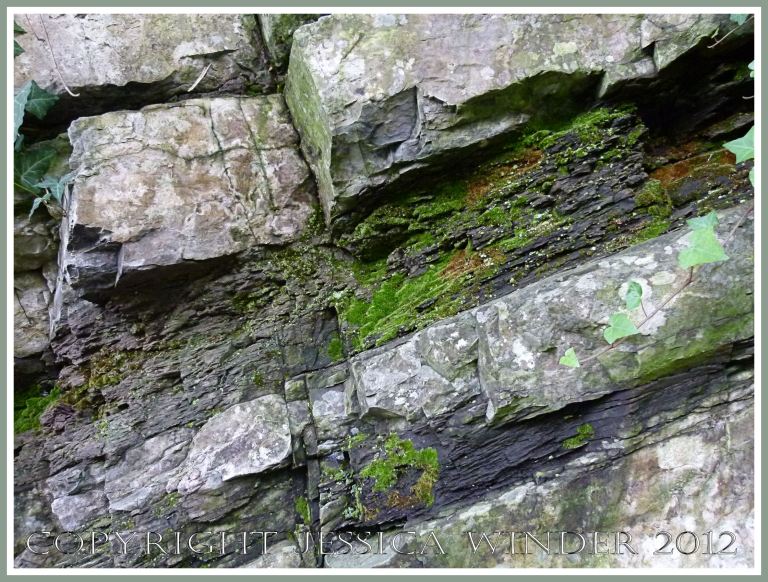
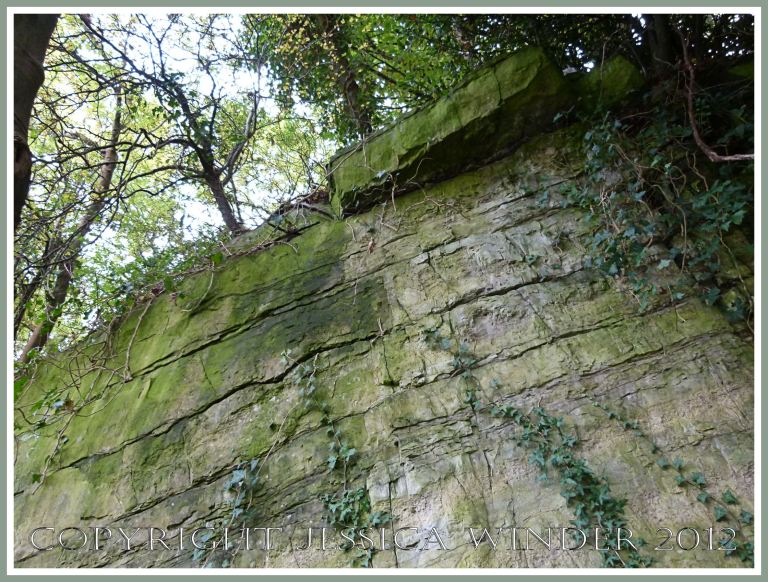
The rocks formed during these varying conditions, transitions between fully marine and brackish environments, is reflected in the rock layers exposed at Clements’ Quarry in Oystermouth. Harder, paler, high calcium content, impure limestones are sandwiched (interbedded) between layers of darker, softer, muddier, finely-stratified calcareous shales. The limestone layers are 20 – 50 cm thick. The shale layers are 5 – 15 cm thick. The cut faces of the quarry look striped.
The rock layers are special with regard to some of the fossil brachiopods, rare corals, and trilobites that are found in them. Two of the fossils are actually named after this site where they were first recorded and described: the coral Amplexizaphrentis oystermouthensis and the brachiopod Spirifer oystermouthensis.
It was the limestone rather than the shale that was considered to have a commercial value. The quarried limestone with its white calcite streaks and veins could be polished to look like marble – but of course, being sedimentary and not metamorphic was not geologically like the real thing. More like the polished fossiliferous ‘Purbeck Marble’ that is so frequently found in decorative features of buildings. Sometimes slabs were quarried that were stained by iron oxides to a liver colour. Occasionally, fossils would be included in the polished surface. The stone was marketed as ‘Mumbles Marble’, also known as Swansea or Cambrian Marble.
Click here for more information about Mumbles Marble.
Useful References to Gower geology include:
George G. T. (2008) The Geology of South Wales – A Field Guide, published by the Author, ISBN 978 0 9559371 0 1 (E-mail gareth@geoserv.co.uk) pp 87-88.
George T. N. (1970) British Regional Geology – South Wales, Natural Environment Research Council Institute of Geological Sciences, HMSO, London, pp 67 – 68
Owen T. R. & Rhodes F. H. T. (1960) Geologists’ Association Guides No. 17: Geology around University Towns: Swansea, South Wales, Benham & Company Ltd, Colchester, p 14.


COPYRIGHT JESSICA WINDER 2012
All Rights Reserved
 Jessica's Nature Blog