

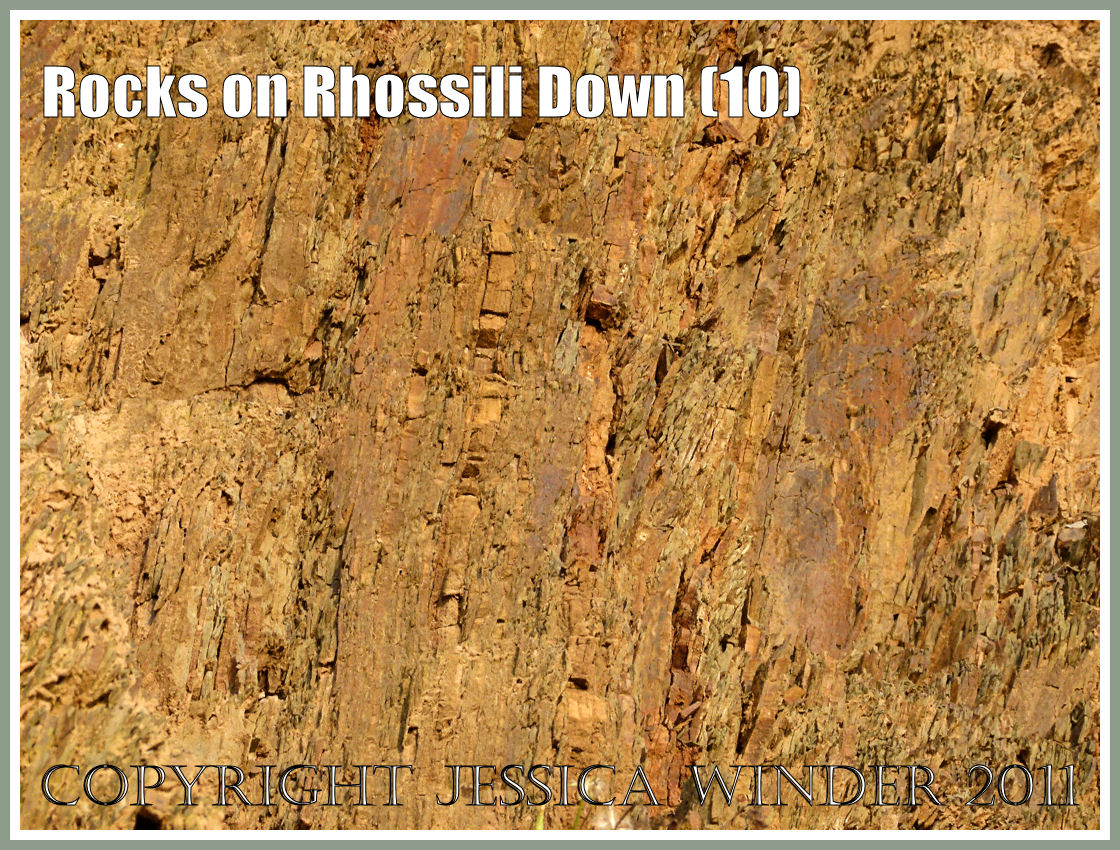
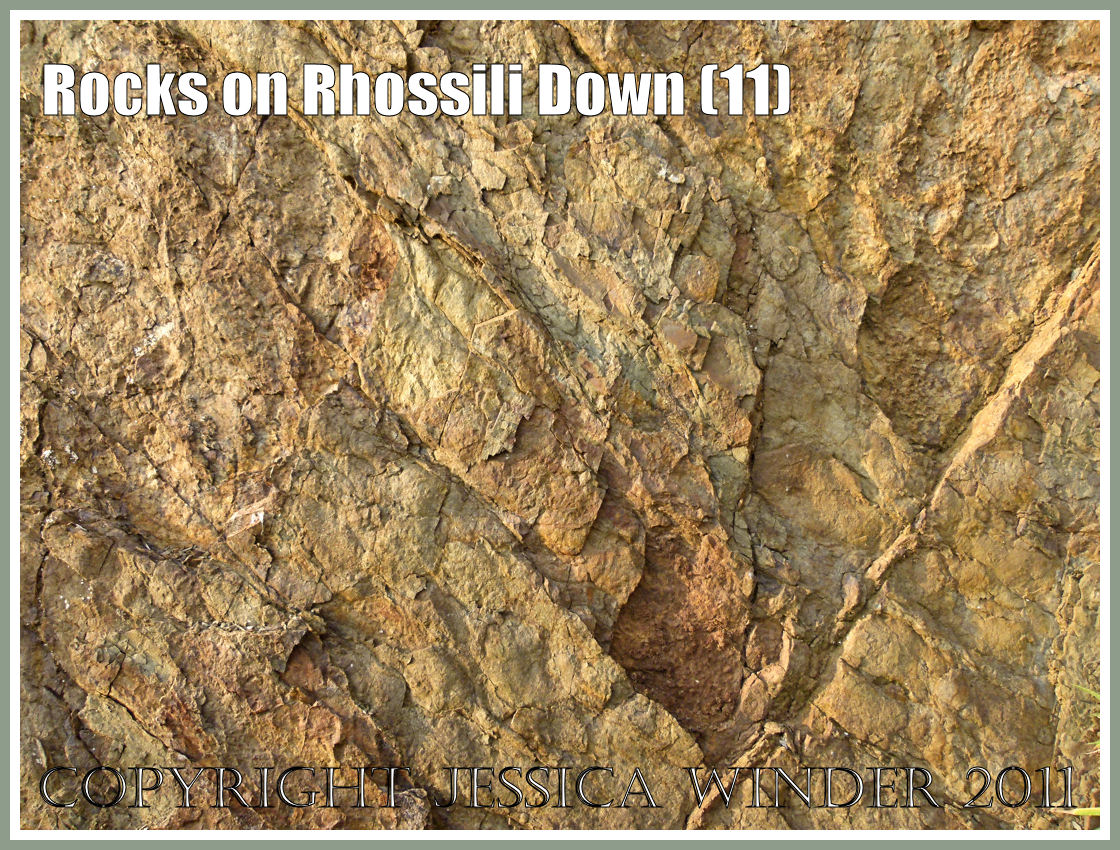
An exposure of Carboniferous Lower Limestone Shales belonging to the Cleistopora Zone (Z) is easily seen at the base of Rhossili Down on the south-west side where it joins the surface of the solifluction terrace near The Rectory.
In the geological layer cake that forms the surface of the earth’s crust, the Lower Limestone Shales represent the first deposits of sediment in the Carboniferous period (starting about 360 million years ago) which follows on from the Old Red Sandstone – both being in the Upper Palaeozoic. In the Gower Peninsula the Lower Limestone Shales consist of alternating bands of calcareous shales and thin limestones which have a depth up to 500 feet. Many of the limestones are impure and may weather to rotten stone that disintegrates and crumbles easlily. These sediments represent a shallow water environment in which a great deal of terrestrial material accumulated.
In this particular exposure, the Lower Limestone Shales have been disturbed and compressed by movements along the fault of the Port Eynon Thrust. This location is known for the brachiopod fossils it contains, such as Camarotoechia mitchelseanensis, Productus (Avonia) bassa, and Crinoidal debris – although I haven’t found any of these fossils myself so far.
The photographs in this post illustrate the patterns and textures created by this rock formation as it crumbles away with weathering. The pictures also show the almost vertically aligned rock strata as they are seen in end-on view in the southern part of the exposure, as well as the flat-on view of the bedding planes as they are seen in the north part of the exposure. The green/grey and ferruginous colours result from contamination during the shallow water formation of these sediments by incoming terrestrial materials from a nearby land surface.
For more information and pictures of this rock exposure see
https://natureinfocus.wordpress.com/2011/03/26/rocks-on-rhossili-down-1/
References
The Geology of South Wales – A Field Guide, Gareth T. George, 2008, published by gareth@geoserv.co.uk, ISBN 978-0-9559371-0-1, Chapter 4 Gower, pp66 -89.
Geologists’ Association Guides No. 17: Geology around the University Towns: Swansea, South Wales, T. R. Owen & F. H. T. Rhodes, 1960, Benham and Co Lyd Colchester, Itinerary III. The Gower Peninsula, pp14 – 18.
Worms Head, England and Wales Sheet 246, Solid and Drift Geology (1:50,000 Provisional Series Map), British Geological Survey, Natural Environment Research Council, ISBN 0751829293.
British Regional Geology: South Wales, T. Neville George, 1970, Natural Environment Research Council, H. M. S. O., Chapter 7: Carboniferous Limestone, pp 58 – 72.




COPYRIGHT JESSICA WINDER 2011
All Rights Reserved


I got lost in the science but the textures and colours are absorbing.
LikeLike
Thanks, Esther. Yes, I just love the colours, patterns and textures in rocks. That’s what first draws my attention to them. Then I get curious about what they are and how they got there – and that makes them even more interesting – but it is sometimes difficult to understand the geological processes that have been involved.
LikeLike
Hi Jessica
I just stumbled across this. Great stuff. Just a quick and minor point, why not use the modern stratigraphic terms instead of Lower Limestone Shales etc? This is a great free download on this and is the new standard .
Waters, C. N., Waters, R. A. J., Barclay, W. and Davies J., 2007. Stratigraphical framework for Carboniferous successions of southern Great Britain (onshore). British Geological Survey Research Report. British Geological Survey Keyworth, Nottingham. (Available as downloadable PDF on the BGS website)
But keep up the good work
Chris Walley
LikeLike
Thank you, Chris, I really appreciate that information. I will download the new stratigraphic terms and use them. I am always looking for new sources of information and I am aware that some of my books and maps are out of date. I was recently at the BGS shop in the Natural History Museum and picked up a new geology map for Gower and other publications. Your suggested reference is most welcome.
LikeLike
Hi Jessica,
It was only after posting this that I realised you were still an ‘amateur’ geologist. Well done and I very much like your nature photographs. If you are in the Gower area again, feel free to get in contact. I am also a trustee of the St Madoc camp at Llanmadoc, which is on the north side of Rhossili and there is a rather ‘fun’ cliff sequence of rocks there. There are also a couple of environmentalists working there who I’m sure will be only too happy to help you with the geography, photography and (if I brief them properly 🙂 ) the geology.
best wishes
Chris
LikeLike
Hello, Chris
Thank you. I will gladly take up your offer to contact when I am in Gower the next time. I would look forward to meeting some people with a detailed knowledge of the area. I’ve lots of questions to ask. I have spent quite a bit of time in Llanmadoc over the years; and I have enjoyed visiting Broughton Bay and Whiteford Sands many times – gradually unravelling their geological story and enjoying their natural history.
LikeLike
Hi Jessica,
I am currently writing an essay regarding the Carboniferous rock found in Gower. Your information above is perfect for me to include (the second paragraph), would it be possible for you to let me know the reference for this information. I would really appreciate it.
Thank you for your VERY informative and engaging blog. Fantastic.
LikeLike
Hello, Gemma,
Thank you for your inquiry. I am glad you found the article useful for your essay. I would have used all four of the references cited at the foot of the article in order to piece together the account regarding what the rocks represented in geological terms. Each of the three books and the geology map provided different aspects of the explanation.
LikeLike