

The Dustbin-lid, Barrel or Root-mouthed Jellyfish, Rhizostoma octopus (Linnaeus), comes in a variety of colours; and its shape will vary depending on the way it has been washed ashore; and according to how long it has lain on the strandline.
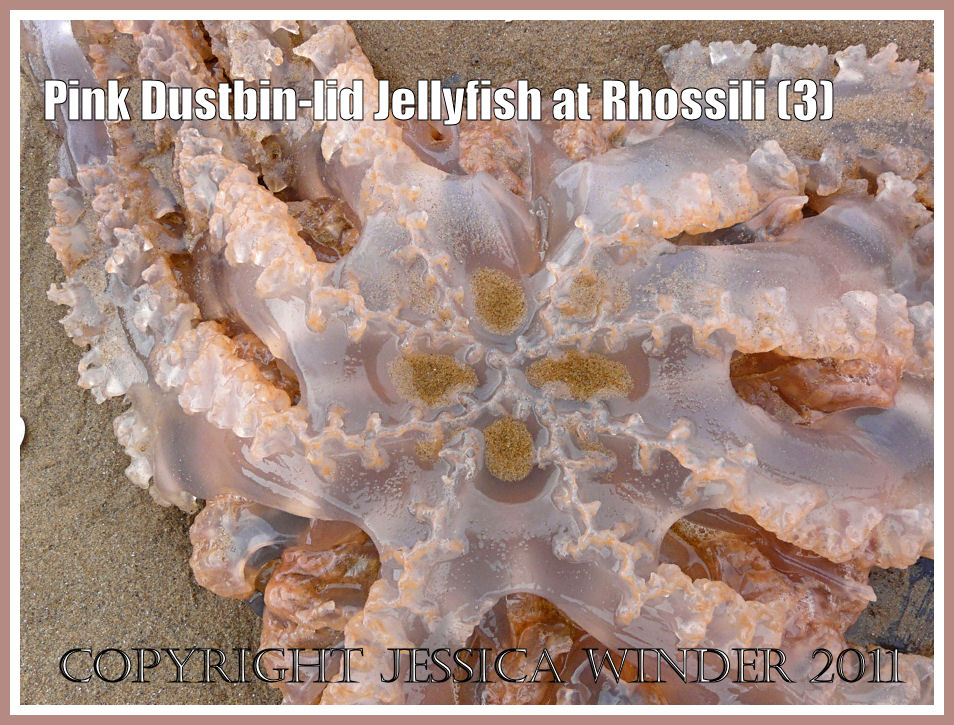
This jellyfish species can be blue or, like the pictures in today’s posting, pink. The photographs show both upper and under surface views, together with a few explanations about its anatomy.
Jellyfish are Coelenterates; and this particular type belongs to the Class Scyphozoa. The large free-floating medusoid form is the dominant individual in the life cycle.
The bell, dome or umbrella can be up to 90 centimetres across, which seems quite big but is small in comparison with the 2 metre diameter of another Scyphozoan called Cyanea arctica – which (thankfully) lives in the Arctic Ocean and not on British beaches.
Most Scyphozoans live in coastal waters where they can create problems for swimmers. The presence of stinging cells called nematocysts make encounters with these jellyfish unpleasant and sometimes dangerous. However, it is important to emphasise that the Dustbin-lid Jellyfish does not have have the circle of trailing stinging tentacles around the perimeter of the bell like the ones in some other more harmful types of jellyfish. There are stinging cells scattered on the outer surface of the bell (ex-umbrella or aboral surface) and on some of the mouth parts. The stinging cells immobilise small fish and planktonic animals that the jellyfish captures and eats.
The bell or dome is filled with a firm, gelatinous, and fibrous substance called the mesoglea. This is thick in the middle but around the edge it thins out to form a more flexible, thinner area like a loose-hanging pelmet. You can see this in the picture above. This thinner outer perimeter of the dome is scalloped into lobes called marginal velar lappets. The edges of the lappets are coloured purple. This jellyfish has a generalised nerve net type of nervous system with synapses; there are specialised sense organs grouped into structures called rhopalia located around the margin between the lappets.
The jellyfish has a muscular system. It moves by means of a band of powerful circular fibres that form the corona muscle around the underside edge of the bell (sub-umbrella or oral surface). When the corona muscle contracts the animal moves upwards through the water. When the muscle relaxes the animal sinks. The overall effect is one of pulsating movement. Sideways locomotion is through wave and current action and the animal has no control over this.
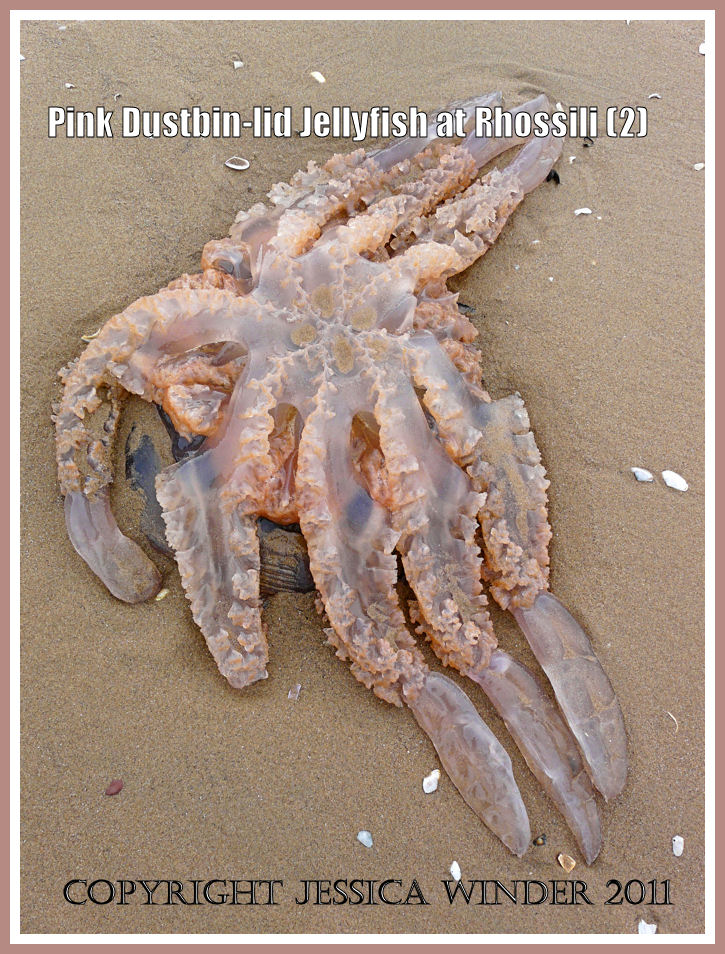
Looking at the underside of the Dustbin-lid Jellyfish you can see that the animal design is based on multiples of four, that is tetramerous symmetry. Beneath the bell – but unfortunately not properly visible in this particular specimen – is a large four-sided tubular manubrium that has a short, pillar-like, basal stem and sixteen epaulets – each with frilled mouth openings.
Beneath the epaulets, the manubrium divides into four pairs of oral arms. These are clearly visible in the photographs radiating out from a central point. Each arm consists of three winged portions; and three winged and elongated terminal appendages. The arms have many mouth openings. All the mouths carry food through the manubrium into a stomach cavity with four gastric pouches housed in the dome.
I think that’s more than enough anatomical information for one post. I will continue with the details regarding digestion and reproduction together with more pictures at another time.
Revision of a post first published 4 June 2010
COPYRIGHT JESSICA WINDER 2011
All Rights Reserved
 Jessica's Nature Blog
3 Replies to “Pink Dustbin-lid Jellyfish at Rhossili”