

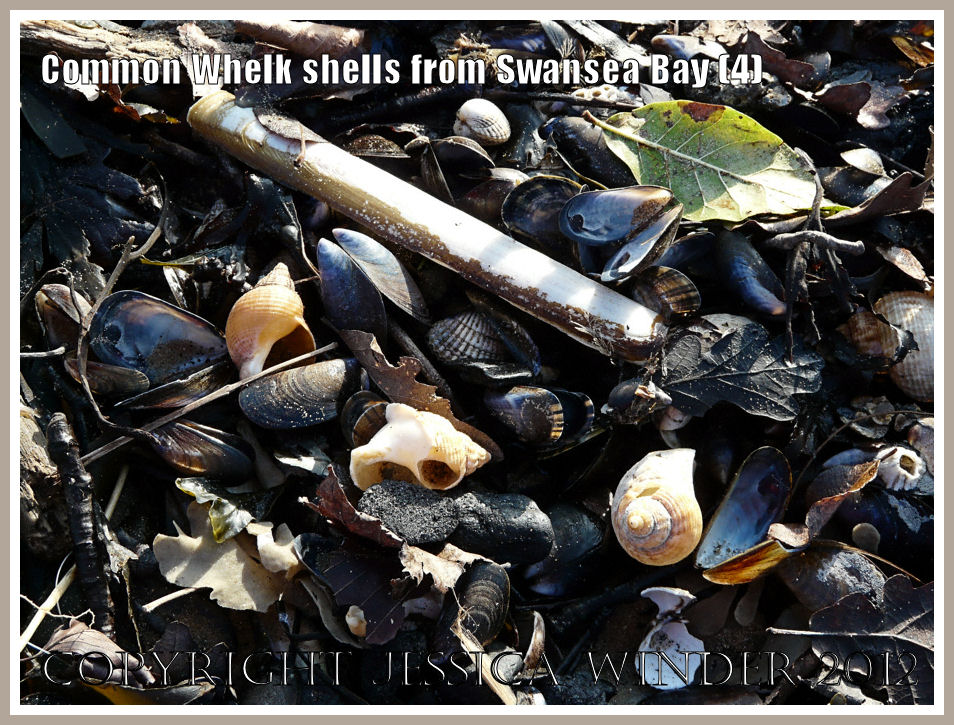
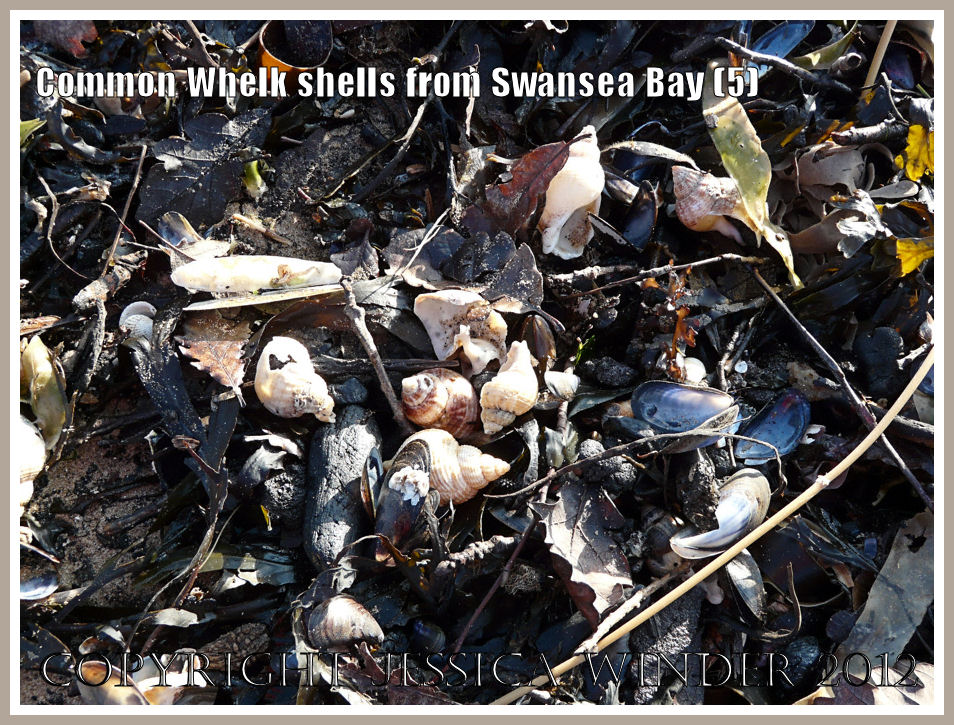
The thousands of Common Whelk shells that I discovered on the sandy beach of Swansea Bay in the New Year were remarkably different from the ones I have previously picked up at Rhossili Bay and Whiteford Sands. The whelk shells were smaller here, about half the size of the Gower specimens. The shells were also thinner with many of them sporting broad brown spiral bands – as you can see from the photograph above. I think the Swansea shells were from younger animals. A few had been stained orange by burial in the sand and others had barnacles and calcareous worm tubes attached.
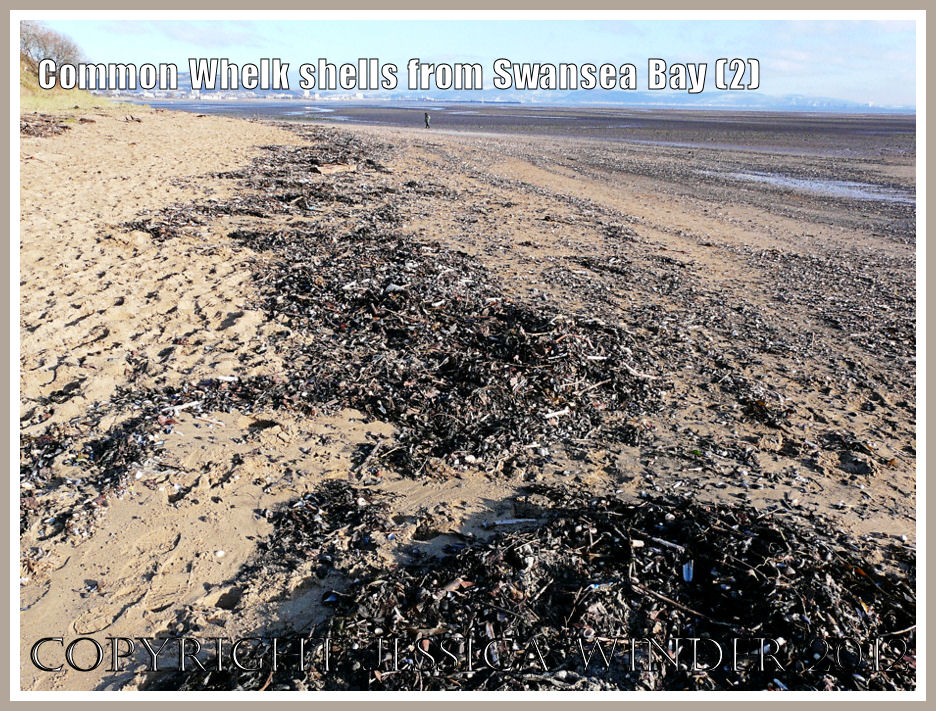
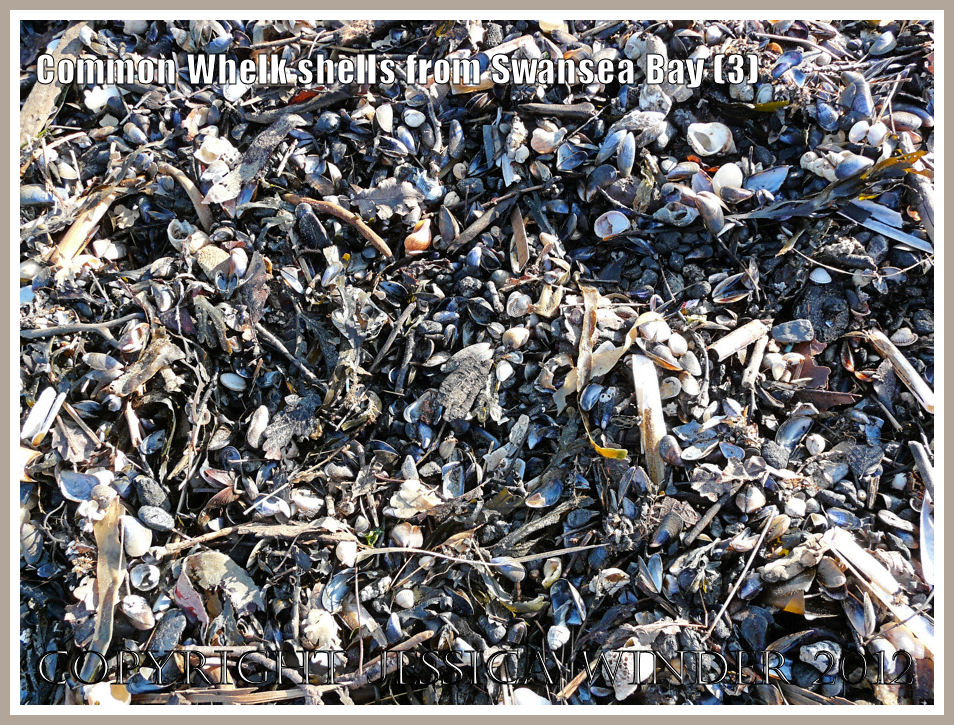
The whelk shells were found together with slipper limpet shells, mussels, cockles, necklace shells and razor clams. There were also many small delicately tinted pink and yellow bivalves such as tellins. Seashells were liberally scattered on the wet sand as well as occurring in thick accumulations on an almost continuous strandline high up the shore. This strandline was unusual in containing many twigs and leaves from the trees that border the bay – reflecting the residential and cultivated backdrop to the shore. While the influence of the port and heavy industries not too far away was shown by the large amount of water worn coal in the strandline. The dark oak leaves, black ‘pebbles’ of coal, and the multitudes of blue-black mussel shells gave the strandline its characteristic dark colour – against which the other bivalves and gastropods gleamed luminously in the bright, slanting winter sunshine.
Click here for more information about the Common Whelk (Buccinum undatum L.) in earlier postings in Jessica’s Nature Blog.
COPYRIGHT JESSICA WINDER 2012
All Rights Reserved
 Jessica's Nature Blog
I can’t get over how many of them wash up on the shore. I’ve never seen anything close to that number of shells in the strandlines along the local beaches.
LikeLike
I wonder why there are comparatively so few shells on your local beaches. Do you think it might be the colder water?
LikeLike